Last October I cycled to the bakery at seven in the morning in just a fisherman knit, perfectly warm, and by noon I was sitting in a sunlit studio peeling that same sweater off over my head while everyone laughed. That day taught me what Scandinavian dressing is actually for: not the cold itself, but the swing — freezing street, overheated café, draughty train home. Layers are how I dress for all three without carrying a second outfit in my bag.
What follows are the ten combinations I genuinely rotate, built on a simple system: a thin, close-fitting base, one textured mid-layer, and an outer shell with some shape to it. I keep to a quiet palette — slate, bone, oat, camel, navy, washed black — so everything swaps with everything else. Each outfit below carries the mistake I made with it, because the mistakes are where the useful rules live.
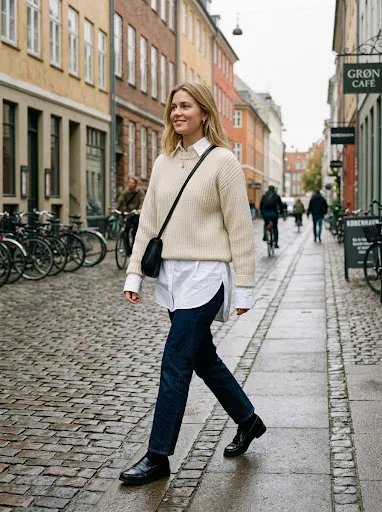
The shirt tails and cuffs do the talking here — my oldest layering trick, still the best.
This is where I started, years ago, and it is still my most-worn combination: a white cotton poplin button-down under a heavy ribbed fisherman knit, with the collar, cuffs and shirt tails deliberately spilling past the knit. Button the shirt right up to the collar stand first, then pull the sweater over and lift the collar points out so they sit flat against your collarbones. I roll the sweater sleeves up about two inches and fold the shirt cuffs back over the knit — that flash of white at the wrist is the whole point. Underneath, straight-leg raw denim and black penny loafers keep it grounded. My early mistake was wearing the shirt untucked and bunched under the sweater, which added a visible roll at the waist. Smooth the tails down flat before the knit goes on, and let them hang below its hem instead.
2. Structured Boxy Trench Over High-Gauge Turtleneck
One dark column under a big coat — the outfit I trust on days the weather cannot decide.
For the in-between weeks this is my uniform: a fine-gauge black merino turtleneck tucked into high-waisted wide-leg wool trousers, with a long boxy trench worn open over the top. The trick is the unbroken dark column underneath — knit and trousers in one tone, so the coat reads as a frame rather than a lid. Fold the turtleneck neck down once, neatly, at the middle of your throat; a doubled, scrunched neck looks untidy by ten o’clock. I push the trench sleeves up toward my elbows so the thin knit shows beneath, which keeps the big coat from swallowing my arms. Cost honesty: my trench was a considered purchase, dry-waxed cotton, and it has outlasted three cheaper coats. What can substitute: any long, structured coat you already own. Skip this if your days involve lots of stairs in the rain — a sweeping hem and wet steps are a poor mix.
3. Quilted Thermal Liner Jacket Paired with Ribbed Cardigan
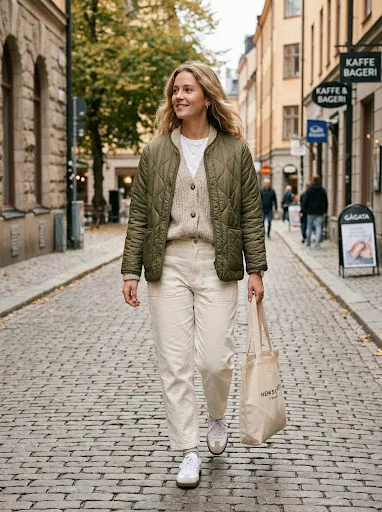
Market-day armour: two open fronts, zero bulk at the neck, warmer than it looks.
This pairing came from a flea-market morning when my coat was too warm and my cardigan too cold. The answer was both, open: a plain white crew-neck tee, a substantial ribbed V-neck cardigan with the bottom two buttons left undone, and a collarless quilted liner jacket over everything, zip open. Because the liner has no collar, nothing piles up around your neck — that is the whole reason it works where a normal jacket over a cardigan feels stuffed. Ecru straight-leg trousers and gum-sole trainers finish it. My liner cost very little at an army surplus shop and weighs almost nothing, yet this is genuinely my warmest errand-running outfit. One caution: two open fronts can look sloppy if the layers underneath are creased. Five minutes with a steamer on the cardigan the night before is the difference between deliberate and dressed-in-the-dark.
4. Tailored Oversized Blazer with Relaxed Hooded Sweatshirt
The hood has to sit flat over the collar — get that right and the rest takes care of itself.
Yes, a blazer over a hoodie — and no, it does not look like a mistake when the pieces are right. Mine is an oversized wool blazer, bought second-hand from the men’s rail, over a heavy grey French-terry hoodie. The one move that matters: pull the hood out and lay it flat over the back of the blazer collar, drawstrings hanging even. Leave the hood bunched inside and the blazer sits crooked on your shoulders all day — I learned that on a client visit, which was not the moment I would have chosen. The hoodie itself needs weight; thin, flimsy fleece collapses under tailoring and reads as gym wear. Medium-wash straight jeans and clean white leather sneakers keep it honest. This is my studio-meeting outfit, my gallery outfit, my long-lunch outfit. Skip it for conservative offices, where the hood still reads as a statement you did not mean to make.
5. Slouchy V-Neck Knit Over High-Neck Ribbed Tank
The neckline does all the work — deep V over high neck, nothing else competing.
This one is purely about necklines. A deep, slouchy V-neck knit — mine is a soft alpaca blend — worn over a high-neck ribbed tank in white, so the ribbed panel fills the plunge and the collarbone stays covered. It is the outfit I reach for in the shoulder weeks when a bare chest under a V feels too exposed but a full turtleneck is too warm. I French-tuck just the front centre of the sweater into double-pleated tailored trousers and let the sides fall; tucked all the way round, a knit this loose turns to a blob. The tank is the unsung hero and it must be genuinely high-necked and snug at the armholes — a scooped vest underneath ruins the geometry. Square-toe ballet flats and small silver hoops finish it. My mistake the first time: a grey tank under a grey knit. Invisible. The contrast is the outfit, so keep the two layers in clearly different tones.
6. Monochromatic Cashmere Knitwear with Fluid Maxi Coat
One colour, three textures. The coat is camel, the knit is oat, and nobody can tell where one ends.
One colour from neck to ankle sounds like a shortcut, and it is — the good kind. I wear a fine oat cashmere crewneck tucked into oat wool trousers, then a long unlined camel coat over the top, open, so the column shows as I walk. Nothing matches exactly, and that is the point: brushed cashmere, smooth suiting wool, structured coat wool. Three textures in one family give the depth that colour usually provides. A suede belt in the same tone and slightly darker tan boots ground it without breaking the run. Honest cost note: the cashmere and the coat were the two biggest spends in my wardrobe, bought a year apart, both in end-of-season sales. Everything else here is ordinary. The upkeep is real, though — cashmere pills where a bag strap rubs, so I keep a cashmere comb in my coat pocket and spend two minutes on it while the kettle boils.
7. Cropped Wool Bolero Cardigan Over Longline Poplin Tunic
Short knit, long shirt — the proportion looks odd on the hanger and right on the body.
This is the strangest proportion I own and the one people ask about most: a chunky wool cardigan cropped at the natural waist, buttoned only at the top, over a white poplin tunic that falls past my hips like a short shirtdress. The cropped knit draws a high line at the waist without anything being tight, and the tunic does the flowing. Fold the tunic’s long cuffs back over the cardigan sleeves — again, that flash of shirt at the wrist ties the two pieces together. Underneath, slim split-hem black trousers and heavy Chelsea boots, because all that floating white needs weight at the ground. Who should skip it: anyone petite who finds long-over-short proportions swamp them; try the tunic half-tucked instead. My own hesitation lasted one wearing. It is also, unexpectedly, a brilliant travel outfit — the tunic shakes out crease-free and the little cardigan doubles as a plane blanket for your shoulders.
8. Fine Merino Base Layer with Oversized Utility Overshirt
My walking outfit: thin merino under a shacket that has survived four winters of weather.
For walking days — harbour, woods, the long way home — this is the system: a skin-close long-sleeve merino crewneck in charcoal, and a thick wool-blend overshirt worn open over it like a light jacket. Roll the overshirt cuffs once so the fine knit shows at the wrist. The merino does the temperature work; the overshirt takes the wind and the drizzle and carries the pockets. I wear it with wide-wale corduroy trousers in sand and a simple webbing belt, finished with leather hiking boots that have already survived four winters. The buying test for the base layer: hold it to the light. A good merino base is fine but not see-through, and it should spring back when you stretch a cuff. My first one, a cheap synthetic, smelled stale by lunchtime and stayed clammy all day — synthetics trap moisture and odour against the skin, and no overshirt can rescue that.
9. Sleeveless Knit Vest Over Menswear Oxford Shirt
Warm core, free arms — and the layer that makes every coat I own fit better.
The knit vest is the layer I recommend to anyone who finds coats over sweaters unbearable. Mine is an oatmeal sleeveless vest, slightly oversized, worn over a pale blue menswear Oxford shirt with the top button undone. Let the shirt hem run two or three inches below the vest’s ribbing so the curved tails show — that little overhang is what makes it look styled rather than school-uniform. The vest keeps my core warm while the sleeves stay slim, which means every coat and blazer I own slides over it without the arm-stuffing problem. Wide-leg charcoal pleated trousers and chunky derby shoes finish it. I bought the vest second-hand and the shirt from the men’s department, where the Oxford cloth is thicker and cheaper per wear. One practical note: iron or steam the shirt properly. A crumpled Oxford under a neat vest reads as laundry, not layering.
10. Thermal Base Layer Beneath Slip Dress and Chunky Knit
The summer dress I refused to pack away — a thin turtleneck underneath bought it four more months.
This is how my slip dresses earn their keep past September. A fine ribbed turtleneck goes on first, smooth and second-skin thin; the bias-cut satin midi dress slides over it; then a chunky oversized knit on top, hem loose at the hip, so only the satin skirt swings below. Knee-high boots disappear under the hem and close the gap where cold air would get in. The textures are the whole argument — liquid satin, dense wool, fine ribbed cotton — inside one quiet colour story. Two honest warnings. First, static: satin over knit can cling and crawl, so I run a wire hanger lightly over the dress before leaving, which discharges most of it. Second, the base layer must be genuinely thin. I once wore a mid-weight roll-neck under a slip dress and looked upholstered. Done right, though, this turns a €40 summer dress into a twelve-month piece, which is the most Scandinavian arithmetic I know.
What I’d buy first — and what can wait
If you are building this from an ordinary rail, spend first on the two ends of the system: one good long coat and one pair of proper leather boots. Everything between them can be modest. Base layers, ribbed tanks and poplin shirts come from the high street — just insist on natural fibres, cotton and merino rather than synthetics. The glamorous middle layers, the fisherman knits and blazers and trenches, are exactly what second-hand shops and men’s departments are full of, often in better wool than new pieces at three times the price. Buy heavy knits in the spring sales and poplin at the end of summer; I have furnished half this list that way. What can wait: the cashmere, the bolero, anything bought to complete a look rather than to be worn three times a week.
Questions I get asked
How many layers is too many?
Three, in my experience — base, mid-layer, shell. The moment I add a fourth, I overheat indoors and the lines go lumpy. If you are still cold at three, the answer is a better base layer or a warmer coat, not another sweater.
How do I stop layers looking bulky?
Keep the base thin and close-fitting, and balance volume: one generous piece per outfit, anchored by something straight or tailored elsewhere. Letting cuffs and hems peek out by an inch or two also helps — the visible edges prove the layers are deliberate.
Do the colours really all have to be neutral?
They have to be tonal, which is not quite the same thing. I work within three colours per outfit and one family at a time — the same system works in forest green or espresso if beige bores you. What breaks it is competing colours and logos, not colour itself.
How do I look after all this knitwear?
Fold heavy knits flat; hangers stretch the shoulders out of shape within a season. Coats and blazers go on wide wooden hangers. I keep a cashmere comb for pilling, a lint roller by the door, and I steam shirt tails, collars and coat hems rather than ironing — crisp edges are what make relaxed layers read as intentional.
Can I wear these layers to an office?
Most of them, yes. The trench over a turtleneck, the monochrome cashmere column and the vest over an Oxford shirt all read as proper work dressing. The hoodie under the blazer depends on your office — creative studio, certainly; conservative floor, I would not risk it.
Layering stopped being a daily negotiation for me once I treated it as a small system instead of a pile of clothes. Start with one thin base and one good coat, and the rest assembles itself. If a combination here joins your rotation, save it to your layering board on Pinterest for the next cold-snap morning. — Elias