Two winters ago I stood in front of a wardrobe so full I could not slide the hangers along the rail, and I still felt I had nothing to wear to the bakery. That morning I pulled out everything loud, shiny or saved for occasions that never came, and gave most of it away. What stayed was one rail of plain, well-made neutrals — and getting dressed has taken about four minutes ever since.
The nine outfits below are the ones I actually rotate, built from straight denim, honest knitwear and coats with proper shoulders. My rules are few: natural fibres where I can afford them, a palette of ivory, slate, camel and washed black, and one deliberate proportion trick per outfit — volume on top with something clean below, or the other way round. I have kept my mistakes in, because they taught me more than the successes did.
1. Oversized Wool Coat and Straight Denim
The camel coat over straight denim — four winters in and still my first reach.
This is the outfit I reach for from October to April. The coat is an unlined, double-breasted wool overcoat in deep camel with relaxed drop shoulders, long enough to clear my calf, worn over a heavyweight white cotton tee tucked fully into non-stretch straight-leg jeans in a washed mid-blue. A slim black leather belt with a plain silver buckle keeps the waist honest. On colder days I smooth a fine charcoal merino crewneck between the tee and the coat. My shop test: the coat must button over my thickest knit without pulling — my first wool coat failed it and spent two winters as an expensive ornament. The jeans hem should break just above the ankle bone. I finish with penny loafers, or clean white trainers when I am walking far. It is the single most useful thing I own.
2. Chunky Ribbed Turtleneck and Pleated Trousers
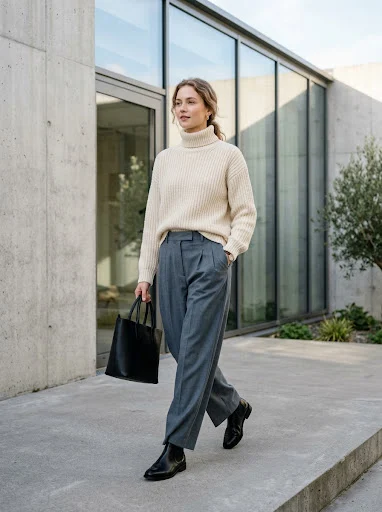
Ecru fisherman rib and taupe pleats: the outfit that taught me the centre tuck.
Heavy knit on top, fluid tailoring below — the contrast is the whole point. My turtleneck is a chunky fisherman’s rib in unbleached ecru lambswool, worn over a thin cotton base layer, with the collar folded down once so it sits cleanly instead of strangling me. The trousers are double-pleated, wool-blend, in a warm taupe, hems falling over the shoe with a soft break. I tuck only the centre front of the sweater into the waistband and let the back and sides drape; a full tuck on a knit this thick bunches into a tyre at the waist, which I learned in a café mirror. The pleats do quiet work — they throw two slim shadow lines down the leg, so the outfit reads long rather than wide. Black leather Chelsea boots peek out under the hems, and I carry an unadorned leather tote. Warm enough for a frosty market run, tidy enough for lunch afterwards.
3. Crisp Poplin Button-Down and Knitted Vest
The white hem stripe under the olive vest is the whole trick, I promise.
This is my mild-weather formula, and the detail that makes it work is a hemline. I wear an oversized organic cotton poplin shirt in optic white — top buttons open, cuffs folded back once to show my wrists — under a fine-gauge V-neck vest in deep olive. The shirt’s hem must extend three to four inches below the vest’s ribbed band; that clean white stripe against my black twill trousers is what stops the layering looking accidental. I align the vest’s side seams over the shirt before I leave, because a twisted layer pulls all day. Below: slim-straight black trousers and low leather lace-ups, with a structured shoulder bag tucked under my arm. Skip it if your shirt is thin or shiny — poplin should feel like paper, crisp enough to hold a collar point. On windy days the vest earns its keep: arms free, core warm.
4. Monochrome Knit Set with Clean Outerwear
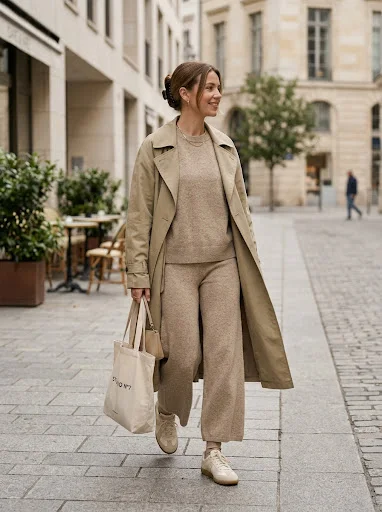
Head-to-toe oat — my train-journey outfit, crease-resistant and calm.
One colour, head to toe, is the fastest route to looking considered — and the easiest to get wrong. My set is a boxy crewneck and wide-leg knit trousers in heathered oat, the top overlapping the waistband by about two inches so there is no gap or bunching when I sit down. Over it goes an unlined stone-coloured gabardine trench, worn wide open so the knit column shows through. The buying check that matters: the knit needs real weight and some recovery in the yarn. I pinch and stretch the trouser knee in the shop; if it stays bagged, it will sag by lunchtime — I returned a cheaper set for exactly that reason. Cream retro runners and a plain canvas market tote finish it. This is my travel outfit: it survives a train journey, a long lunch and a delayed connection, and still looks like I meant it.
5. Structured Boxy Blazer and Vintage Denim
The vintage-rail blazer that cost less than the jeans it sits over.
Tailoring with denim is where second-hand shopping pays for itself. My blazer is a single-breasted wool-twill one in charcoal, found on a vintage rail for less than a new high-street knit, with shoulder seams sitting about an inch past my own — that borrowed width is deliberate, and it is the difference between boxy and simply too big. Underneath, a fine-ribbed white cotton tank tucked tightly into high-waisted vintage-wash jeans, straight from hip to hem with almost no distressing. A matte black belt with a brushed nickel buckle anchors the waist. I wear square-toe black ankle boots and a small leather crossbody slung across the chest. The mistake to avoid is a blazer that fits neatly but pulls when you sit; if you cannot reach a high shelf in it, it is a costume, not a coat substitute. This has carried me from studio days straight into dinners without a change.
6. Cashmere Crewneck and Bias-Cut Satin Midi
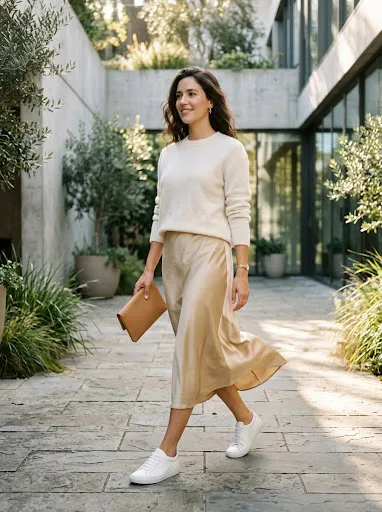
Olive satin and grey cashmere — the skirt I nearly returned, then kept for years.
Texture contrast does all the decorating here. The skirt is a bias-cut satin midi in deep olive — heavy viscose satin, so it pours rather than clings, hem at mid-calf — and over it a plush cashmere crewneck in soft grey. The one styling move is a small asymmetric front tuck: I ease a corner of the sweater into the skirt’s waistband to mark my waist — gently, because dragging on satin pulls the bias out of line and the skirt twists as I walk. I roll the cuffs back once and wear a single thin gold bangle, nothing more. White leather tennis shoes keep it daytime; for dinner I swap in black kitten-heel boots and a plain clutch. Honest note: my cashmere was a considered purchase, not a bargain, but it has outlasted three cheaper knits and still looks new — because it gets folded, never hung.
7. Relaxed Striped Knit and Wide-Leg Linen Pants
Breton stripes and oatmeal linen: my whole coastal summer in one outfit.
This is my summer default, built for heat rather than despite it. The top is a heavyweight cotton jersey with wide navy-and-white Breton stripes, boxy with dropped shoulders — heavy matters, because thin striped jersey twists and looks tired by August. I tuck the front hem loosely into high-rise, wide-leg linen trousers in washed oatmeal and let the back hang free. The linen is a medium-weight blend that holds its drape instead of collapsing; it creases immediately, and I have made my peace with that. Sleeves rolled to three-quarter length show a clean wrist line. Woven leather slide sandals, black rectangular sunglasses and an open jute market bag finish it. Who should skip it: anyone whose day involves a bicycle chain or a toddler with jam on their hands — unbleached linen shows everything. For a slow coastal weekend, though, nothing I own breathes better or asks less of me.
8. Quilted Liner Jacket and Tonal Sweatpants
The liner jacket that turned my sweatpants into a legitimate outfit.
Loungewear leaves the house in my wardrobe, but only under conditions. The base is a matched set: a loopback French terry sweatshirt and straight-leg sweatpants with elastic cuffs, both in washed bone, fitting cleanly through the seat rather than pooling. Over it goes a diamond-quilted collarless liner jacket — the kind made to button inside a field coat — with only the centre two snaps fastened, so collar and hem peek out at both ends. Staying in one tonal family is what makes it read as an outfit instead of a duvet day; the one time I mixed a grey set with a black jacket, I looked like I had given up — honestly, I had. Chunky trail runners and a fine merino beanie pulled down over my ears finish it. The jacket cost less than the coffee run it was bought for. It is my dog-walk and bakery uniform all winter.
9. Minimalist Trench Coat and Tailored Shorts
Long trench, tailored shorts — my answer to days that cannot pick a season.
A long coat over shorts sounds like a styling stunt, but it is the most practical transitional outfit I own. The shorts are tailored Bermudas in black cotton twill — high-waisted, with sharp front pleats and a hem finishing two inches above my kneecap — with a fitted elbow-length white top tucked in and a leather belt. Over everything goes my double-breasted gabardine trench, hem three or four inches past the shorts, belt tied behind my back so the sides pull in and the shorts stay visible. That contrast of lengths is the outfit; a shorter coat would just look unfinished. I wear chunky black fisherman sandals and carry a compact crossbody. The honest limit: this is a dry-day piece. In real rain the bare legs lose, and I swap the shorts for the straight denim from outfit one. For warm city days with a cool evening coming, nothing beats it.
What I’d buy first — and what can wait
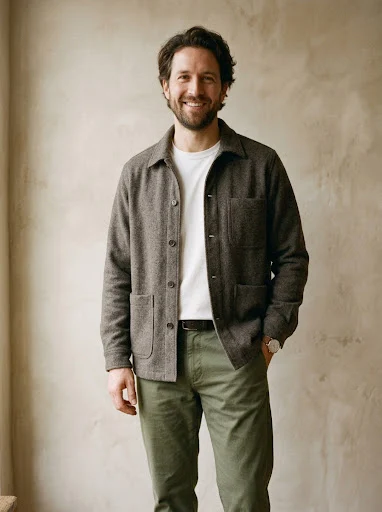
If I were starting this rail from nothing, my first money would go on three things: a proper wool overcoat, one genuinely good knit — cashmere or heavy merino — and leather shoes that will take a resole. Everything else can be modest. Cotton tees, tanks and chinos are fine from ordinary basics ranges, and the blazer, the vintage denim and my most-asked-about piece came second-hand: a heavyweight wool-blend overshirt with patch pockets and horn buttons, worn open over a pima tee with tapered chinos cuffed once so the hem just touches the shoe, finished with suede desert boots. That overshirt works as a light jacket in spring and a middle layer under a coat in January, and it cost less than a night out. Buy that combination before any trend piece.
What can wait: a second coat, the satin skirt, anything in a colour outside your palette. I add one or two planned pieces at the start of a season and nothing on impulse in between. And one free habit saves me more rushed mornings than any purchase — on Sunday I hang the week’s outfits together, steamed and in order. Four minutes on a weekday, no decisions left.
Questions I get asked
How do I wear oversized pieces without looking swamped?
Buy the shape, not the size. A designed boxy cut has dropped shoulders and a body length that still shows your frame; a garment two sizes too big just hangs longer everywhere, sleeves past your knuckles included. My checks: shoulder seams may pass your own by about an inch, no more, and you should be able to sit, reach up and button a coat over your thickest knit without anything pulling.
Doesn’t one colour head to toe look flat?
It does if every surface is the same. Mix textures inside the one colour family — ribbed knit against smooth leather, brushed wool against raw denim, matte sweatshirt fleece under a quilted shell — and the light does the separating for you. That is why my all-black and all-oat outfits work: nothing matches in finish, even when it matches in tone.
How do I keep knitwear looking new?
Three habits. Run a fabric shaver or comb over sweaters every few wears to lift pilling before it mats. Fold heavy knits on a shelf instead of hanging them, because hangers stretch shoulders into points within a season. And steam rather than iron: five minutes with a handheld steamer makes plain basics look deliberate. Coats and blazers get the wide wooden hangers and a brush-down after wet days.
How many colours should my wardrobe actually have?
Four or five neutrals, held firmly. Mine are warm ivory, slate grey, washed charcoal, camel and navy, and because everything sits inside that family, any top on my rail works with any bottom. The moment I add a bright piece, it demands a supporting cast of its own. If you want colour, let one scarf or one bag carry it — not a whole garment.
Can an overshirt really stand in for a jacket?
From March to November, yes. A heavy wool-blend or moleskin overshirt over a tee and tapered chinos is my most-worn combination, and worn open it gives the same clean vertical line as a blazer with none of the formality. Fasten the bottom two buttons when the wind picks up. Below freezing it stops being outerwear and becomes the middle layer under my wool coat — which is exactly what a good rail piece should do.
That is the whole rail: nine outfits, a handful of neutrals, and mornings that no longer start with a small crisis. If one of these combinations earns a place in your week, save it to your minimalist outfits board on Pinterest for the next morning when the wardrobe feels full and useless. — Elias