The church I know best is an old stone building that never quite warms up, and the service is not short. Somewhere after forty I stopped dressing for the photograph and started dressing for the second hour: the sitting, the standing, the kneeling, the coffee in a draughty hall. A lovely outfit can still be a misery by the second hymn. Church clothes have to earn their keep quietly.
That is why the Scandinavian way of dressing suits Sundays so well. It is built on natural fibres, calm colours and cuts that skim instead of squeeze — modest without a hint of frumpy; the interest sits in the cloth itself. Fifteen years at a graphic designer’s desk taught me restraint is not the absence of ideas. It is knowing which one idea to keep. These are the ten combinations I come back to.
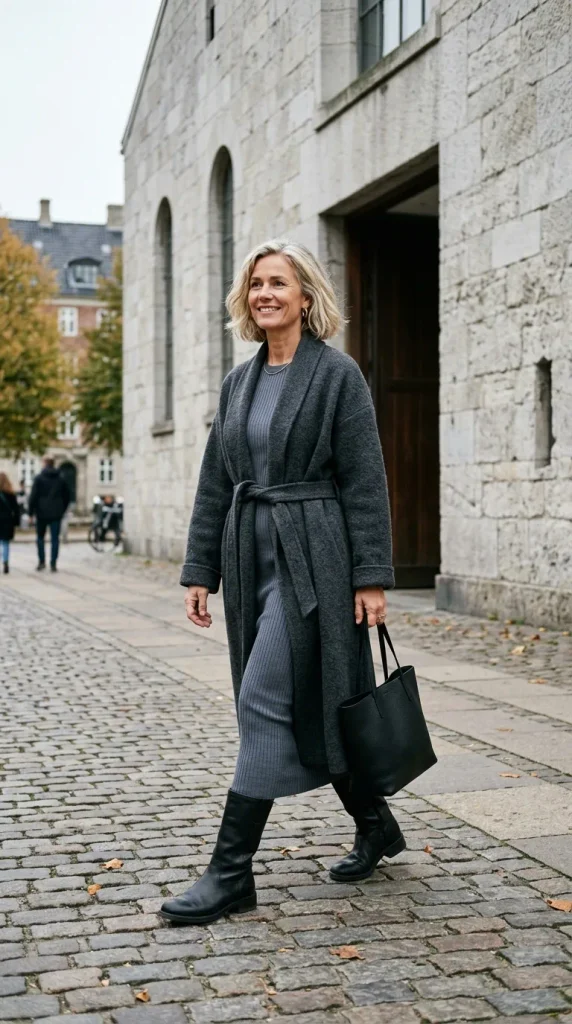
1. The boiled wool wrap over a long knit dress
The cold-church answer. I have never been chilly in it.
Boiled wool is the material I trust most in winter. It is felted so densely that wind gives up on it, it holds a clean architectural shape with no lining or padding inside, and it never needs ironing. Underneath goes a fine-gauge merino knit dress, ribbed, high at the neck, falling in one unbroken line to the lower calf. Charcoal over slate, or pale stone over bone. Nothing to match, nothing to adjust.
Two checks matter. The dress hem should cover the top of your boots by a good two inches, or the line breaks and the warmth leaks out with it. And tie the wrap’s belt loosely, a little off-centre — a hard knot turns it into a bathrobe. My first wrap coat was a size too grand; I spent a winter looking swaddled. Bought right, this is the outfit for draughty churches and long Christmas services.
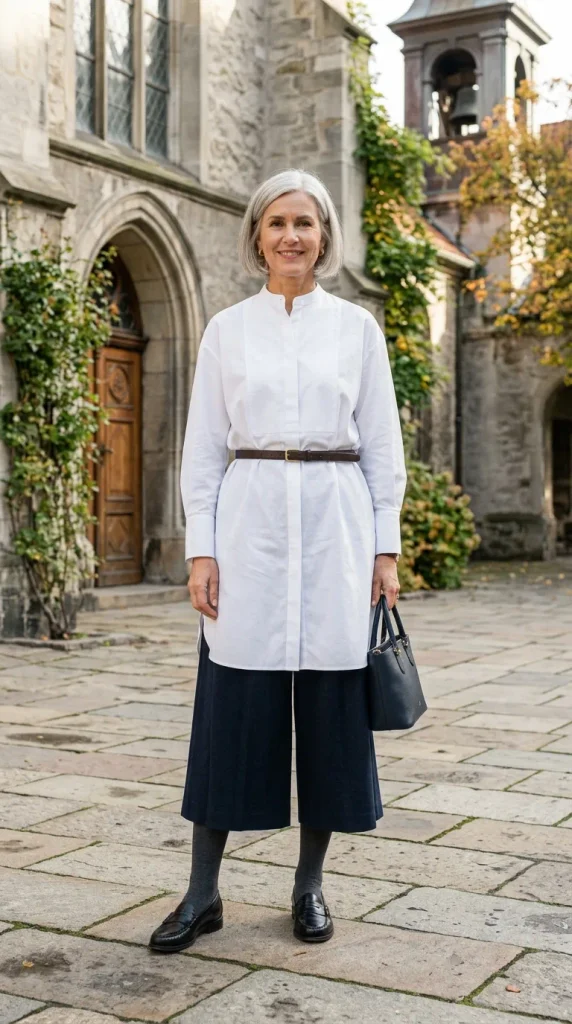
2. A crisp poplin tunic with flannel culottes
It reads as a skirt until you walk. Then it reads as a very good idea.
From a distance, the wide wool flannel culottes look like an A-line skirt; up close, they are trousers, with all the warmth and freedom that brings. Over them, a long cotton poplin tunic — white or the palest grey — with a neat band collar, worn untucked so it falls clean past the hip. Crisp against matte, sharp against soft. The contrast does all the work.
Poplin is humble cotton, but it only looks humble when it is tired. Press the collar band and cuffs properly the night before and the whole outfit lifts. A plain leather belt through the culotte loops keeps the waist honest, and I’d roll the tunic cuffs back exactly once — wrists free for a hymnal. Flannel this weight is warmer than any skirt I own, which is why this is my pick for unheated chapels. Skip it in high summer.
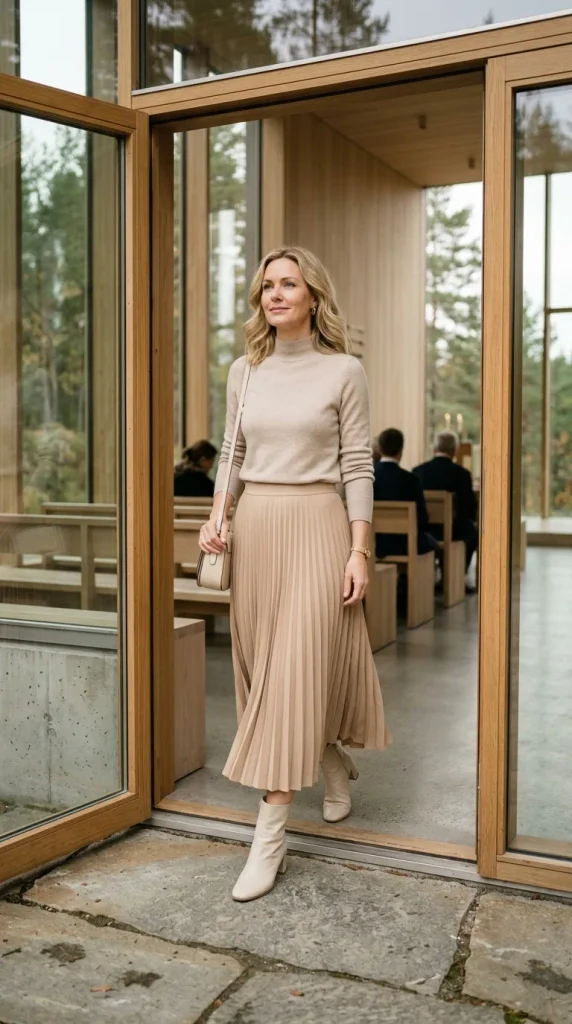
3. Cashmere mock-neck, pleated skirt, all one tone
Oat on sand. Nobody notices the outfit; everybody notices how calm you look.
Tone on tone is the oldest Scandinavian habit I know, and this is its gentlest version: a featherweight cashmere mock-neck — high enough to frame the face, without the bulk of a full turtleneck — tucked into an accordion-pleated crepe midi skirt a shade deeper. Oat over sand, or soft grey over softer grey. The pleats move as you walk up the aisle, and the matte crepe makes no sound doing it — which matters in a quiet building.
The practical notes are unglamorous and essential. Front-tuck the sweater and blouse out a little all round so the waist stays soft rather than pinched. If your church has fierce heating, wear an anti-static slip under the skirt — static makes pleats cling, and the whole calm effect collapses. I learned that mid-service, peeling crepe off my shins. Ankle boots in the same tone keep the column unbroken. Suits anyone who finds a turtleneck too much but wants the neckline covered.
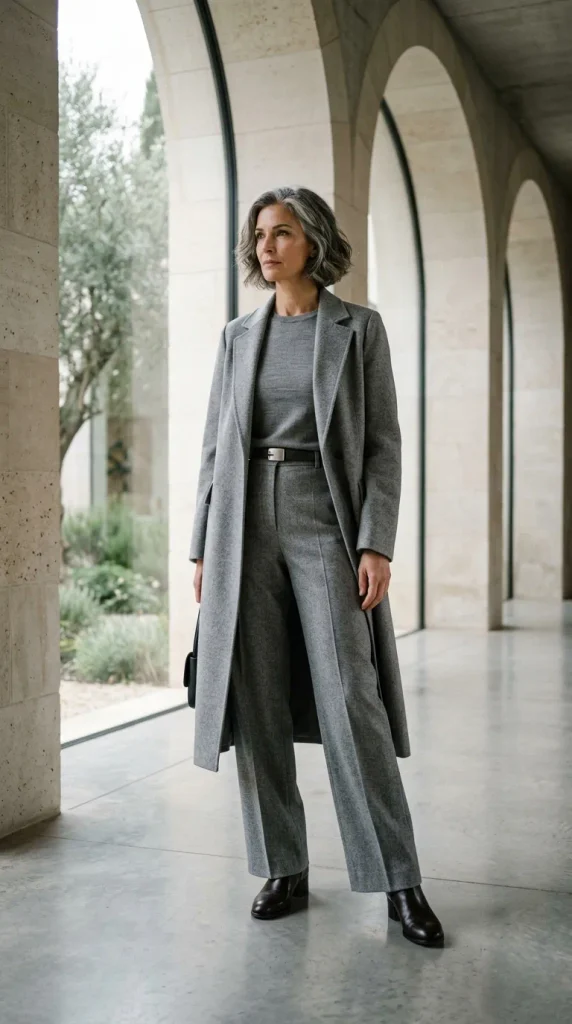
4. The double-faced wool coat, worn as the outfit
The coat is the investment. Everything under it is deliberately plain.
Double-faced wool is two layers of fine cloth woven together as one, so the coat needs no lining. It drapes like something much softer than a winter coat has any right to, and it is warm out of all proportion to its weight. Underneath, keep it almost plain: a thin merino layer tucked into high-rise wool trousers with a proper pressed crease, everything in one family of grey, granite or deep forest. Leave the coat open indoors. It frames the trousers’ crease like a doorway.
This is the one real investment on the list, and I’d be lying if I called it cheap. But cost per wear tells the truth: a coat like this anchors a decade of Sundays. Get the crease set with a damp pressing cloth and steam, and check the break — the hem should kiss the shoe once, never pool. If your service is short and the building runs warm, you will carry this coat more than you wear it. For long, cold, formal services, nothing here beats it.
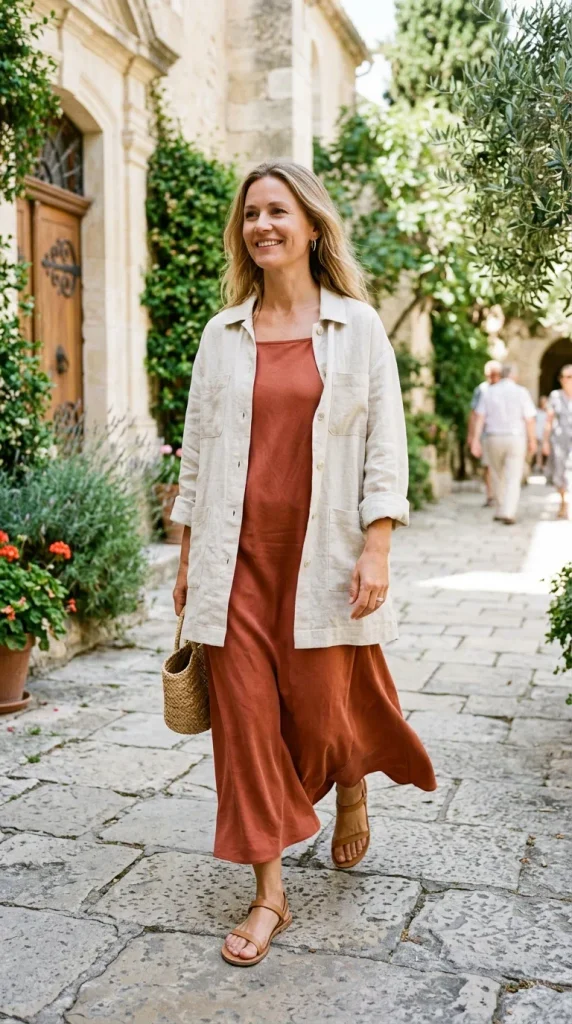
5. A linen overshirt over a silk slip dress
Summer church, solved. The linen does the modesty; the silk does the grace.
Summer services have their own problem: warm outside, arctic air conditioning inside, and a silk slip dress on its own can feel like evening wear that wandered into the wrong room. The fix is a heavy, boxy linen overshirt worn open over it, like a summer duster. The linen’s rough, honest texture gives the silk structure and coverage; the silk gives the linen movement. Ecru over sage, or washed terracotta. It looks considered because it is.
One thing I insist on: choose a slip cut on the straight grain, not the bias. Bias silk clings to every hip and ripple; straight-cut silk skims past and falls clean to mid-shin. A friend brought me a bias slip to alter once, and no amount of letting out would calm it down. Steam the dress hanging, so the hem settles, and push the overshirt sleeves up one roll onto the forearm. Flat leather mules, no jewellery beyond a watch. Best for anyone who runs hot outdoors and cold indoors — most of us, by July.
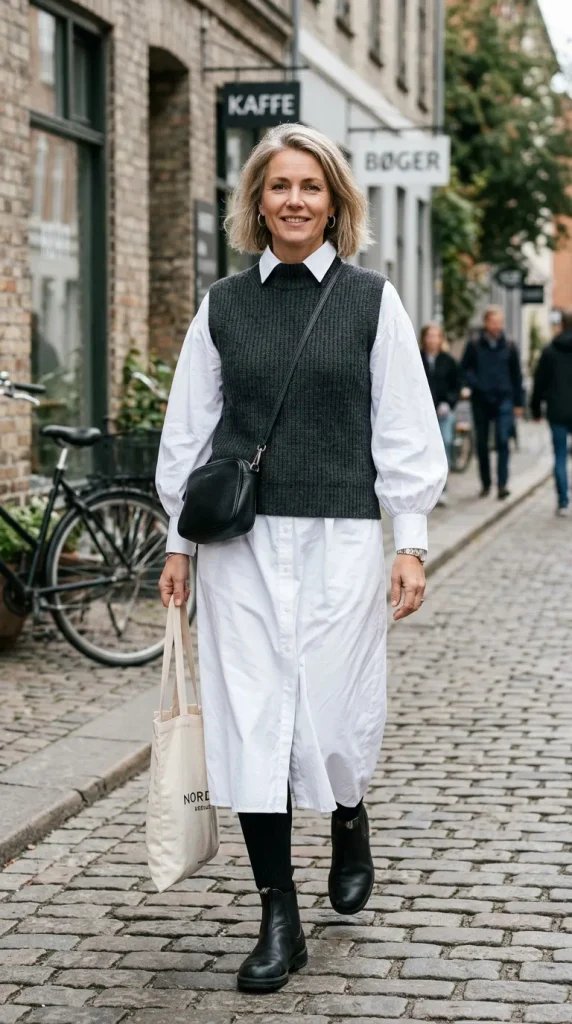
6. A white shirtdress under a heavy knit vest
The vest turns a shirt into an outfit. My most-worn in-between layer.
An oversized shirtdress is a good church dress alone — buttons, collar, hem safely below the knee. But it can drift towards casual. The correction: a dense, sleeveless ribbed knit vest over the top, charcoal or black against the white cotton. The vest gathers the whole silhouette in across the torso while the sleeves billow free, and the contrast is sharp without a single loud colour anywhere.
The fitting trick nobody tells you: reach up through the vest’s armholes and pull the sleeve fabric out evenly, so both shoulders billow the same. Lopsided sleeves make the whole thing look borrowed. Check the vest hem sits level at the high hip, and button the dress all the way — a gaping placket ruins the clean line faster than anything. Chelsea boots balance the weight of the knit. I reach for this between seasons: vest off for the warm hall, on for the cold nave. Skip it if you dislike anything sleeveless over your clothes; the dress alone still works.
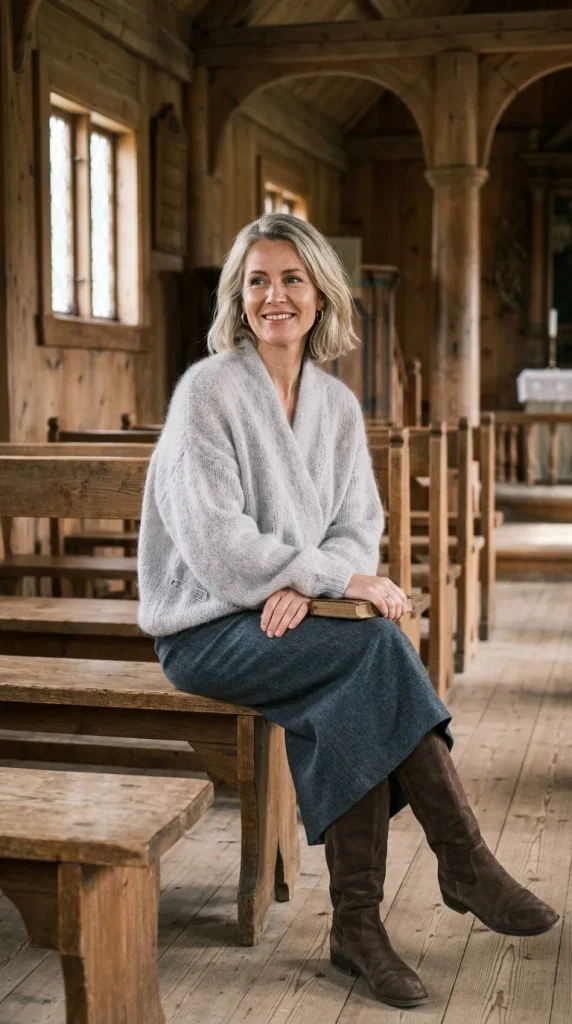
7. Brushed mohair and a straight column skirt
Soft light around the face, straight lines below. For the quietest Sundays.
Mohair has a halo — the brushed fibres catch light gently and blur every edge — and close to the face it does the flattering work scarves and jewellery usually get asked to do. As a plain wrap cardigan, crossed over and pinned discreetly at the hip, it is the softest alternative to a blazer I know. Underneath, discipline: a straight column skirt in heavy ponte or boiled wool, falling unbroken to the lower calf.
Mohair sheds a little, always — brush it before you go, and don’t wear it over a dark skirt unless you enjoy lint rollers. And it needs a smooth silk camisole beneath, because the fibres will grip a cotton layer and creep as you move. Hang a flattened cardigan in a steamy bathroom for fifteen minutes and the loft comes back. Suede boots that vanish under the hem finish it. This is the outfit for solemn winter services, and any Sunday when soft feels more respectful than sharp.
8. A fine turtleneck under a wool pinafore
Folk roots, minus the embroidery. The square neckline does the decorating.
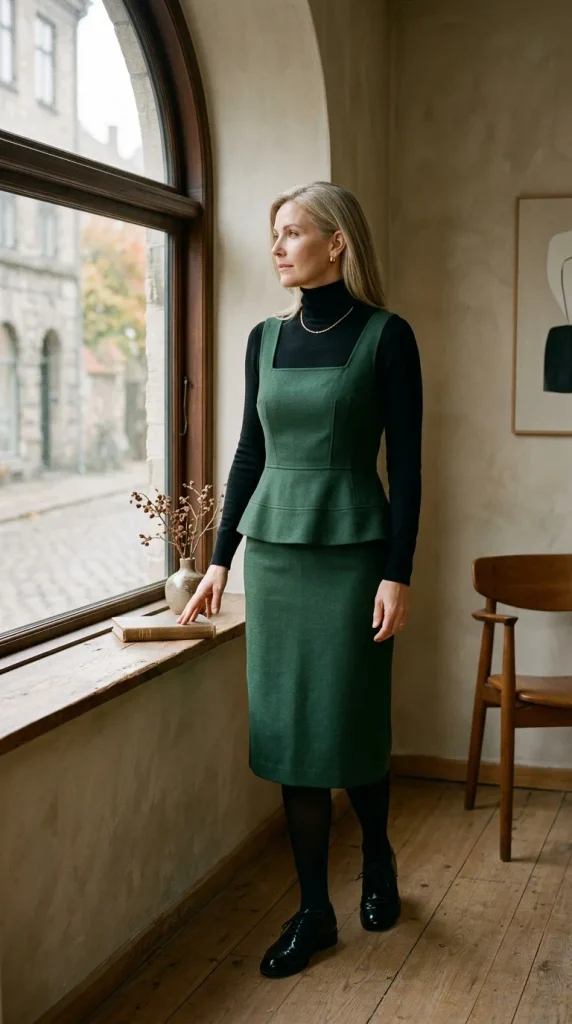
The pinafore is old Scandinavian workwear — wide straps, a square neck, room to move — and cut in dense suiting wool with a small dropped peplum at the waist, it becomes something quietly formal. Under it, a fine merino turtleneck, close and smooth, so the square neckline frames a clean band of knit at the throat. Forest green, deep ink or espresso, all one tone. The depth comes from the two fabrics arguing gently: soft knit against structured wool.
Roll the turtleneck collar out once and smooth it flat; a lumpy collar undoes the whole neckline. Fasten the side zip slowly — it will try to eat the knit underneath. Check the peplum from behind in a mirror: it should flare and settle, not ride up, because you will be sitting and standing all morning. Matte tights and Oxfords finish it. I’d skip this if your shoulders are much broader than your hips — the wide straps exaggerate the line. For everyone else it is modest, warm and oddly youthful.
9. A tailored peacoat with silk trousers underneath
Sea-captain coat, silk underneath. Coat off, the outfit still stands.
The peacoat is the most structured thing I own — sharp lapels, heavy wool, a shape that holds its corners. Wearing it open over wide-leg silk trousers in ivory or sand softens the whole stance: naval discipline on top, water underneath. A silk-cashmere crewneck tucked into the trousers keeps the middle plain, because with a coat this strong and trousers this fluid, anything fussy in between is noise.
The coat comes off indoors, so what is underneath has to stand alone — that is the real test, and the reason the sweater must be good cloth, not an afterthought. Press the silk trousers with a pressing cloth on a medium iron; silk scorches faster than you expect, and a shine mark never comes out. The hems should float about half an inch above the floor in your actual shoes — ankle boots with a moderate block heel. Camel and ivory suit warmer colouring beautifully. On very fair, cool-toned skin I’d swap the camel for navy and keep everything else.
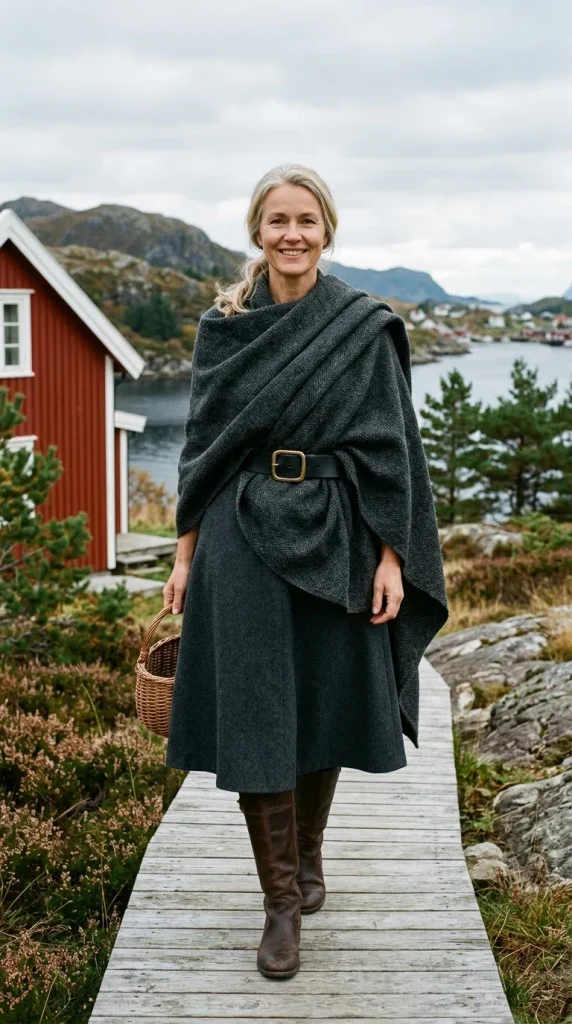
10. A blanket wrap, belted over an A-line skirt
A blanket, made architectural by one belt. Draughty churches stand no chance.
This is the oldest idea here — a generous wrap of virgin wool or alpaca, the kind Nordic weavers have made for centuries — given architecture by one wide leather belt. Drape it evenly, cross the panels right over left, and belt it firmly at the waist, capturing both layers. Ease out a little slack above the belt so the folds sit softly; below it, a tailored A-line skirt in dense Melton wool holds the structure, and tall boots close the line.
The belt is not optional decoration. Unbelted, this is a blanket, and it reads as one — I wore it that way once and spent the service clutching it shut like a Roman senator. Belted, the wrap becomes a bodice with presence, and the warmth is total: shoulders, back and lap all covered while you sit. Charcoal, toffee or dark moss keep it grounded. A plain belt works; a simple horn or silver brooch works too. For the coldest buildings and the longest services, this is the one I’d lend a friend first.
What I’d buy first — and what I’d leave
If I were starting from an ordinary wardrobe, the money goes in this order: one serious coat, one good knit, then stop. The boiled wool wrap or the double-faced coat anchors almost everything above, and a good knit layer works under half of it. Most women already own the rest in some form — a white shirt, a straight skirt, trousers that fit. Skip the matched occasion sets in shiny fabric; they date in a season and photograph worse than honest wool ever does. Plan it on Saturday evening, shoes and all. Sunday morning is no time for decisions, and a settled outfit is half of looking composed.
Questions I get asked
Can I wear trousers to church without looking underdressed?
Yes — if the cloth does the dressing up. Tailored wool trousers with a pressed crease, flannel culottes, or silk wide-legs all read as occasion wear. What reads as underdressed is not the trouser — it is thin fabric and trainers underneath.
How do I stay warm in a cold church without looking bundled?
Layer wool against wool and keep the silhouette in one long line. A knit dress under a boiled wool wrap, or the blanket wrap, will out-warm a padded coat while looking far calmer. Bulk comes from mixed lengths and competing layers, not from warmth.
What shoes actually work on stone floors?
Low block heels, loafers, Oxfords, or Chelsea boots with a rubber sole. Stone and old tile are unforgiving: thin stilettos slip and click with every step. A boot that meets the hem keeps the draught off your ankles.
Is black too severe for a Sunday service?
Not if the texture is alive. Black boiled wool, brushed mohair or ribbed knit all soften it. If black still drains you, navy, charcoal or forest green give the same dignity with a kinder light on the face.
How do I keep knits and pleats looking new?
Fold knitwear, never hang it — hangers pull the shoulders out of shape. Keep a fabric shaver for pilling, steam rather than iron where you can, and brush pleats downward so they hang straight. Ten minutes of care beats any new purchase.
That’s the Sunday rail as I keep it. If one of these finds its way into your wardrobe, save this page to Pinterest for the Saturday-evening planning — future you will be grateful. — Elias