A few years ago I watched my friend Ingrid, who is sixty-two and has never once apologised for her size, try on a coat in a Copenhagen shop. The assistant brought her the smaller size “just in case,” and Ingrid handed it back without a flicker of irritation. “I dress the body I have,” she said. “The other one can wait outside.” That sentence rearranged something in my head.
Scandinavian dressing suits plus-size women after forty precisely because it was never built on squeezing. It is built on weight, drape and one clean line at a time — heavy fabrics that fall where they should, room where you breathe, and nothing that clings out of cheapness rather than intention. These ten outfits are the ones I recommend to friends built like Ingrid, and the ones she keeps stealing back.
1. The chunky fisherman knit with tailored wool trousers
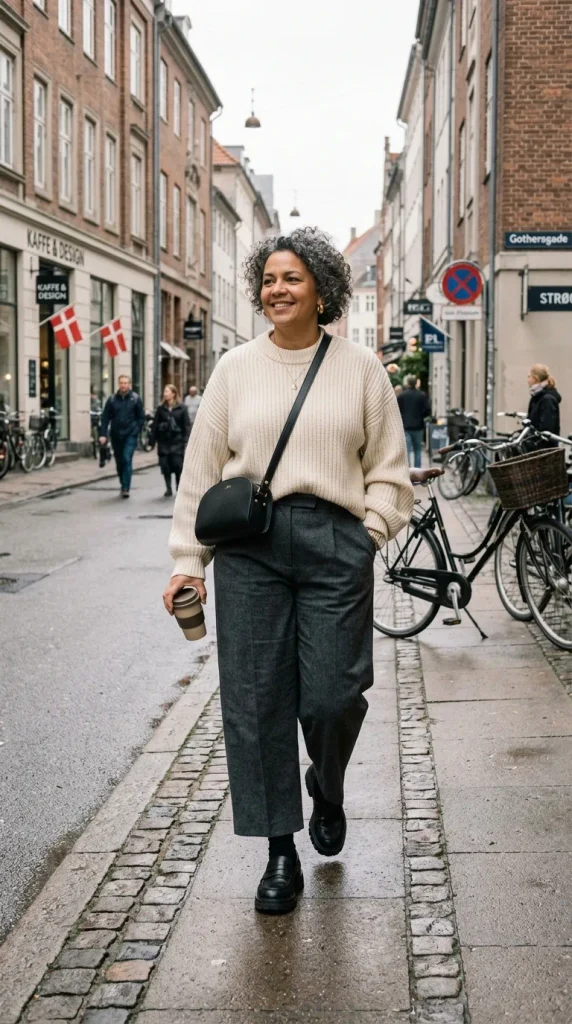
The cream fisherman knit over proper trousers — the first outfit I ever put Ingrid in, and still the one she wears most.
A heavy ribbed fisherman sweater in cream or ecru, worn over straight, flat-front wool trousers, is the outfit I reach for first. The knit brings texture and width at the shoulder; the trousers bring order below. Tuck just the front two inches of the sweater into the waistband — that small French tuck marks the waist without cinching anything, and stops the thick knit from reading as a tent.
The check that matters is weight. A real fisherman knit should feel almost heavy in your hands; a flimsy acrylic version clings to the stomach and pills within a month. The trousers want a smooth front, no pleats, sitting at your natural waist. Mine cost more than I like admitting, but four winters on, the cost per wear is pennies. Skip this if your office runs hot — proper wool is not a half-season fabric.
2. The crisp poplin shirt dress under a longline vest
Crisp cotton underneath, a long vest doing the architecture. This one photographs better than outfits three times its price.
A midi shirt dress in firm cotton poplin — white or the palest blue — with a long sleeveless vest over the top. Leave the top two buttons open so the neckline forms a soft V, and let the vest fall straight from the shoulder to below the hip. That long vertical panel is the whole trick: it gives the eye a line to travel and the dress a frame.
Poplin quality is easy to test. Hold it to the light; if you can see straight through it, it will show every seam of what is underneath and crumple by ten o’clock. Good poplin is dense, almost papery. The vest should skim, not pull — if the fronts gap when you sit, go up a size. I once bought the vest in the size I wished I was; it spent a year unworn at the back of the wardrobe, which is the most expensive kind of clothing there is.
3. The tonal cashmere turtleneck with a pleated midi skirt
One colour, two textures. My sister calls this my expensive-looking outfit, and it is the simplest one I own.
One colour from neck to hem — a fine-gauge turtleneck in cashmere or merino over a pleated midi skirt in the same tone, a shade deeper at most. Monochrome dressing works on a fuller figure because there is no horizontal break for the eye to stop at. The interest comes from texture: matte knit against pleats that move when you walk.
Fit notes from experience. The skirt’s waistband should sit at the narrowest point of your waist, and the pleats must fall from the hip rather than springing open — sit down in the shop, stand up, and look. The turtleneck should skim the body, never grip it; fine-gauge knit a size too small shows every line of your bra, and I have the photographs to prove it. Cream and stone are kind tones after forty, softer against the face than black. This is my Sunday-lunch outfit, dressy enough for guests, comfortable enough for seconds.
4. The relaxed double-breasted blazer with straight-leg denim
The blazer from the men’s rail of a vintage shop, over jeans that have never once let me down.
An oversized double-breasted blazer — mine is a quiet houndstooth — over a plain white crew-neck tee tucked into straight-leg jeans. This is Copenhagen street style at its most forgiving: the blazer supplies structure and shoulder, the denim supplies ease, and because both are classics, the outfit never dates in photographs.
Two checks before you pay. The denim should have very little stretch; rigid denim holds its line all day, while stretchy denim sags at the knee and seat by lunch. And the blazer’s shoulder seam should sit close to your own shoulder — an inch of slouch is style, three inches is a dressing gown. Mine came from a vintage shop for less than a good dinner out, and a tailor took the sleeves up for the price of a coffee. Who should skip it: anyone whose day involves lifting, carrying or grandchildren — a blazer is a sitting-down garment.
5. The boiled wool wrap coat over a wide-leg lounge set
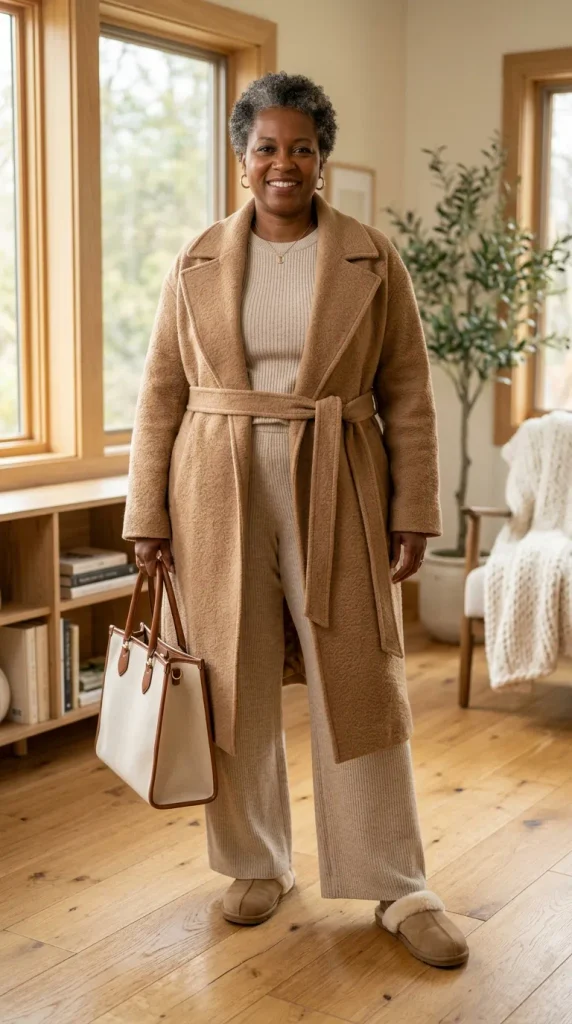
Essentially pyjamas, made respectable by one very good coat. My long-train-journey uniform.
Underneath: a matching knit two-piece, a soft top and wide-leg knitted trousers in one calm colour. Over it: a wrap coat in boiled wool, collar up, belt tied once and forgotten. The coat is doing all the public work here, and it is more than up to it — boiled wool is felted so densely that wind gives up and creases simply fall out overnight.
The set underneath must earn its place, though. Knitted trousers should fall, not cling: if you can see the outline of the pocket or your knee through the fabric in the shop, leave them there. Check the waistband sits high and flat without twisting when you walk. Honestly, this is comfort dressing, and I wear it for travel days and slow weekends, not for anything with a seating plan. The coat was an investment. The set was not, and that is exactly the right way round.
6. The linen chore jacket with tonal tapered linen trousers
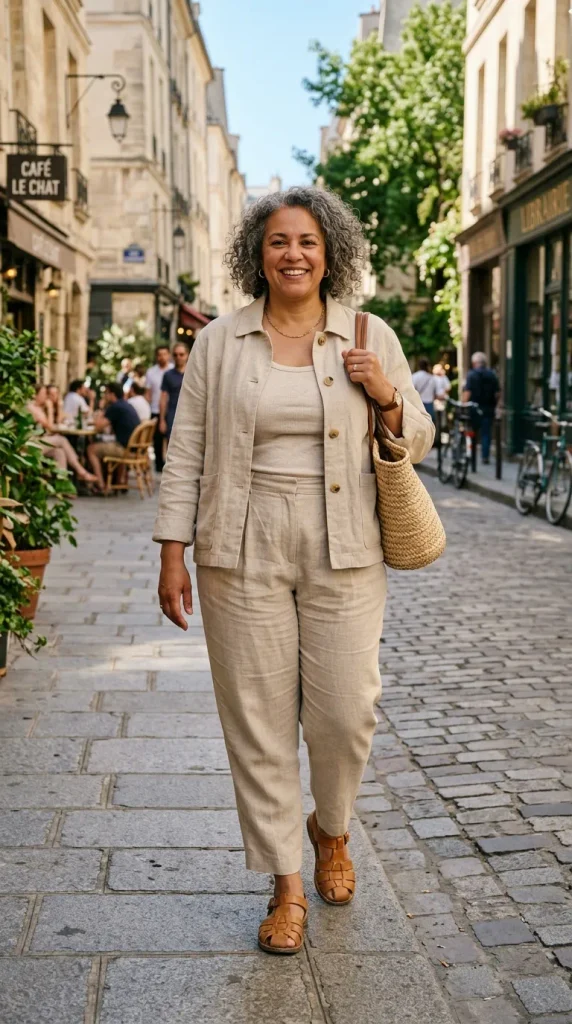
All linen, all one colour. The outfit that finally made peace between me and August.
For warm weather: a boxy, unlined chore jacket in heavy European flax, worn over a ribbed tank tucked into tapered linen trousers in the same family of colour. Linen is the summer fabric that does not cling, because it stands slightly away from the skin and lets air do the work. On a plus-size body that stiffness is a gift — the cloth holds its own shape instead of borrowing yours.
The buying check is the same as for poplin: hold it to the light. Cheap, thin linen shows everything and creases into tissue by midday; heavy linen creases too, but softly, like it means it. Tuck the tank firmly so the line stays clean, and roll the jacket sleeves to the forearm — a glimpse of wrist keeps all that cloth looking deliberate. Cost note: real flax linen is not cheap, but my trousers are in their fifth summer. The chore jacket doubles as a light coat in spring, which spreads the money further.
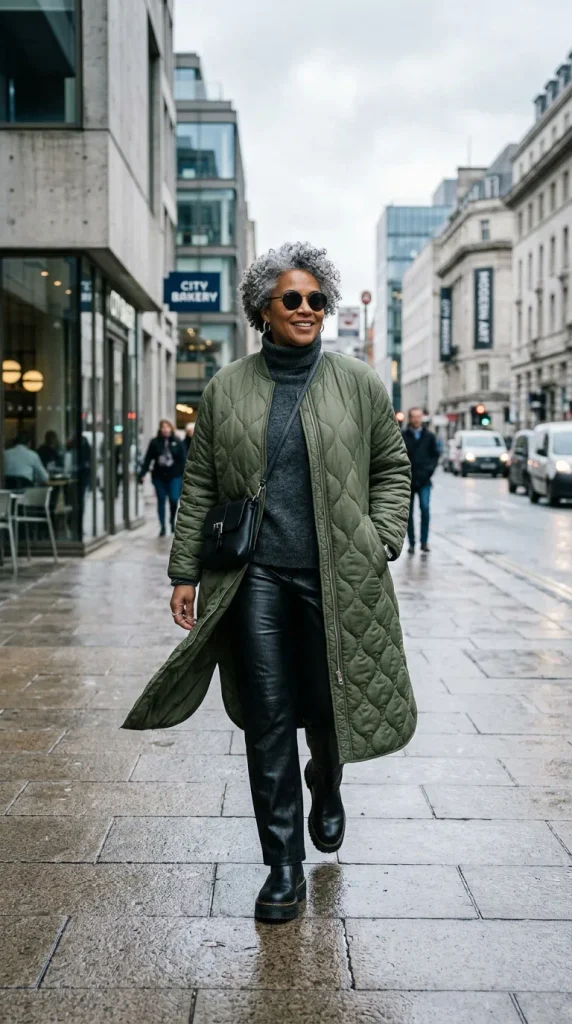
7. The quilted longline liner coat with leather-look trousers
Matte quilting against smooth trousers. The combination strangers ask me about at the market.
A collarless, onion-quilted longline coat in deep moss green, worn over a chunky alpaca knit and straight-leg leather-look trousers. The quilting gives the top half texture and architecture; the smooth trousers keep the lower half quiet. It is a lot of look, and it works because each piece sticks to one job.
Details decide this one. The coat must be matte — glossy quilting reads as sportswear no matter what you pair it with. The trousers should be relaxed through the thigh, a trouser cut rather than a legging cut; skin-tight faux leather under a long coat unbalances everything and is miserable to sit in. Do the sit-down test and the stairs test in the shop. My honest warning: the full combination is warm. Wonderful in January, a slow punishment in a heated café, so plan an escape layer underneath.
8. The structured pinafore over crisp shirting
The pinafore I reach for on days that need to look organised. The striped cuffs are my favourite part.
An A-line pinafore dress in deep wool or heavy twill, worn over a striped poplin shirt buttoned to the top, sleeves folded back once so the cuffs show. The pinafore’s clean geometry — wide straps, a square neckline, a skirt that falls from under the bust — skims a fuller figure without a single tight seam anywhere. It is structured dressing that you can still breathe in.
Fit is decided at the straps: they should rest on the mid-shoulder point, not slide toward the neck or the arm. If they wander in the shop, they will wander all day. The shirt underneath wants the same crispness test as the shirt dress — dense poplin, collar that stands. One confession: my first pinafore was a size optimistic and the buttons at the side gaped by lunchtime. A-line only forgives if the cloth has room to fall. Buy the size that falls, not the size that fits on the hanger.
9. The oversized cardigan coat over a column slip skirt
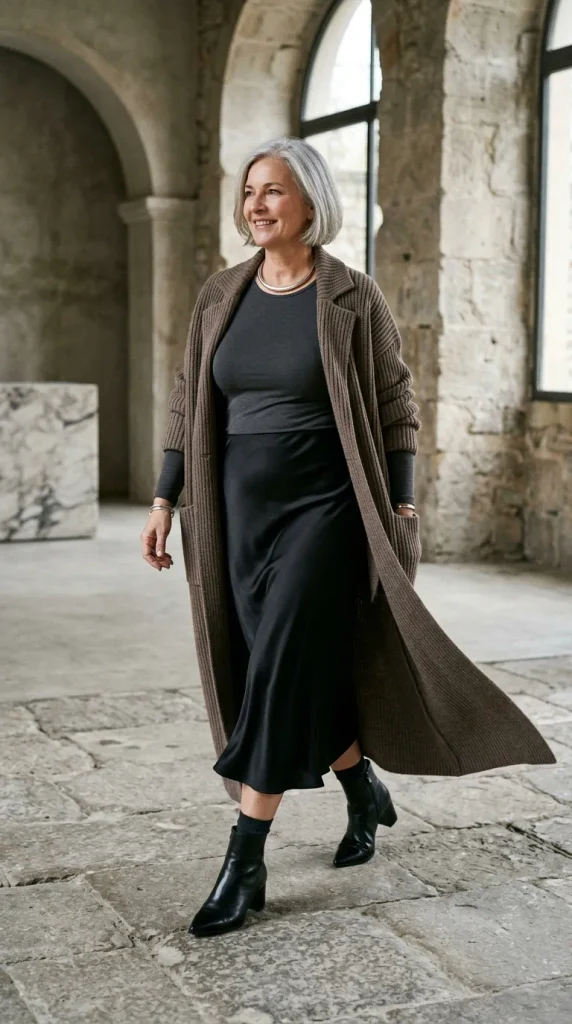
Heavy knit over fluid satin. The outfit I wear when there is dinner and I intend to enjoy it.
A calf-length cardigan coat in heavy-gauge wool, worn open over a fitted fine-ribbed long-sleeve top tucked into a bias-cut slip skirt in matte satin. The cardigan brings weight and length; the skirt brings movement. Bias cut is the kindest cut there is for a fuller hip, because the fabric is cut on the diagonal and pours over curves instead of gripping them.
The skirt is the piece to check hardest. It should be matte — shiny satin under knit looks like evening wear that got lost — and heavy enough to fall straight. Tug the waistband gently sideways; a good bias skirt settles back without twisting. The cardigan should have real heft in the hand; a thin one clings to the skirt and ruins both. This is my dinner outfit, the one with room for pudding built in. Skip it for standing-around drinks parties, where a long open cardigan spends the evening being stepped on.
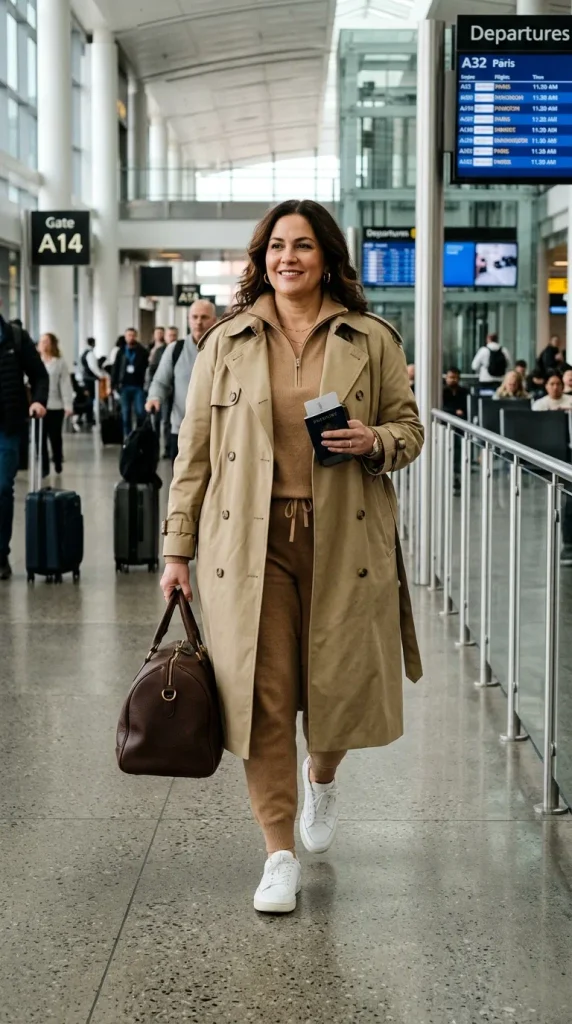
10. The utility trench over monochrome knit joggers
A trench over a knit tracksuit, and somehow it looks intentional. The airport outfit that started arguments at home.
Last, the high-low one: a matching fine-gauge knit set — half-zip top and jogger trousers in one colour — under a proper utility trench. The set is soft, elastic-waistbanded, entirely comfortable; the trench walks in and makes it look like a decision. Keep the knit cuffs sitting cleanly above the ankle bone so the line stays sharp at the bottom.
The set has to be fine-gauge and dense. Baggy, pilling knit under a trench reads as pyjamas caught outdoors; a smooth, weighty knit reads as leisurewear with somewhere to be. Zip the collar halfway and fold it down once. Ingrid laughed when I first wore this to collect her from the station — then asked where the set was from before we reached the car. It is the easiest outfit on this page, and the one I would hand a nervous beginner first.
What I’d buy first — and what can wait
Spend in the order the clothes work. One heavy wool coat first — the wrap coat or the blazer — because it frames half the outfits here and turns up in your life three seasons a year. Then the tailored trousers and one honest knit. After that, honestly, most of this list is assembly: the shirt, the vest, the trench over things you may already own. What can wait is the leather-look trouser and the quilted coat — fun, but seasoning. And audit your wardrobe before buying anything: Ingrid found two of these outfits already hanging in hers, separated by a decade of not thinking of them together.
Questions I get asked
Won’t oversized pieces just make me look bigger?
Only when everything is oversized at once. One volume at a time — a big knit with tailored trousers, a long coat over a slim column — and the contrast is what reads as shape. Two baggy pieces together is where the trouble starts.
Do I have to tuck things in at my size?
No, but a two-inch front tuck is the cheapest tailoring there is. It marks the waist without a belt and stops a long top from hanging like a curtain. Try it in the mirror before you rule it out — most women who resist it end up converts.
Which shoes actually balance all this fabric?
Grounded ones: lug-sole loafers, Chelsea boots, structured leather trainers. A delicate thin-soled shoe under a heavy coat looks like the outfit might blow away. The shoe needs as much presence as the clothes.
How do I keep heavy knits looking new?
Two minutes with an electric fabric shaver every few wears, fold them rather than hanging, and rest a knit a day between wearings. Wool recovers if you let it. Most tired-looking jumpers are just overworked, not worn out.
Where do I start if my wardrobe is mostly prints?
Don’t purge anything. Add one plain, heavy layer — the blazer or the trench — and wear your prints underneath it. Framed by a calm coat, a print stops shouting. Build the neutrals around what you already love.
That’s the list as Ingrid and I actually wear it — coats that fit the body in front of the mirror, not the one in the shop assistant’s imagination. If one of these combinations earns a place in your rotation, save it to your wardrobe board on Pinterest for the next fitting-room trip. — Elias