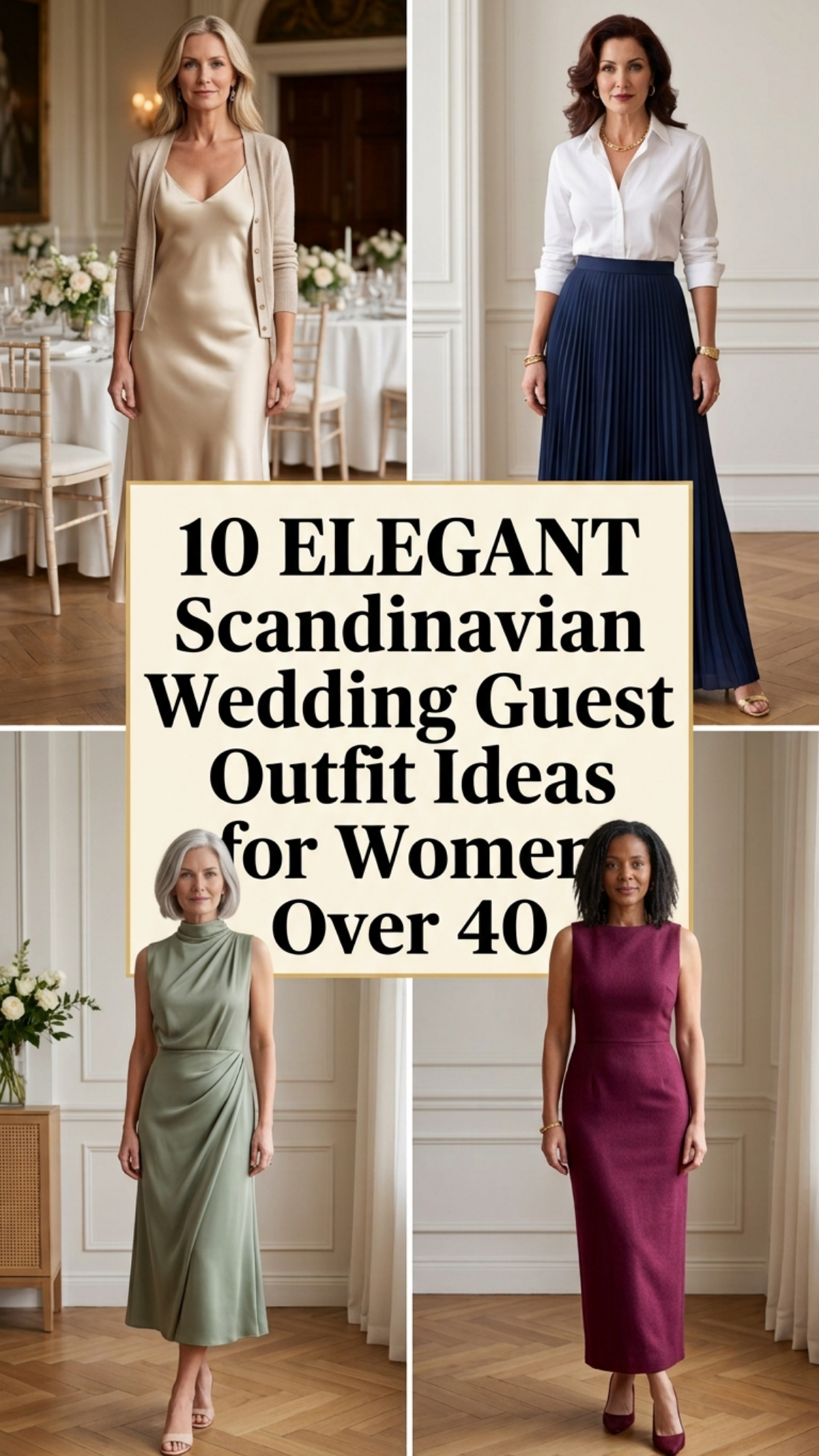
10 Scandinavian Wedding Guest Outfit Ideas for Women Over 40
Somewhere around forty, wedding invitations stop being simple. There’s the ceremony, then photographs on grass, then a dinner that runs long, then dancing — and the outfit has…
Somewhere around forty, wedding invitations stop being simple. There’s the ceremony, then photographs on grass, then a dinner that runs long, then dancing — and the outfit has to survive all of it without you thinking about it once. The rules nobody says out loud: no white, nothing that needs adjusting every twenty minutes, shoes you can actually walk in at hour six. I’ve watched too many guests spend a whole celebration managing their clothes instead of enjoying it.
That’s why I keep coming back to the Scandinavian way of dressing for these things. Less decoration, better cloth. A calm colour, a cut that skims rather than squeezes, and one good piece of jewellery instead of five nervous ones. Below are eleven combinations I’d genuinely recommend — most built from pieces that will earn their keep at dinners and gallery evenings long after the wedding.
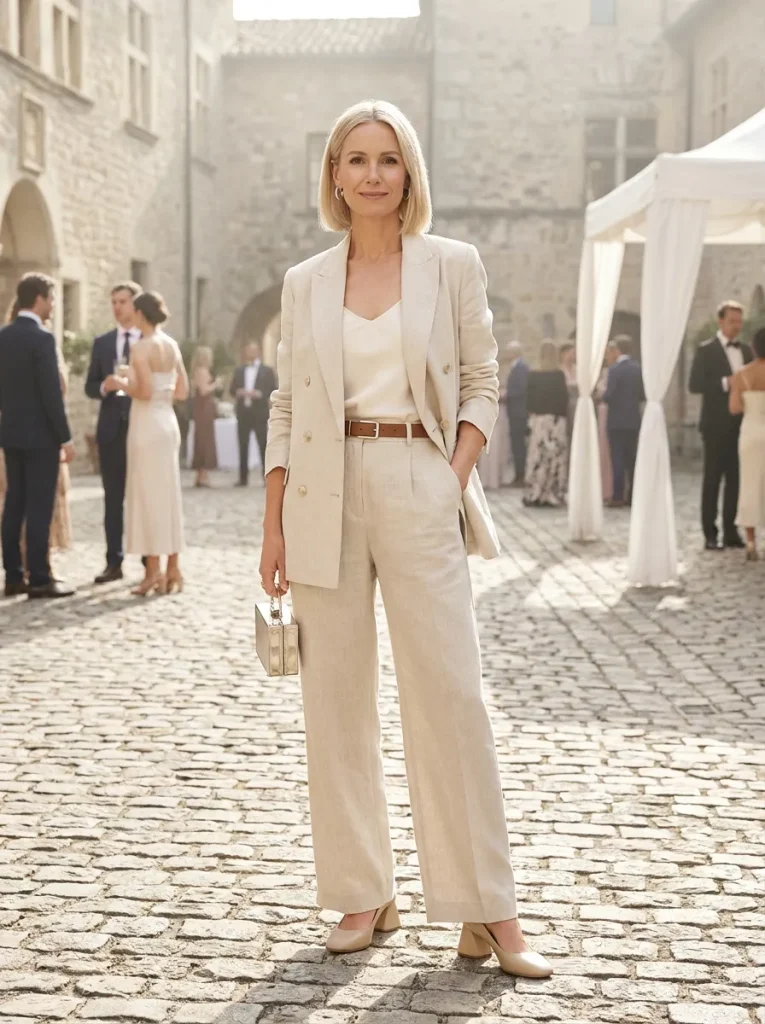
1. The pastel linen trouser suit
The suit I’d lend to any friend who says she has nothing to wear. It has never once let anyone down.
A relaxed double-breasted jacket over wide-leg, high-waisted trousers, in something soft — oat, pale sage, washed cornflower — with a plain silk camisole underneath. It works because the line runs unbroken from shoulder to hem, and trousers mean you’re warm in a draughty church and free to move at the reception. Linen does crease; that’s the price, and honestly it reads as ease rather than mess by evening.
My tip: buy the suit in a medium-weight, pre-washed linen. The flimsy stuff goes transparent in sunlight and bags at the knee by lunch. A thin leather belt at the waist and low block heels finish it. It costs less than most occasion dresses and gets worn ten times more. I’d skip it only for a very formal evening dress code.
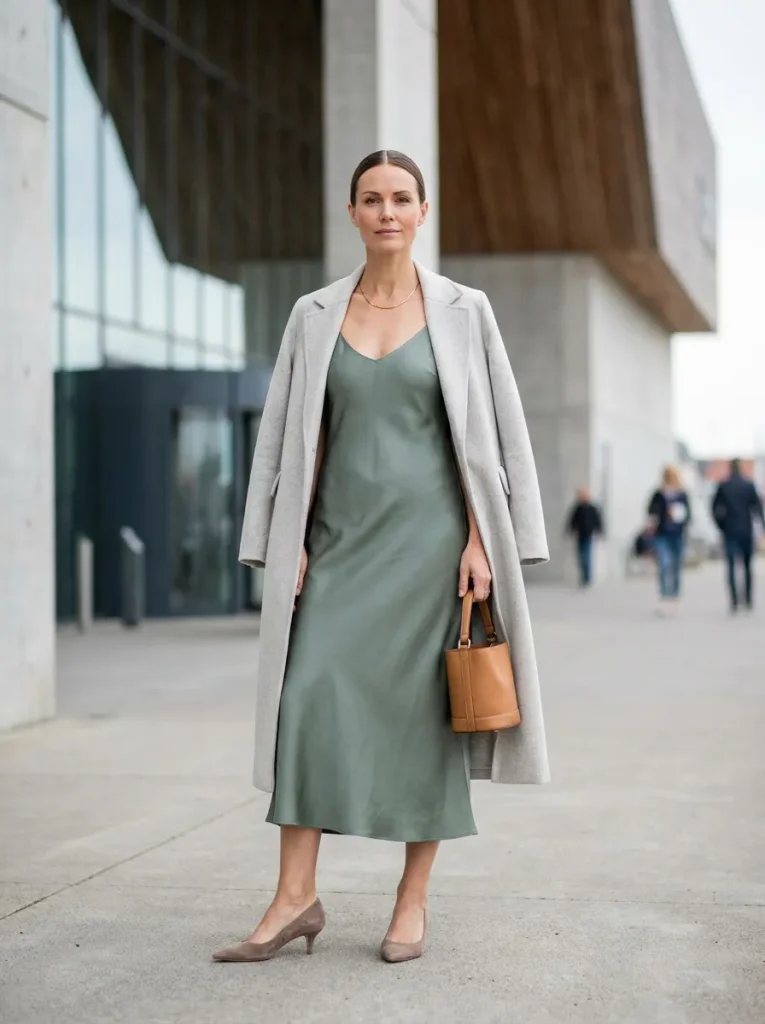
2. Sage silk slip dress under a grey wool coat
Fluid under structured. That contrast is the whole trick, and it photographs beautifully.
A bias-cut slip in deep sage or sea-glass green, midi length, worn under a long, collarless coat in soft heather grey wool. The silk moves; the coat gives it architecture. Together they handle the classic northern problem of a warm room and a cold churchyard in the same afternoon.
Fit checks that matter: adjustable straps, so you set the neckline where you want it, and silk heavy enough not to show every seam of what’s underneath — look for a weightier charmeuse, and wear smooth, seamless underpinnings. I drape the coat over my shoulders for arrival, then actually wear it when the temperature drops. Taupe suede kitten heels and a small bucket bag, done. Who it suits: anyone who runs cold. Who it doesn’t: anyone who hates the feeling of silk shifting as they walk — it does move, that’s its nature.
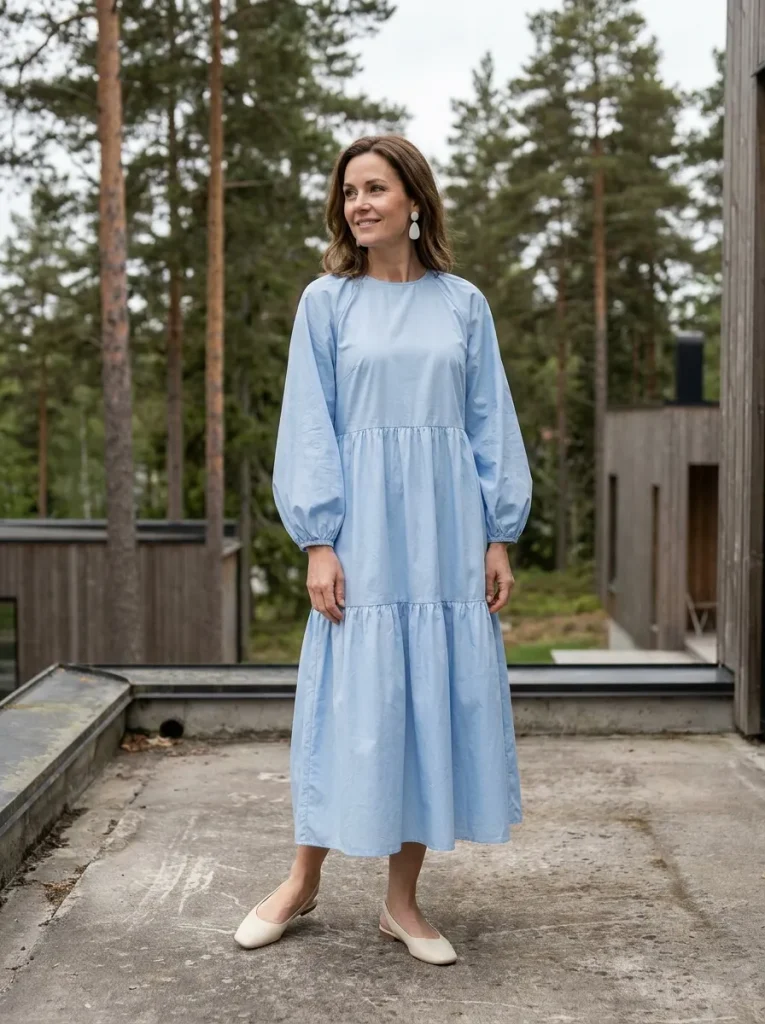
3. The powder blue poplin dress with real volume
All that fabric, and nothing touching you anywhere it shouldn’t. Pure relief in dress form.
A big, gathered midi in crisp cotton poplin — powder blue, tiered skirt, soft balloon sleeves, clean round neckline. This is the dress for women who are done with shapewear. The volume does the formal work; your body gets the day off. It sounds like a tent on paper. In person it looks confident, almost architectural.
Practical tip: the poplin has to be dense and crisp. Cheap poplin collapses and looks like a nightdress by the second hour, so pinch the fabric when you shop — you want a faint papery crackle. Check for deep side pockets — a genuine bonus. Hair worn sleek and low balances the fullness, and cream slingback flats keep it grounded. Add a wide leather sash if you want a waist, skip it if you don’t.
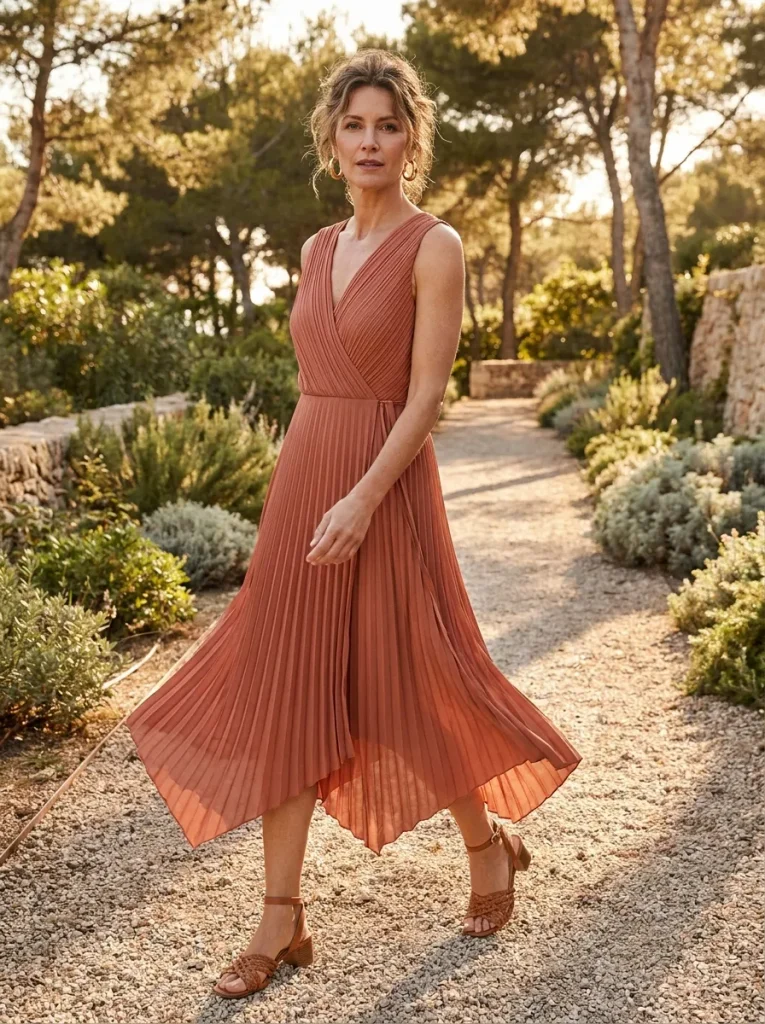
4. Terracotta pleats that never crease
The dress that comes out of a suitcase ready to wear. Destination weddings, sorted.
A wrap dress in heat-set micro-pleats, in terracotta, clay or dusky ochre. The crossover bodice gives you a V-neck you can actually trust — there’s an inner anchor button and a stabilising ribbon inside, fasten those first — and the pleats fall into an asymmetric hem that moves when you walk. The colour is kind to almost every skin tone I know; it brings warmth back into faces that grey and black drain.
The honest selling point is travel: the pleats are permanent, so the dress rides in a carry-on and hangs crease-free an hour later. Hang it overnight before the wedding so they drop back into line. Cognac leather heels, an envelope clutch, hammered gold hoops. One caution from experience: polyester-silk blends vary wildly, and the shiny ones look cheap under flash photography. Choose matte. If it gleams in the shop, put it back.
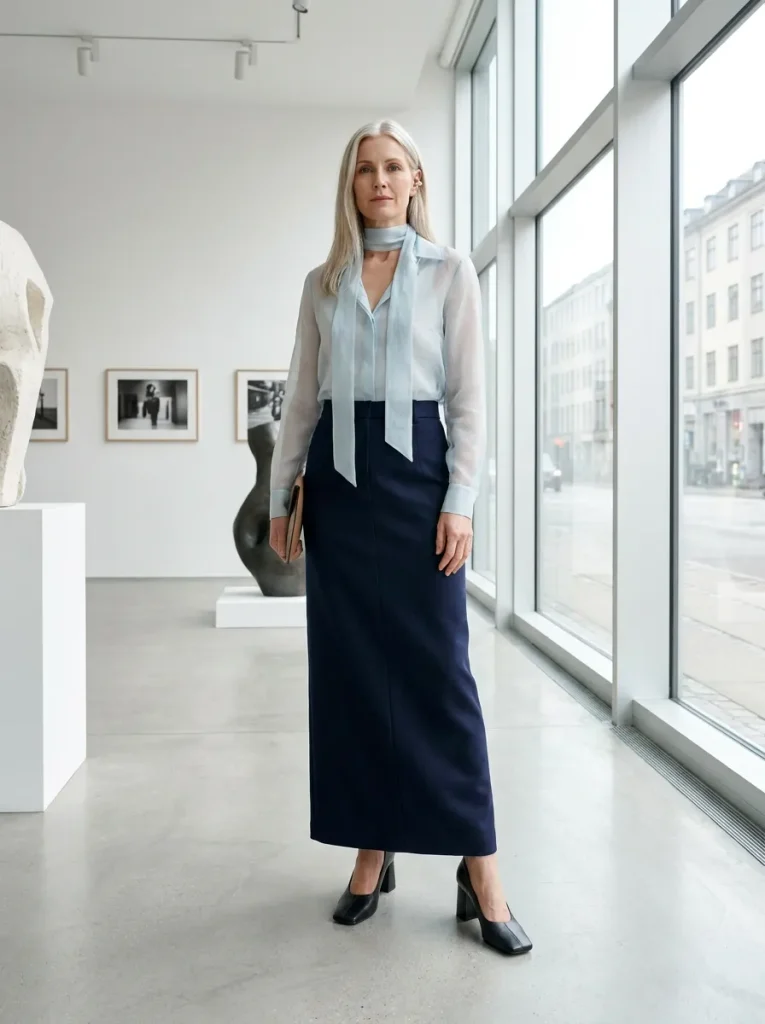
5. Column skirt, sheer blouse, two sizes that both fit
Separates are the quiet cheat code. Top one size, skirt another, nobody knows.
A straight, ankle-length column skirt in navy or slate matte crepe, with a semi-sheer organza or chiffon blouse tucked in — raglan shoulders, high cuffs, a soft sash at the neck tied loose. The skirt gives one long grounded line; the blouse gives light. And because it’s two pieces, you buy each in the size that actually fits that half of you. No compromise in the middle, which is where most dresses go wrong after forty.
You will need a camisole underneath — match it to your skin or to the blouse, but decide deliberately rather than discovering the problem in the venue’s mirrors. Square-toe block heels in black or navy, a flat portfolio clutch, silver ear cuffs. My mistake the first time I wore this: tucking the blouse too loosely, so it bloused out by dessert. A smooth, firm tuck and a waistband sitting at your true waist fixes it.
6. Butter yellow silk, head to toe
One colour, worn with nerve. The light it throws back onto your face is free makeup.
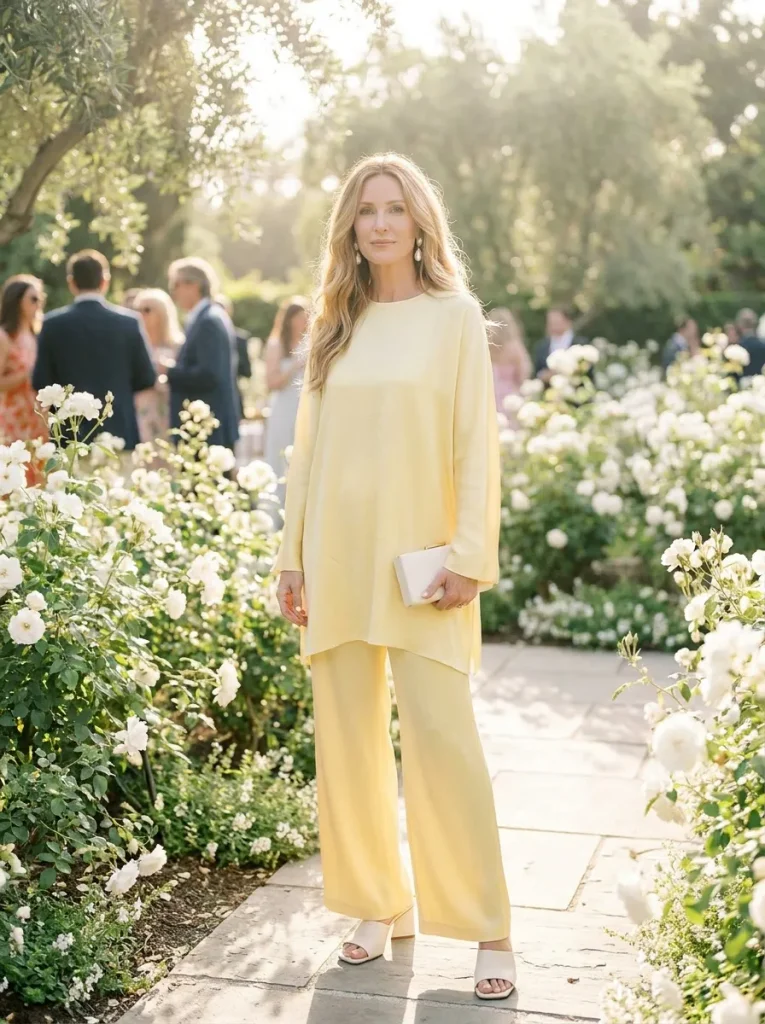
A fluid silk tunic over matching wide-leg palazzo trousers, all in butter yellow or soft vanilla. Monochrome is the oldest elongating trick there is, and this pale, warm yellow does something extra — it reflects light upward, gently, the way long summer evenings do. The tunic has side slits to the hip, so nothing pulls when you sit or reach.
Details to get right: the trouser hem should clear the floor by about a centimetre in your actual wedding shoes, so take the shoes to the tailor. Push the sleeves to three-quarter so your wrists show — it stops a full-coverage outfit looking heavy. Silk crepe de chine rather than satin; the matte surface keeps pastel from going flat or bridal-party shiny. Ivory slides with a low sculptural heel, a small ivory box clutch, baroque pearls if you like them. I’d skip this one for redheads who find yellow fights their hair — try the sage in idea two instead.
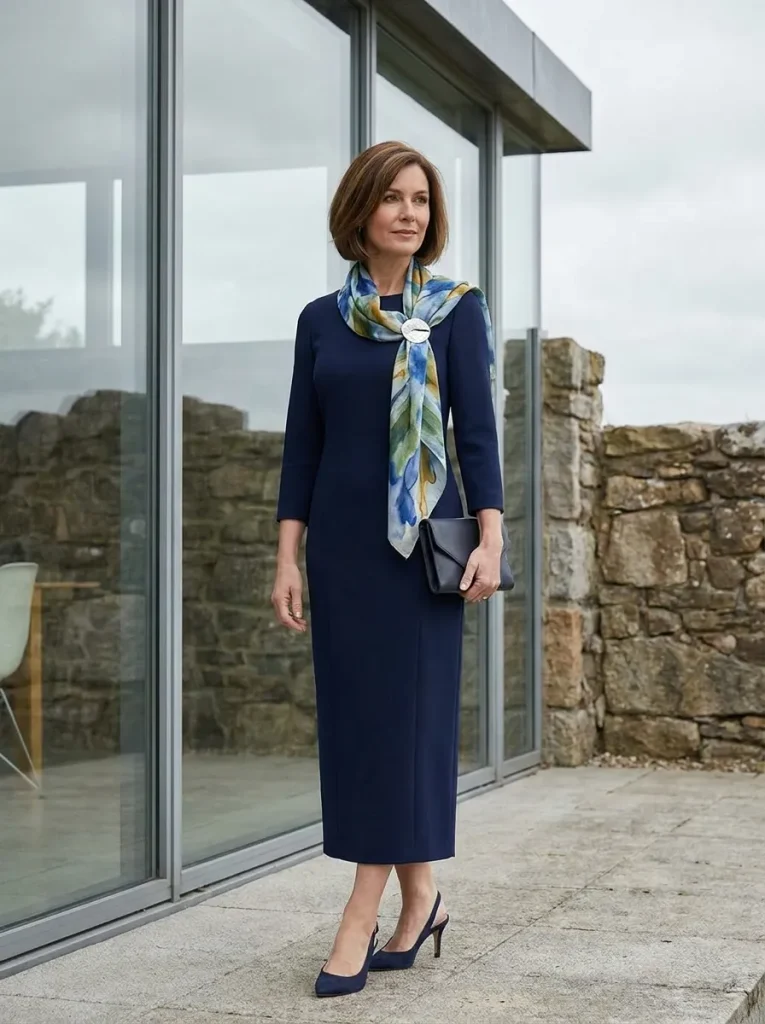
7. The navy column dress and one good scarf
Navy is black’s kinder sister, and the scarf does all the talking so you don’t have to.
A plain, beautifully cut column dress in deep navy — wool crepe or compact matte viscose, shoulder to mid-calf, nothing on it at all. Then one oversized silk scarf, printed with loose watercolour strokes, folded on the diagonal and draped across one shoulder, pinned at the collarbone with a simple silver brooch. The dress is the canvas; the scarf is the painting.
This only works if the plain part is impeccable. Shoulder seams exactly on your shoulders, bust darts where your bust actually is — if the dress needs twenty euros of tailoring, spend it, because there’s nowhere for a bad fit to hide. Navy over black, always, at our age: black drains; navy flatters and still reads formal. Let the scarf’s end fall past the hip or tuck it at the waist. Matching navy slingbacks and an unadorned envelope pouch. I wear this when I know nobody and want to feel quietly armoured. It has never failed.
8. Dusty lilac jacquard with a cropped kimono jacket
The jacket ends exactly at the waist. Thirds, not halves — that’s why it flatters.
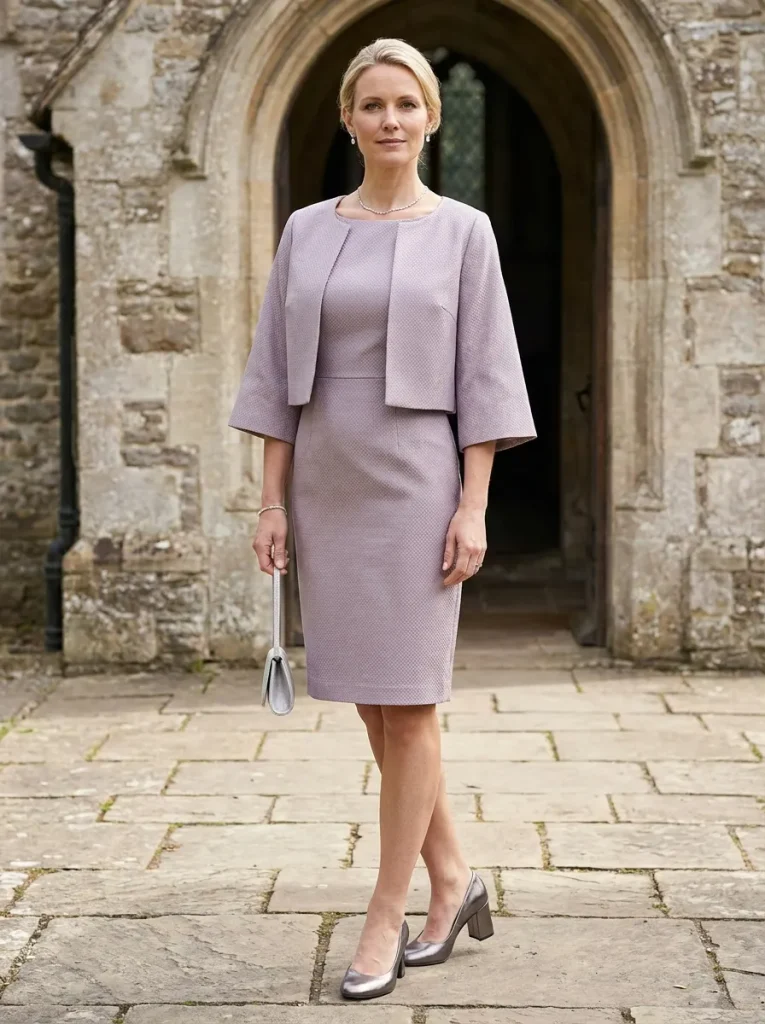
A boat-neck shift in dusty lilac jacquard — the pattern woven into the cloth itself, botanical or geometric, tone on tone — with a matching cropped jacket, wide kimono sleeves cut at three-quarter. The jacket finishes at the waist, which divides the body into thirds instead of halves, and gives covered arms and shoulders for a traditional church service without a shawl to babysit.
Jacquard is forgiving stuff: it holds its shape seated, standing and dancing, and barely wrinkles. Steam it from the inside so you don’t flatten the raised weave. Practical check — the back zip on textured fabric can snag, so zip slowly and keep a finger between zip and cloth. Pewter block heels suit the cool tone and cope with flagstones; silver jewellery, a small metallic clutch. Who it suits: anyone who wants structure without tailoring appointments. It’s the most formal-feeling outfit here that still lets you breathe.
9. Cream and charcoal, blocked like a painting
For the guest who’d rather be at a gallery opening. Some weddings, that’s exactly right.
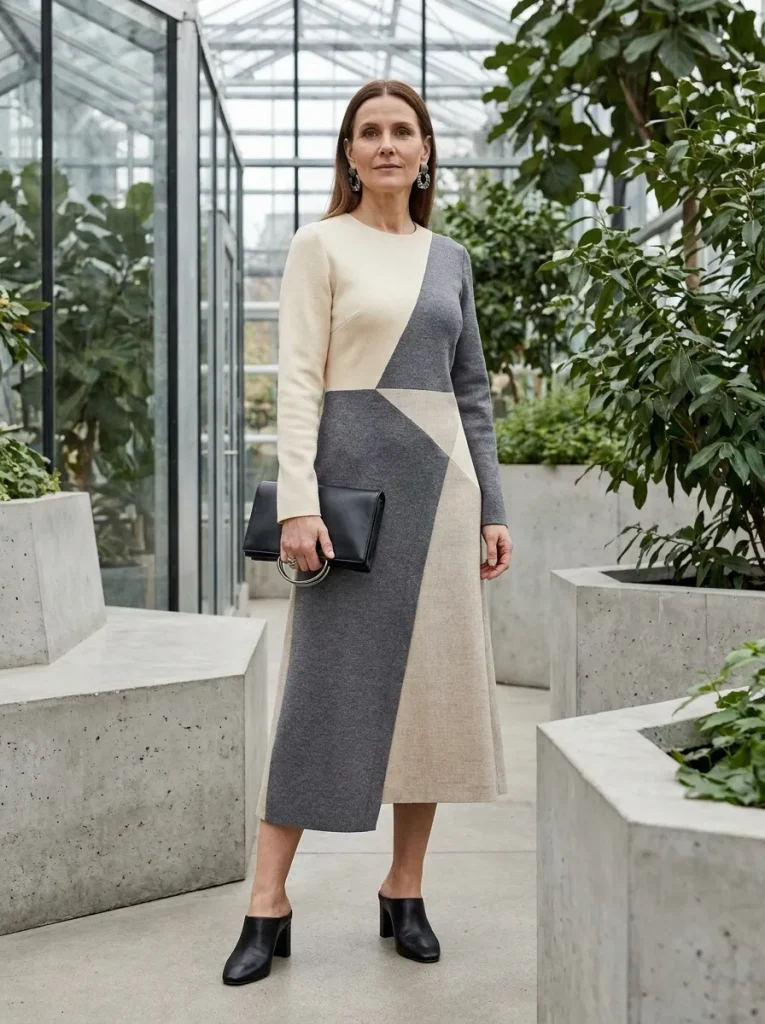
A tailored midi split into bold panels — warm cream across the shoulders and chest, charcoal wrapping the lower hip and hem, a band of oat between. No print, no ornament; the geometry is the decoration. In heavy structured jersey it holds its line all day without anything rigid underneath.
Fifteen years of graphic design left me with strong feelings about where a colour break lands, so: check the panel seams in a full-length mirror, sitting down as well as standing. A seam that cuts across the widest point of the hip will argue with you all day. Press seams flat with a cloth on low heat if they ripple. Then keep everything else sharp and plain — black leather mules, an architectural clutch with a metal handle, gunmetal drop earrings, and no necklace. The neckline is the composition; don’t hang anything on it. Not a romantic look, and that’s precisely its charm at a modern city wedding.
10. Forest green plissé jumpsuit, properly belted
It moves like a gown and behaves like trousers. The belt is non-negotiable, though.
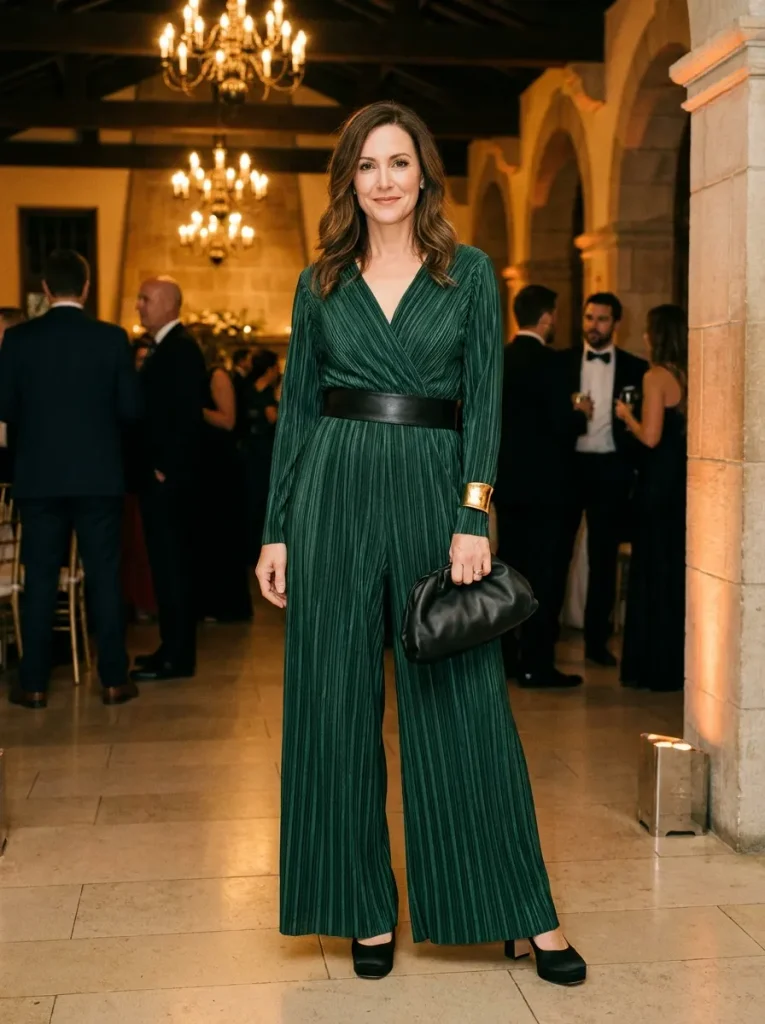
A finely pleated jumpsuit in deep forest green — crossover bodice, wide palazzo legs that sweep like a maxi skirt in motion, long cuffed sleeves. Green this dark has the depth of black with none of the drain; on mature skin it looks rich rather than severe. The pleats stretch over the body and fall back into a clean column, which means no ironing, ever, and a forgiving fit.
The belt makes or breaks it. Unbelted, all that pleating can swamp a smaller frame, so wrap a wide, smooth black leather belt at your natural waist and let the fabric gather above and below it. Secure the crossover with a hidden snap or a strip of fashion tape — test it by raising your arms and bending, in the shop, without embarrassment. Platform block heels or wedges so the hems float just above the ground. Gold cuffs over the sleeves, a soft black pouch bag. The honest downside: bathroom logistics. Practise once at home. You’ll manage.
11. All the creams, worn together
Three whites that don’t match, on purpose. The mismatch is where the depth lives.
The boldest quiet look I know: a chalk-white double-breasted blazer over flowing ecru trousers, stone-coloured leather shoes and bag, everything within a whisper of the same tone but nothing exactly matching. Tonal dressing reads expensive because it relies entirely on fabric and cut — there’s no colour contrast to hide behind. The blazer gives the shoulders; the trousers give the movement.
Rules from my own mistakes. First, keep it clearly cream, never bright white — there’s a line near the bride you do not cross, and ecru and oat stay safely on your side of it. Second, vary the textures deliberately: matte wool blazer, fluid trouser, smooth leather, or the whole thing flattens into a uniform. Third, this outfit shows every mark, so it’s a city venue look, not a garden one. Cost-per-wear is superb, since both pieces separate into your ordinary wardrobe the following week. If you buy one idea from this list as an investment, I’d make it this blazer.
What I’d buy first — and what I’d skip
If I were starting from an ordinary wardrobe, I’d put the money into one piece with a long life: the silk slip dress, the navy column, or a chalk blazer you’ll wear for a decade. Then I’d spend the unglamorous money — twenty percent of the budget, roughly — on tailoring, because a hem at exactly the right length does more than any accessory. Shoes come third, and they should be shoes you’d walk to dinner in, not just stand in.
What I’d skip: the matched jewellery set, the brand-new stilettos bought the week before, and any outfit bought for a fantasy version of the day rather than the real one — grass, weather, long seating and all. Photograph your full outfit, shoes and layers included, laid out in daylight the week before. Future you, on the morning, will be grateful.
Questions I get asked
Can I wear trousers to a wedding after 40, or does it read too casual?
You can, and it doesn’t — provided the fabric does the formal work. Linen suiting, silk palazzos and plissé all read occasion; thin jersey and daytime cotton don’t. It’s never the trousers. It’s the cloth.
What shoes honestly survive a whole wedding?
Low block heels, kitten heels with an ankle strap, or good leather flats. Stilettos sink into lawns and catch on cobblestones, and by hour five you’ll be carrying them. Break anything new in at home for at least two evenings.
How do I handle the temperature swings?
Plan the layer as part of the outfit, not an afterthought — a wool coat over silk, a cropped jacket, a blazer. The coat you grab from the hall cupboard will fight whatever you’re wearing. Choose one that belongs with it.
Is navy really better than black?
For most of us, yes. Black at a wedding can look severe in daylight and it drains warmer skin tones; deep navy gives the same formality with a softer edge. Forest green does the same trick if navy feels too safe.
How far ahead should I start?
Six to eight weeks, if you can. That leaves room for alterations, shoe breaking-in and the steamer session everything needs the day before. The outfit itself can be simple — it’s the preparation that makes it look considered.
That’s my eleven. Whichever you choose, I hope the day is long, the food is good, and your feet forgive you by morning. If one of these makes it into your wardrobe, save it on Pinterest so you can find it again before the next invitation lands. — Elias