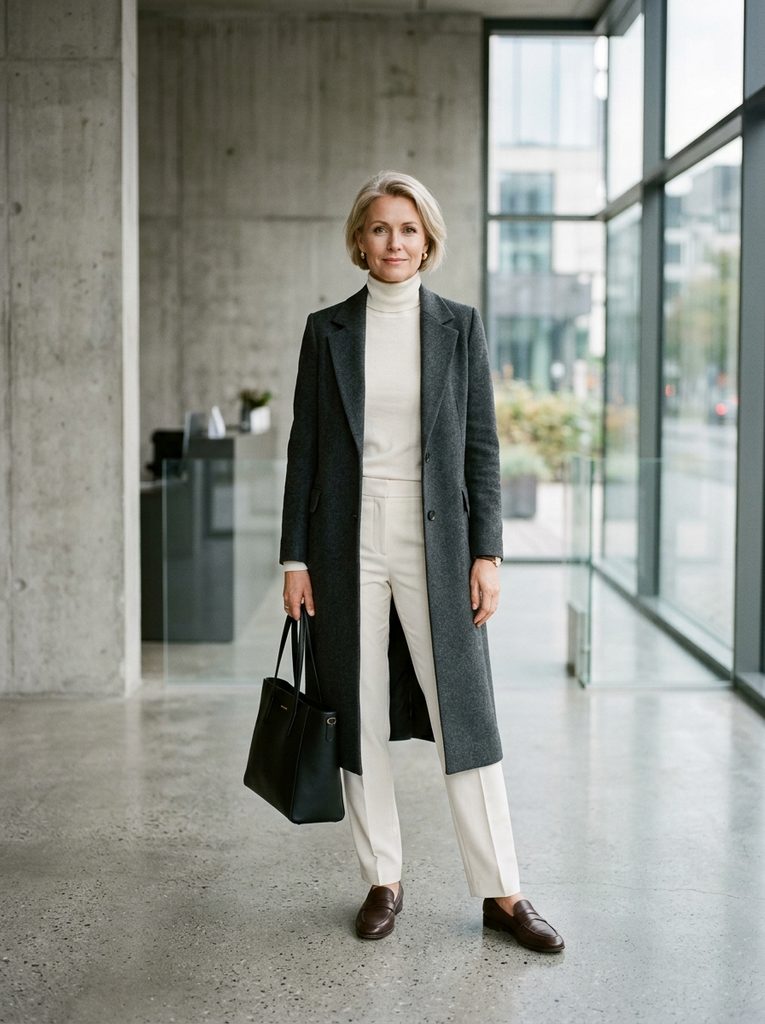
10 Scandinavian Work Outfit Ideas for Women Over 40
Somewhere around forty, most women I know stop dressing to impress the office and start dressing to forget they’re dressed at all. The outfit has to survive the…
Somewhere around forty, most women I know stop dressing to impress the office and start dressing to forget they’re dressed at all. The outfit has to survive the commute, the meeting, the overheated afternoon — and still look like itself at six. I spent fifteen years as a graphic designer, and these days I make and mend clothes instead, but the lesson carried over: the pieces that last are the quiet ones, cut well, made of fibre that behaves.
That’s why Scandinavian workwear suits this stage of life so well. A small palette, pieces that repeat, volume in one place at a time. Nothing shouts. Below are the ten combinations I recommend most often, each built from a handful of honest garments, most of which you probably own already. I’ve added the checks I actually use — how to test a fabric, where a hem should land, and which of these I’d skip in certain offices — because an outfit that only works in a photograph isn’t worth your money.
1. Wide-leg wool trousers and a fine cashmere crewneck
The one I’d build first. Most of the other outfits on this list borrow from these two pieces.
Start with the trousers: high-rise, wide through the leg, in a mid-weight wool that holds a crease. On top, a fine-gauge cashmere crewneck, front tucked, back left loose, a slim belt if you like one. The pairing works because the volume sits low and the top stays quiet — your waist does the talking, not any single garment. Two checks in the shop. First, pinch the wool and let go: if the crease vanishes, the fabric is too soft and the trousers will look tired by Christmas. Second, the hem. Wide legs should break just at the instep over your usual work shoes, so have them hemmed wearing those shoes, not barefoot at home. I learned that one by paying for the same alteration twice. This is the priciest pairing here, and still the cheapest per wear — both pieces turn up in half the outfits you own.
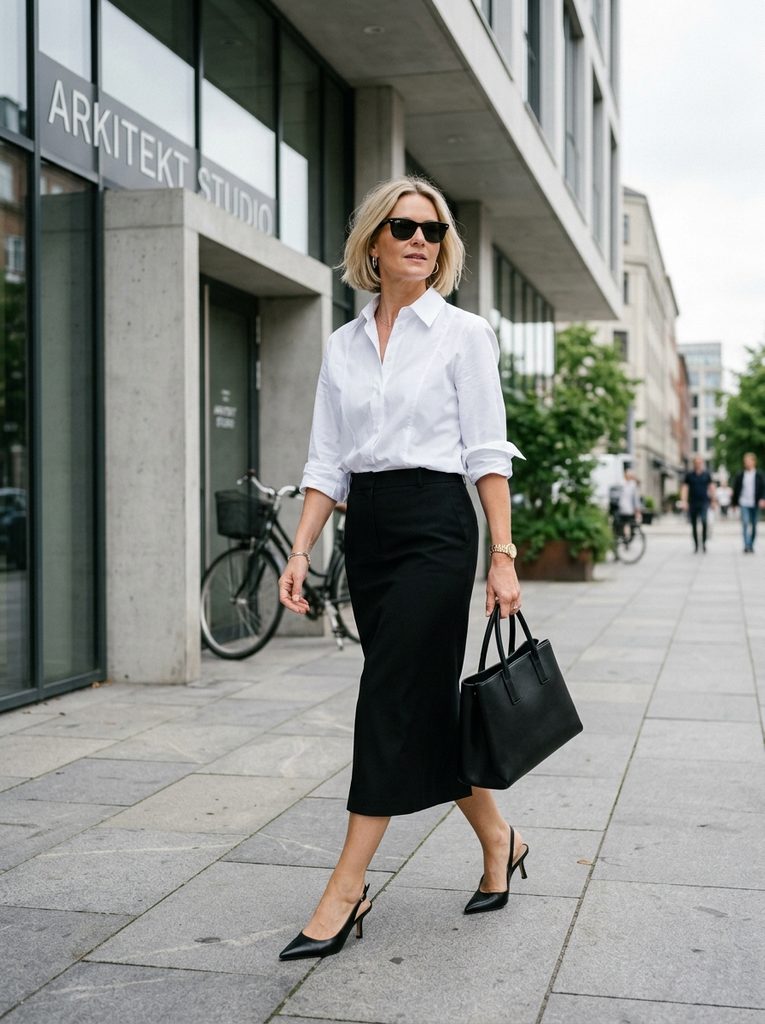
2. The big white poplin shirt, tucked into a column skirt
Crisp shirt, straight skirt, nothing else needed. The rolled cuffs are what keep it human.
The shirt is deliberately too big — long cuffs, a collar with some presence, dense cotton poplin that holds its shape. The skirt is the opposite: straight, narrow, mid-calf, in ponte or a light wool. That contrast is the entire outfit. Tuck the front in, leave the top two buttons open, and roll the cuffs back twice so your wrists show; that small flash of skin is what stops an oversized shirt from swallowing you. My rule for poplin: hold it to the light. If you can see your hand through it, it will crumple by lunchtime — good poplin is nearly opaque. And do the sit-down test in the skirt: if it pulls across the hips seated, it will annoy you in every meeting. In a very traditional office, swap the skirt for the trousers from idea one and nobody will blink.
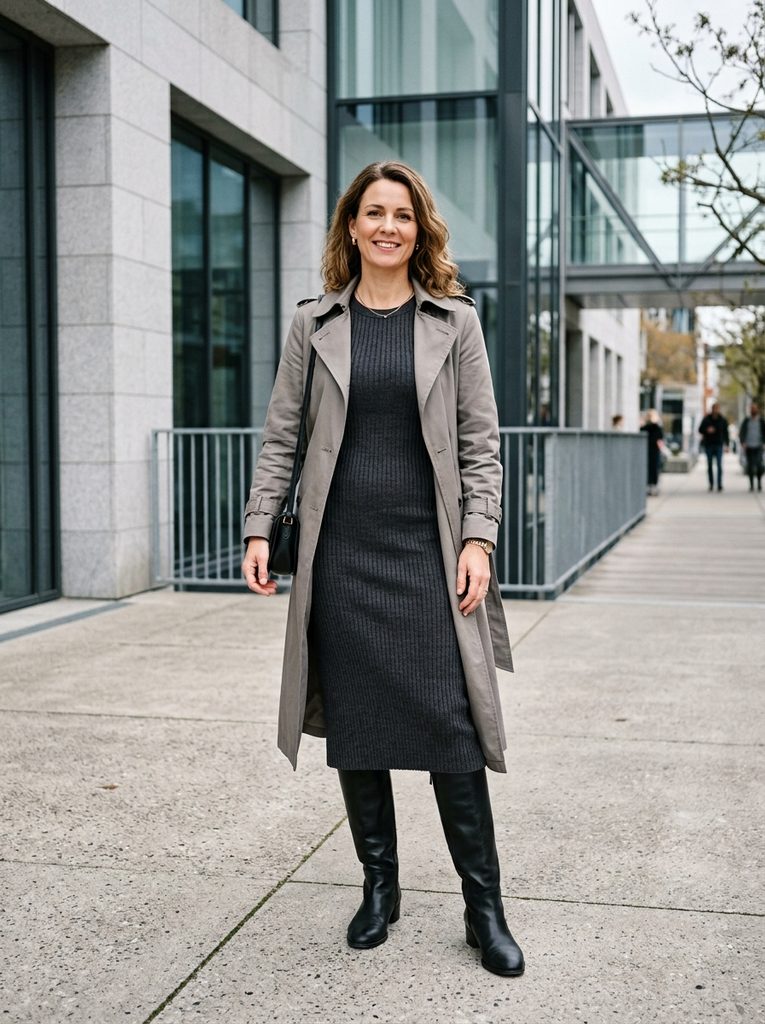
3. A ribbed knit dress under an open trench
One colour, top to toe. The trench frames the dress — belt knotted behind, never buckled in front.
A ribbed knit dress in merino, long sleeves, ending mid-calf, in the same colour family as your trench — camel on stone, slate on charcoal. Worn open, the coat frames the dress, and the unbroken column underneath is what makes it look calm. Knot the trench belt loosely behind your back so the sides pull in a little; buckled in front, it fights the dress. One honest warning from the mending pile: knit dresses with a lot of elastane feel wonderful in the shop and bag out at the seat and knees by spring. Look for wool-rich yarn and ribs that spring back when stretched. Boots should disappear under the hem, too — a gap of leg between boot and dress chops the line in half. This is the outfit I suggest when someone tells me their mornings are chaos. One dress, one coat, done.
4. A soft blazer over proper straight-leg jeans
The jeans have to earn their place — dark, rigid, no fading, no rips.
Dark jeans can go to work, but they have to be the serious kind: deep indigo or black, rigid, no fading, no distressing, hems neat. Over a plain fitted tee goes a single-breasted wool blazer with a slightly relaxed shoulder — the jacket does the authority, the denim keeps you human. Loafers or clean ankle boots; if the office is borderline, not trainers. The fit check that matters is the waistband test. If you can pull it two inches away from your body, the jeans will bag at the seat by noon. Rigid denim gives a little in the first week and then holds its shape for years, which is why I trust it over any comfort-stretch pair. My sister wears some version of this three days a week; her cost per wear on that blazer must be down to pennies by now. Skip it only where the dress code is genuinely formal — no blazer rescues denim in a courtroom.
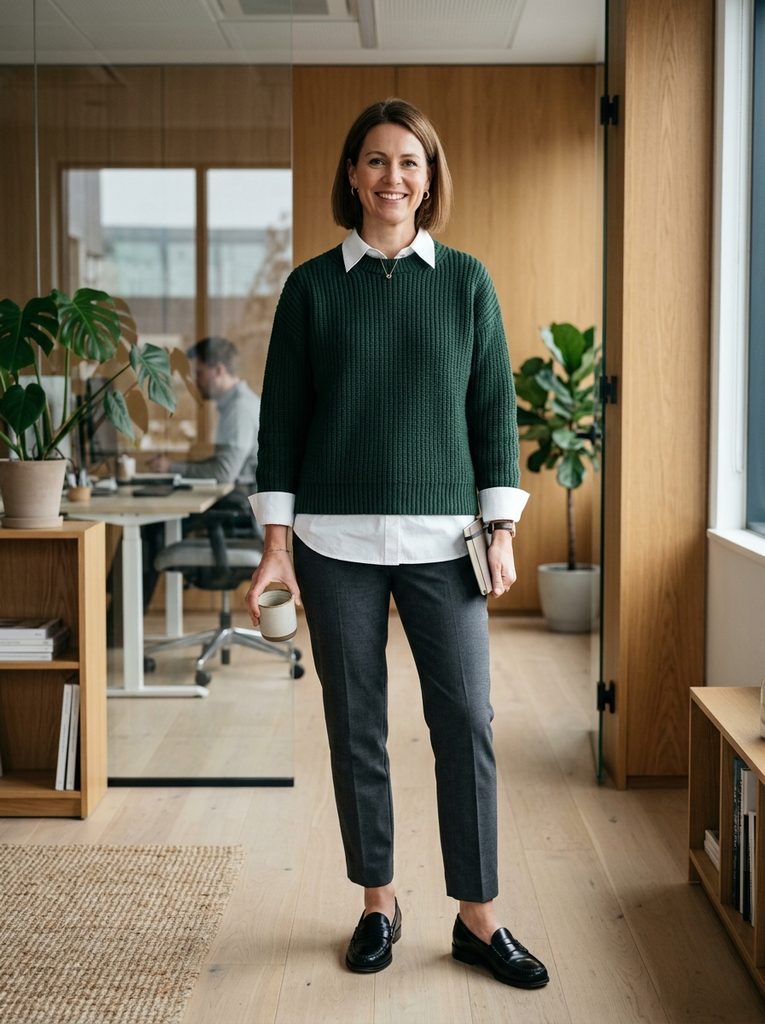
5. A white shirt peeking out under a boxy sweater
Collar, cuffs, hem — three little flashes of white doing all the work.
Take a plain white button-down, button it all the way up, then pull a heavy, boxy wool crewneck over it. Fish the collar out and lay it flat, pull the cuffs an inch or two past the sweater’s and fold them back once, and let the shirt’s hem show below the knit. Three white edges — collar, cuffs, hem — and a plain sweater suddenly looks considered. Underneath, keep the trousers slim: cigarette cut or cropped at the ankle, with loafers. The common failure here is a shirt that’s too big. An oversized shirt under a boxy sweater isn’t layering, it’s volume on volume, and it bunches at your elbows all day. The shirt should be the fitted one you already own. I spent years tucking the collar in, thinking it looked neater. It doesn’t — it looks unfinished, like you dressed in the dark. This is my pick for freezing offices and long winter commutes — warm, tidy, and easy to cool down when the heating wins.
6. A silk blouse with pleated culottes, all one colour
Warm-weather armour. Everything moves, nothing clings, and the colour never argues.
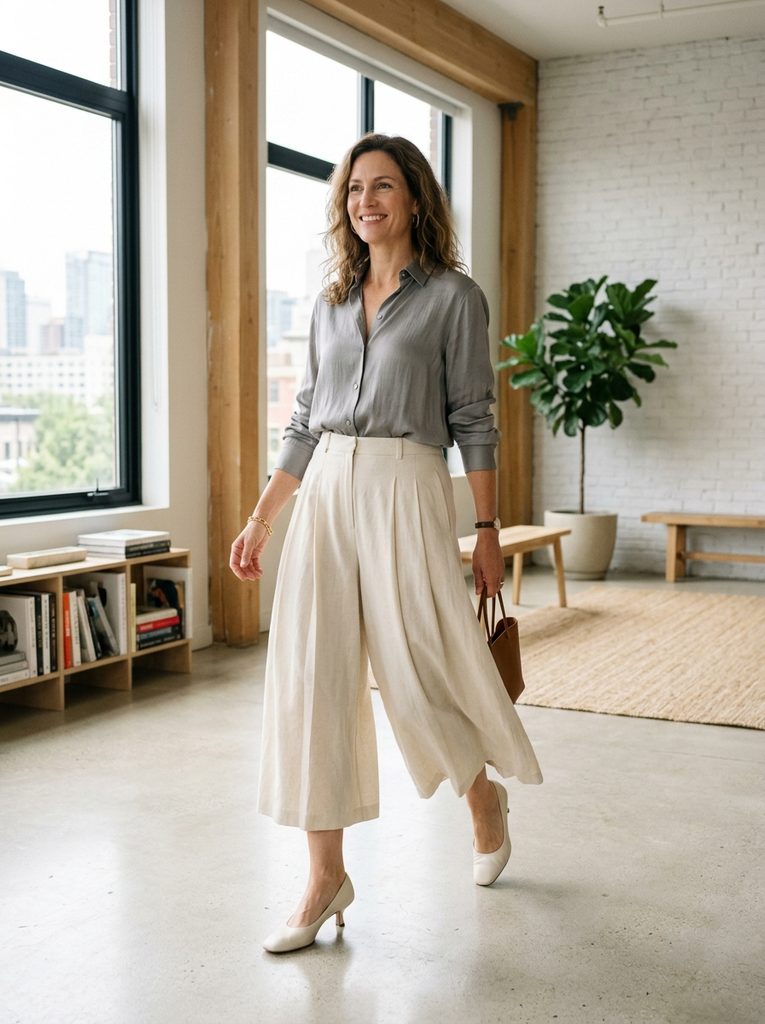
Warm offices are where most work wardrobes fall apart, and this is my answer: a fluid silk or cupro blouse, French-tucked into high-rise pleated culottes, everything in one soft colour family — dove grey, dusty slate, muted sage. The blouse moves, the culottes hold the structure, and the bare ankle between hem and slingback keeps the wide leg from looking heavy. The buying tip that matters: watch the pleats, not the waistband. Standing in the fitting room, they should fall straight and stay closed. If they pull open across your stomach, go up a size and have the waist taken in. It’s a ten-minute alteration, and the difference between tailored and borrowed. Be honest about silk, too: it spots in rain and asks for care. Washable silk and good cupro exist, and for a wet cycle commute I’d choose those every time.
7. The boiler suit, belted like it means it
One piece, no decisions. Just swap the fabric tie for a real leather belt.
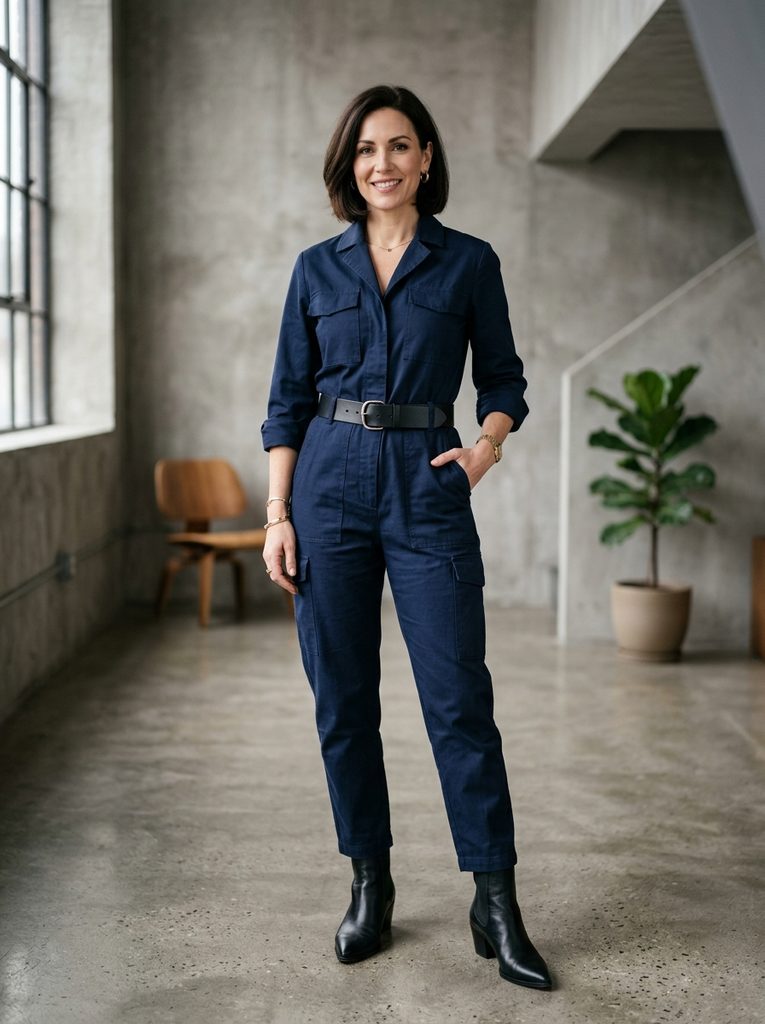
One garment, no matching, no decisions: a boiler suit in dense twill or tencel — olive, navy, black. The trick is the belt. Most come with a fabric tie that slides and sags — swap it for a firm leather belt at your natural waist, and the utility shape turns deliberate. Roll the legs twice, push the sleeves to the elbow, wear it with ankle boots or clean oxfords. Fit is everything, so do the test nobody does in the shop: sit down and reach forward as if typing. If it pulls hard across the shoulders or the back, it’s too short in the body. Size up and let the belt do more work. And buy the zip-front version if you can. Buttons look lovely; at four in the afternoon, after three coffees, you will have opinions about buttons. I’d keep this one for creative and casual offices — it has a point of view, and conservative clients may not share it.
8. A long tailored vest over a fine turtleneck
The vest does the tailoring; the turtleneck just keeps you warm.
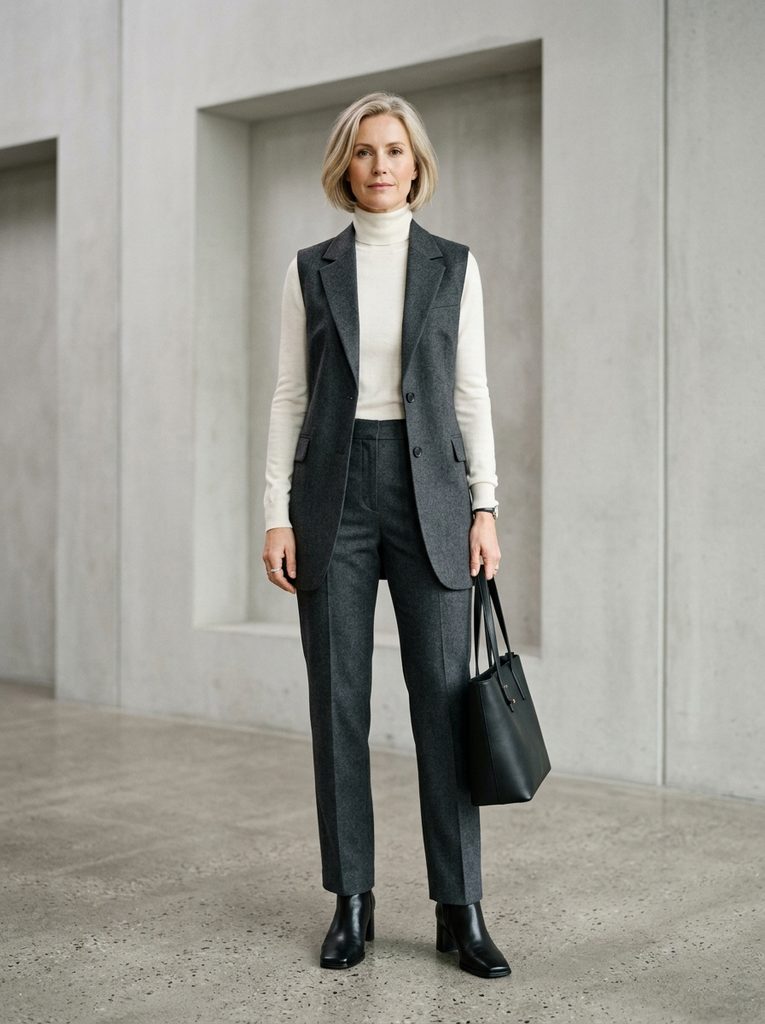
On days when the office can’t decide what season it is, this is my layer: a fine merino turtleneck with the neck folded in one even cuff, straight wool trousers, and a tailored sleeveless vest falling past mid-thigh. Leave the vest open and its front edges draw two long lines down your body; do up the middle buttons and it reads almost like a dress over trousers. Your arms stay free for typing and presenting — minor, until you’ve worked a whole day in a stiff jacket. Check the armholes before anything else. They should sit close under your arm. A gaping armhole makes even a good vest look borrowed, and a tailor can close it up for very little. Vests are the piece I’d buy secondhand, too: good tailoring survives its first owner, and cost per wear drops to nearly nothing.
9. The short suit: double-breasted blazer and long shorts
Copenhagen summer uniform. The shorts must reach the knee — that’s the whole deal.
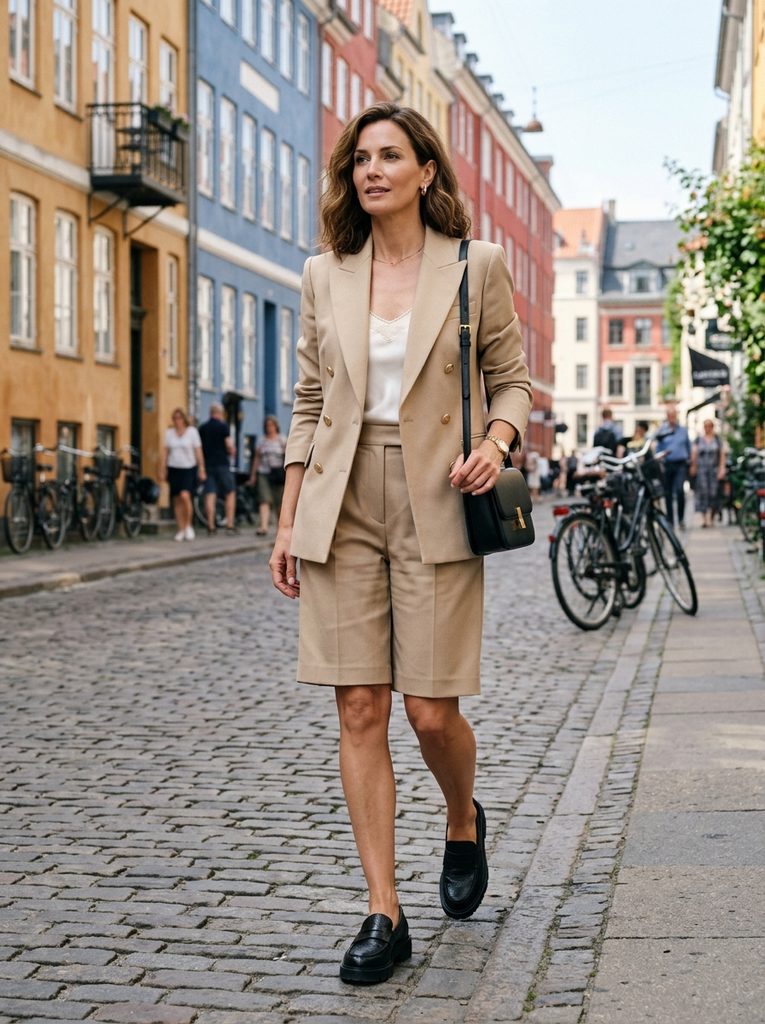
The brave one. A double-breasted blazer and matching pleated Bermuda shorts, cut from the same suiting fabric so the outfit reads as one decision, not two accidents. A silk camisole or fine ribbed tank underneath, the creases pressed sharp, loafers or low pointed mules. The jacket’s boxy shoulders earn the bare legs — that’s the bargain — and in Copenhagen this is simply summer office dressing. Everything depends on the hem: it should land right at the top of the kneecap. Shorter and you’re on holiday; longer and the proportions go muddy. Check it seated, too, because that’s how the meeting room sees you. Honest limits: I’d skip this entirely in an old-school corporate office, however well it’s cut. Know your room. And buy the pieces as a set: separates never quite match, and washing them apart drifts the colour.
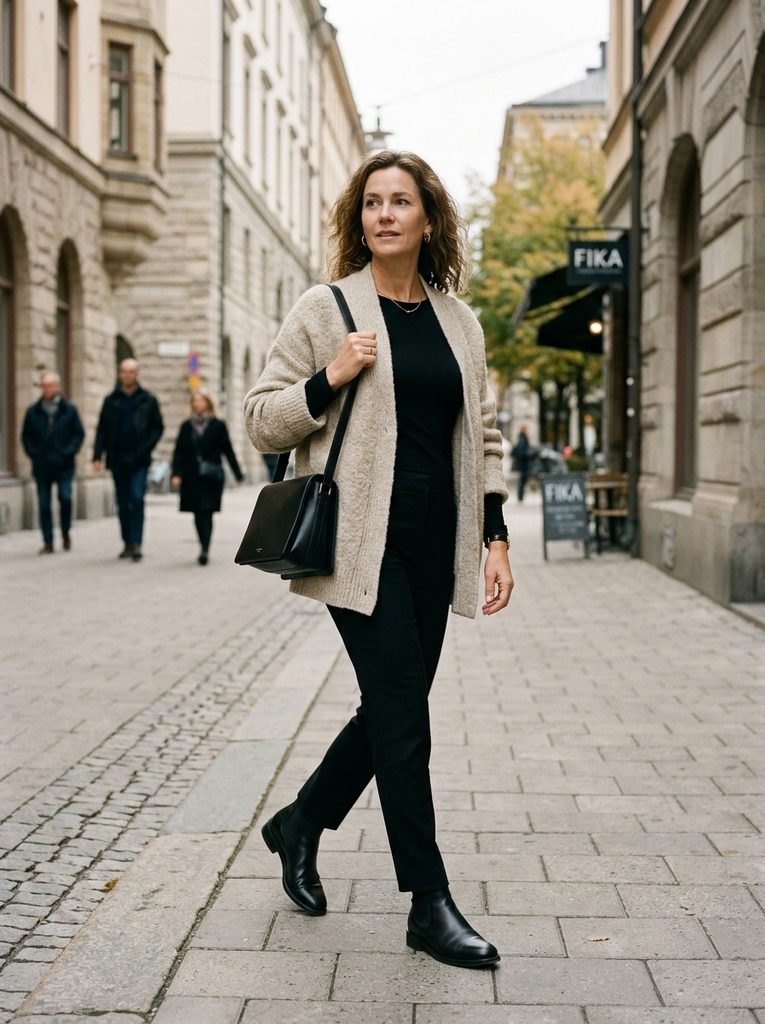
10. A big cardigan worn as a coat over black basics
Boiled wool, deep pockets, worn open. The comfort blanket that still gets you into meetings.
Build a plain black column first: a fine long-sleeve top, slim ponte trousers, Chelsea boots, nothing competing. Then the cardigan — heavy, structured, boiled wool or alpaca, drop shoulders, deep pockets, in oatmeal or moss or heather grey — worn open like a coat. The black column does the streamlining; the cardigan is the texture and the warmth. Weight is the whole test. Pick it up: if it feels like a dressing gown with buttons, it’s loungewear pretending. A proper one has heft, almost like a jacket. Never fasten it all the way up, either. Buttoned, it pulls and goes frumpy; open, it hangs in two clean vertical lines — a trick I learned from laying out pages, honestly. Everything is a column if you squint. Heavy knits pill where a bag strap rubs, so keep a fabric comb in your desk drawer. Teachers and consultants I know live in this all winter. I understand why.
If I were building this wardrobe from nothing
I’d buy in this order: the wide-leg wool trousers, one fine-gauge knit, the white poplin shirt. Those three make a week of outfits between them. The blazer comes next, then the trench. Everything else here is a variation, not a necessity, and can arrive slowly — secondhand, in the sales, one piece a season. Two things I’d skip without regret. Any synthetic that promises to look like wool: it won’t by November, and it holds every smell the office kitchen produces. And buying a whole look at once because a photograph convinced you. A new piece should work with at least three things you already own. If it can’t, it isn’t minimalism, it’s just shopping. Get the hems right, keep a fabric comb in your bag, and judge by cost per wear rather than the number on the tag.
Questions I get asked
Can I wear trainers with any of these?
With the trousers and the jeans, yes — plain leather ones, clean, no logos doing gymnastics. With the column skirt or the short suit, no: those outfits make a tailored argument that trainers undercut. When in doubt, loafers land in the middle of almost everything here.
I don’t like anything sleeveless. Is the vest idea lost on me?
Not at all. Wear it over the fine turtleneck as shown, or over a long-sleeved silk blouse. The exposed-arms part was never the point — the long line down your front is what does the work.
How many colours should the whole wardrobe be?
Four or five neutrals that all tolerate each other — charcoal, black, cream, navy and camel cover most people. Add one softer colour at a time, in a knit or a blouse, and live with it a full season before adding another. Restraint is what makes the mixing easy.
Is cashmere honestly worth the money?
One fine-gauge piece, yes — especially secondhand or on sale, where it often costs less than a new mid-range sweater and outlasts three. But don’t let anyone shame you out of good merino. It washes more easily, pills less, and nobody at work can tell the difference from a metre away.
I’m petite. Do all these long lines still work?
Yes, if the proportions shrink with you: a narrower trouser leg, the vest ending nearer the hip, hems set exactly to your shoes. Length has never been the problem — unadjusted length is. Budget for the tailor the way you’d budget for the garment itself, and the long lines will do the same work.
That’s the list as I use it. If you try one, start with the trousers and the knit — and save this to your workwear board so the fitting-room checks are in your pocket when you need them. — Elias