10 Scandinavian casual outfit ideas with a monochrome look
Last Tuesday I stood in front of my wardrobe at half past seven, coffee going cold, and realised I had been “getting dressed” for twenty minutes without actually…
Last Tuesday I stood in front of my wardrobe at half past seven, coffee going cold, and realised I had been “getting dressed” for twenty minutes without actually choosing anything. So I did what I do now on mornings like that: I picked one colour — charcoal — and only looked at pieces in that family. Jacket, knit, jeans, boots. Six minutes later I was out the door, and my neighbour asked if I had somewhere important to be. I did not. I was walking to the bakery.
That is the whole trick behind monochrome dressing, and it is the reason my rail is mostly black, grey, cream and stone. When everything shares one tone, the interest has to come from texture and shape instead, and that is where Scandinavian dressing quietly shines. Below are the ten single-colour formulas I actually rotate, with the mistakes I made learning them left in.
1. Idea 1: Architectural Charcoal Boiled Wool and Denim
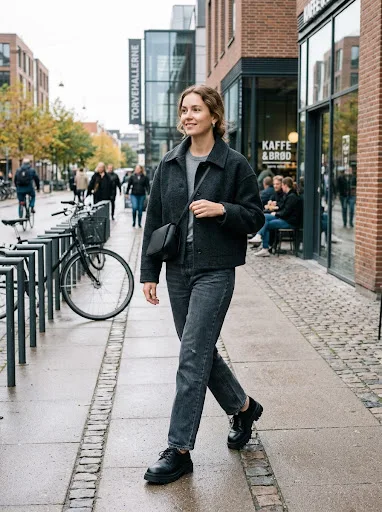
My charcoal boiled wool jacket — the piece strangers ask about most at the market.
This is my default city outfit from October onwards: a boxy boiled wool jacket over a fine heather grey crewneck, tucked into relaxed straight-leg jeans in a washed charcoal denim. Charcoal is kinder than jet black near my face, and the felted wool reads matte against the denim’s twill, so the two greys never blur into one lump. My practical test before buying any boiled wool jacket: brush it hard with a clothes brush in the shop. Good boiled wool sheds almost nothing; cheap felt pills under your palm. I cuff the jeans once, about two centimetres, so the hem breaks cleanly over chunky derby shoes. Honest note: my first version used black jeans instead of charcoal, and the contrast killed the softness. Keep every piece inside the same grey register and the construction does the talking.
2. Idea 2: Ivory Ribbed Cashmere and Wide Poplin Trousers
The ivory cashmere I save for bright mornings — coffee stays in the kitchen until it is on.
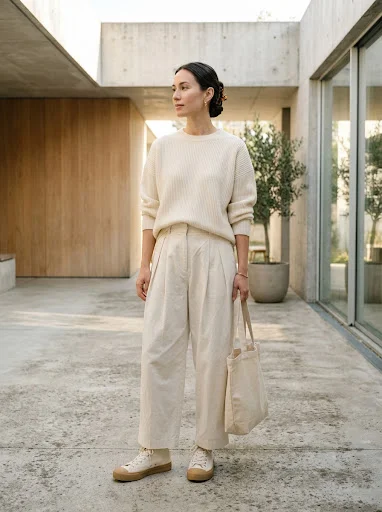
All-white dressing scared me for years because it felt clinical, but warm ivory is a different thing entirely. I wear an oversized ribbed cashmere sweater in a buttery ivory, French-tucked — just three inches of front hem folded into the waistband — over wide-leg poplin trousers in a matching warm ecru. The ribbing gives the top its texture; the poplin falls smooth and crisp below, and that contrast is what stops the outfit looking like pyjamas. I press the trouser pleats the night before, because poplin forgives nothing. Cream canvas high-tops or ecru loafers, depending on the weather. The honest cost: cashmere is the one fabric I buy new and full price, because second-hand cashmere is usually already thin at the elbows. Skip this outfit entirely on days involving red wine, toddlers, or public transport in the rain.
3. Idea 3: Triple Black Tailored Trench and Knit Layering
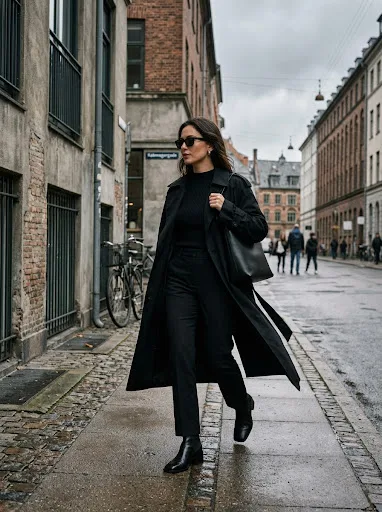
Triple black on a grey evening — the trench belt knotted behind, never buckled in front.
Head-to-toe black only works if the blacks are different from each other. Mine are: a matte cotton gabardine trench, a ribbed knit mock-neck with a slight sheen, and wool trousers that hold a hard crease. Three finishes, one colour, and suddenly the outfit has depth instead of looking like a uniform. I tie the trench belt in a loose knot behind my back rather than buckling it, which keeps the front clean and lets the coat swing when I walk. The mock-neck matters too — it frames my jaw without the bulk of a rolled turtleneck under a coat collar. Square-toe Chelsea boots finish it. My early mistake was adding a black leather bag with shiny silver hardware; the metal glared against all that matte fabric. Covered buckles and tonal leather only, or the spell breaks.
4. Idea 4: Heather Slate Oversized Blazer and French Terry
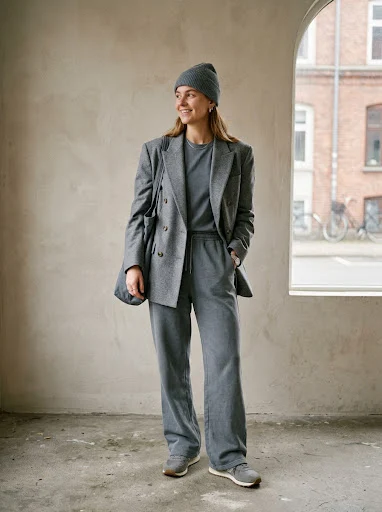
Blazer over sweatpants sounds wrong until the colours match exactly — then it just works.
This is the outfit that gets the most disbelief, and it is the one I wear most: an oversized slate wool blazer over a plain grey tee and heavy French terry sweatpants, everything in the same heathered grey. The flecked yarn is doing quiet work here — it softens the blazer’s tailoring and makes the sweatpants look intentional rather than borrowed from the sofa. Two rules make or break it. First, the sweatpants must have open hems, never gathered ankle cuffs, so they drape over your shoes like trousers. Second, keep the blazer unbuttoned; buttoned, the formality wins and the outfit looks confused. I add grey suede runners and a ribbed beanie worn high. Time note: this takes me four minutes to put on and has carried me through client calls, school runs and one very casual gallery opening.
5. Idea 5: Monolithic Sandstone Quilted Vest and Corduroy
Sandstone head to toe for market mornings — warm core, free arms, pockets full of lists.
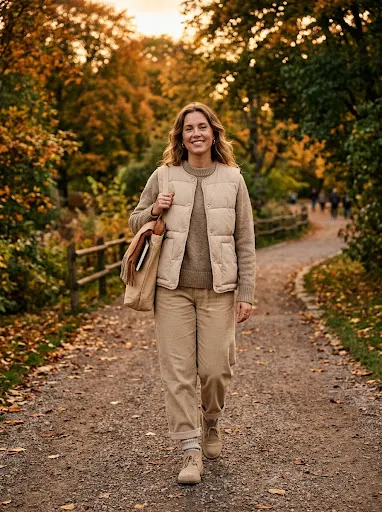
Sandstone is the warmest neutral I own, sitting between cream and beige, and it is my weekend uniform from September to November. A fine-knit sandstone crewneck goes untucked over high-waisted, wide-wale corduroy trousers in the same tone, with a matte quilted vest on top. The corduroy’s ridges catch the light so the single colour never looks flat, and the vest keeps my core warm while my arms stay free for carrying market bags. One check I always do in the shop: hold the vest against the trousers in daylight. Sandstone shades drift warm or cool, and a mismatch shows immediately. Suede desert boots and ribbed oatmeal socks finish it. Who should skip it: anyone who overheats easily — a down vest over wool is warmer than it looks, and I have peeled mine off in more than one café.
6. Idea 6: Ecru Denim Utility Jacket and Relaxed Chinos
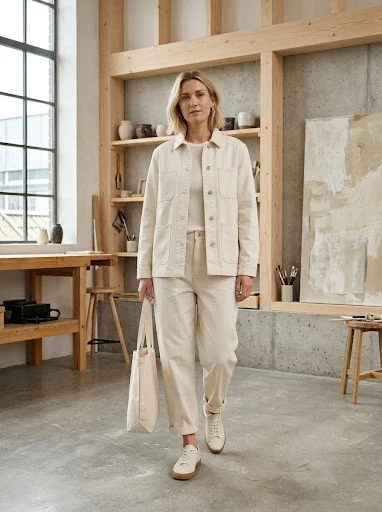
My ecru chore jacket — unbleached denim still flecked, exactly the way I like it.
Ecru is unbleached cotton, still flecked with tiny dark specks from the cotton seed, and I love that it looks honest rather than pristine. I wear an ecru denim chore jacket over an ecru waffle-knit thermal — the grid texture stops the two ecru pieces merging — with relaxed ecru chinos that taper slightly at the hem. I fasten only the middle two buttons of the jacket and cuff the sleeves once, which keeps it from looking like a uniform someone issued me. Cream leather sneakers or canvas deck shoes below. Practical warning: ecru shows every mark, so this is not a gardening or small-children outfit; mine has a coffee stain story I will not repeat. But for bright spring mornings and outdoor lunches, nothing in my wardrobe feels cleaner. The whole set cost less than one designer coat, bought piece by piece over a spring.
7. Idea 7: Ink Navy Boiled Wool Overcoat and Fluid Trousers
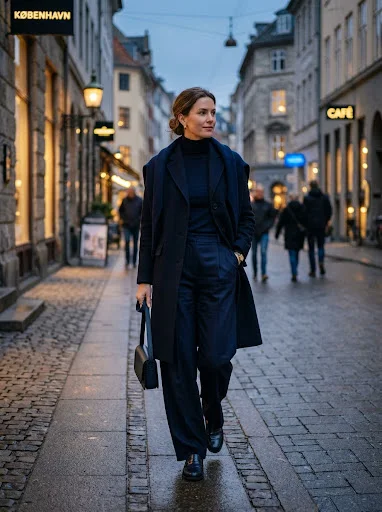
Ink navy instead of black for evening — softer in low light, just as serious.
Very dark navy is my evening substitute for black: same weight, but kinder in low light and far less likely to look like a uniform. I tuck a fine-gauge ink navy merino turtleneck into wide, fluid navy trousers, add a slim navy belt with a brushed gunmetal buckle, and put a knee-length boiled wool coat over the top. The dense coat stays still while the trousers move, and that contrast in motion is the whole elegance of it. One discipline matters: every piece must share the same cool, blue undertone. I once added a scarf that leaned purple and the outfit quietly fell apart — nobody could say why, but everyone could see it. Navy loafers or slim leather boots finish it. This is my upscale-casual dinner outfit, and it has never once felt overdressed or underdressed.
8. Idea 8: Soft Taupe Bouclé Cardigan and Pleated Culottes
The bouclé cardigan I reach for on studio days — texture doing all the work.
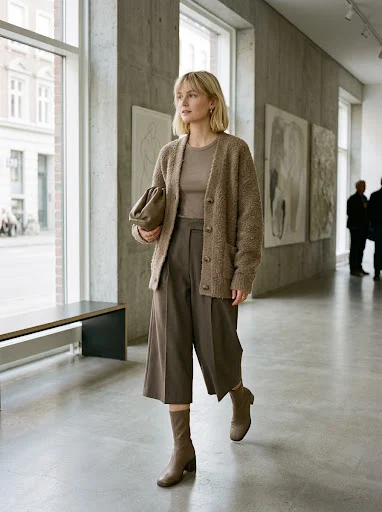
Taupe shifts between grey and brown depending on the light, which makes it the most forgiving monochrome to wear and the hardest to buy. My rule: shop for the pieces together, in daylight, or not at all. I wear high-rise pleated culottes in muted taupe with a smooth modal tank tucked in, then an oversized bouclé cardigan over the top, fastening only the two lower buttons so the neckline opens into a soft V. The tank’s smoothness is essential — bouclé against bouclé would be texture overload. The cardigan’s looped surface does all the visual work while the culottes keep the tailored geometry. Taupe sock boots slide up under the wide hems; flat mules work indoors. Honest note: bouclé snags on jewellery and bag hardware, so I keep both minimal with this one. It is my museum-and-studio outfit, comfortable enough for a full day on my feet.
9. Idea 9: Cloud Grey Poplin Shirt and Tailored Sweatshorts
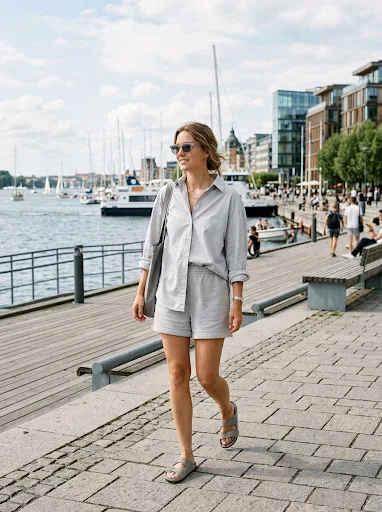
Cloud grey for heatwave days — smart from the waist up, honest about the weather below.
This is my warm-weather answer to the blazer-and-sweatpants idea: a crisp, oversized cloud grey poplin shirt with tailored sweatshorts in exactly the same pale grey. The shirt is proper — pointed collar, real buttons, sleeves rolled twice to the forearm — and the shorts are heavyweight loopback cotton cut two inches above the knee, tailored rather than gym-shaped. I tuck one front corner of the shirt into the drawstring waist and leave the rest loose; fully tucked looks strained, fully out looks like I gave up. The shade match has to be exact here, closer than with any other outfit in this list, because pale grey shows drift mercilessly. Grey suede slides or canvas tennis shoes, no-show socks. It is my video-call outfit all summer: professional from the waist up, honest about the heat below. Ten minutes with the iron is non-negotiable.
10. Idea 10: Storm Grey Maxi Slip Dress and Chunky Knit
The slip dress I refuse to save for evenings — a chunky knit makes it a Tuesday outfit.
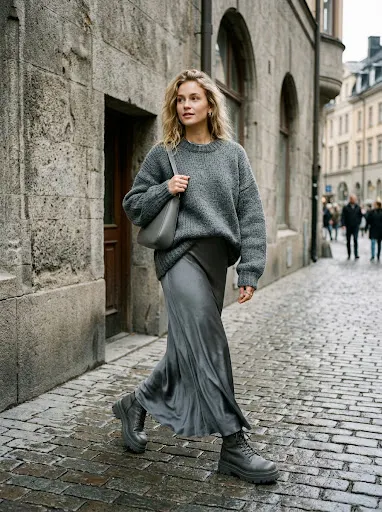
A bias-cut satin slip dress is too good to save for dinners, so I wear mine in daylight under an oversized storm grey wool-and-alpaca crewneck. The trick that makes it work is a thin belt worn over the sweater at my natural waist, with the sweater’s hem tucked up into it — it fakes a cropped knit and gives the dress a waist without stuffing thick wool into a delicate dress. Storm grey has blue in it, which gives the satin its depth as it moves. Heavy lug-sole boots ground the whole thing; delicate shoes would tip it back into evening wear. The honest downside: satin shows every crease from sitting, so I give it a quick steam in the morning and accept some rumpling by lunch. Come evening, the sweater comes off and the same dress goes out to dinner. Two outfits, one rail space.
What I’d buy first — and what can wait
If you are starting from a mixed wardrobe, spend first on one excellent wool coat in charcoal or ink navy and one dense knit sweater you love — those two anchor half the outfits above. Everything else can arrive slowly and second-hand: trenches, blazers and boiled wool jackets turn up in vintage shops constantly, because people buy them for a look they never commit to. Sweatpants, tees and thermals should be bought for fabric weight, not brand. What can wait: the cashmere, the bouclé cardigan and any second coat. And before buying anything new, do the inventory first — most people already own three or four pieces in one colour family without realising it, and that is a monochrome wardrobe already started.
Questions I get asked
Doesn’t one colour head to toe look flat?
Only when the fabrics are all the same finish. I follow a three-texture rule: something matte, something structured like twill or poplin, and something tactile like bouclé, corduroy or ribbed knit. Three textures in one tone read as depth, not flatness.
How do I stop shades in the same colour clashing?
Check undertones in daylight before you buy. Cool greys have blue in them; warm taupes and sandstones lean yellow-brown. Pieces in one outfit all need the same temperature. Shop lighting lies, so I hold things up at the window or step outside the shop door.
What shoes work with heavy monochrome outfits?
Match the shoe’s visual weight to the heaviest garment. Lug soles and Chelsea boots under wool coats; canvas sneakers under ecru and cloud grey. Thin, delicate shoes under a heavy coat make the whole outfit look unstable.
How do I keep dark outfits looking clean?
A lint roller lives in my bag from October to April, and dark knitwear gets a fabric shaver whenever it pills. Coats go on wide wooden hangers, knits get folded, and I sort the rail by shade — ivory to grey to black — so choosing takes minutes.
Can monochrome work if pale colours wash me out?
Yes — frame your face with the piece closest to your skin. A deeper collar, a mock-neck, or the darker end of your colour family worn on top changes everything. I keep ink navy and charcoal near my face and save the palest ivories for days when I am rested.
One colour, chosen on purpose, has saved me more mornings than any new purchase ever did. If dressing in a single tone makes your week easier, save these formulas to your monochrome board on Pinterest for the next slow morning. — Elias