My wardrobe has a quiet centre of gravity, and it is a rail of jeans. I realised it last spring, standing in a flea market outside Copenhagen with two pairs of vintage Levi’s over my arm, doing the maths: I already owned six pairs, and I still wanted these. That is not greed, exactly. Jeans are the piece I live in — market mornings, studio days, the train to visit my sister — and everything else I own was chosen, over years, to work with them.
These are the ten combinations I rotate, from a blazer over straight-leg denim to the shearling coat that comes out when winter means it. My rules are few and firm: rigid denim that holds its shape, a quiet palette of mid-blue, ecru, ink and washed black, and one structured piece in every outfit so the casual half looks chosen. Each one below carries the mistake I made with it first, because that is where the useful part is.
1. Oversized Wool Blazer with Mid-Blue Straight Jeans
The men’s-rail blazer that does more work than anything else I own.
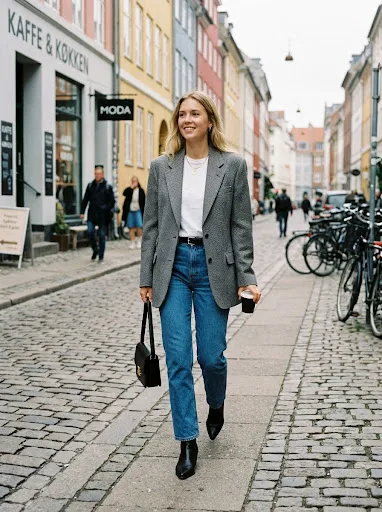
This is my weekday uniform. The blazer came from the men’s rail of a second-hand shop — boxy, double-breasted, a textured grey wool — and it goes over a plain white crewneck tee tucked into high-rise, rigid mid-blue jeans. A slim black belt with a plain buckle marks the waist, and black leather loafers slide under the straight hems. The fit test that matters: the blazer’s shoulder seam should sit a couple of centimetres past your own shoulder, and you should be able to sit down and reach a high shelf without the front pulling. My first attempt failed on a too-neat blazer that fit like a uniform; the borrowed shape is the whole point. The blazer cost me less than the jeans, and shortening its sleeves was the best tailoring money I have spent.
2. Chunky Cream Fisherman Knit and Vintage Washed Denim
Six winters in, and this is still the knit I reach for on cold bright mornings.
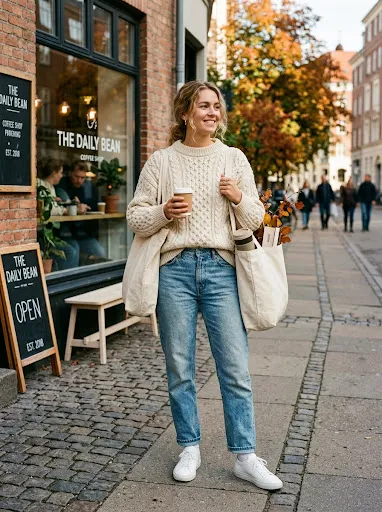
The fisherman knit is the heaviest sweater I own — unbleached wool, deep cables, a collar that stands up on its own — worn with relaxed vintage-washed jeans in a pale, honest fade. The styling move is the half-tuck, and there is a technique to it: pinch two inches of the centre hem, fold it upward, and tuck just that folded edge into the waistband. The sides drape, the front sits clean, and the knit keeps its slouch. Fully tucked, I look stuffed; untucked, I look like laundry. White leather sneakers or suede desert boots keep the palette soft, and I carry a heavy canvas tote. Cost note: the jeans were a flea-market find, worn in by somebody else. The sweater was bought new and has earned it back over six winters.
3. The Structured Trench Coat over Wide-Leg Denim
Belt knotted behind, column showing — my rainy-day architecture.
A long trench changes the way wide-leg jeans behave. Mine is stone-coloured gabardine, double-breasted, falling to mid-calf, worn open over a fine black merino turtleneck tucked into high-waisted wide-leg denim. I knot the coat’s belt loosely behind my back so the front hangs clean and the column shows as I walk. Two practical rules. First, the coat has to reach at least mid-calf — a shorter trench over wide trousers chops you into awkward sections. Second, the shoes need chunk: I wear black derby shoes with thick soles, because a wide hem over a delicate shoe drags, and a dragged hem in November rain comes home soaked and frayed in a month. I learned that with my first wide-leg pair, re-hemmed by Christmas. The crossbody bag sits high on my chest, hands free.
4. Crisp Poplin Button-Down with Raw Selvedge Denim
The cuff is deliberate: two inches, selvedge edge out, every time.
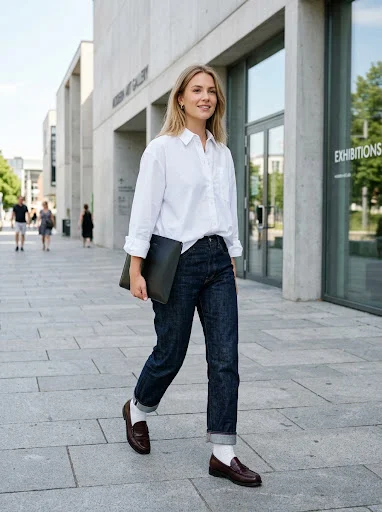
Raw selvedge denim is the smartest jeans fabric I own: dark, unwashed indigo with no fading done for you, stiff enough to hold a line. I pair mine with an oversized white poplin shirt, top buttons open, sleeves rolled twice, and one side of the front tucked in — the asymmetry stops the dark trousers feeling like a uniform. The jeans get a single two-inch cuff so the selvedge edge shows above burgundy penny loafers and white socks. The warning I wish someone had given me: raw denim shrinks, mostly in length, at the first wash. Buy them long, wear them for months first, and when you do wash, make it cold and inside out. My first pair came out of an impatient hot wash two inches shorter and became permanent cuff jeans. Still good. They were meant to be better.
5. Tonal All-Black Monochrome Denim Ensemble
Faded black jeans in the middle of the blacks — that washed tone is the trick.
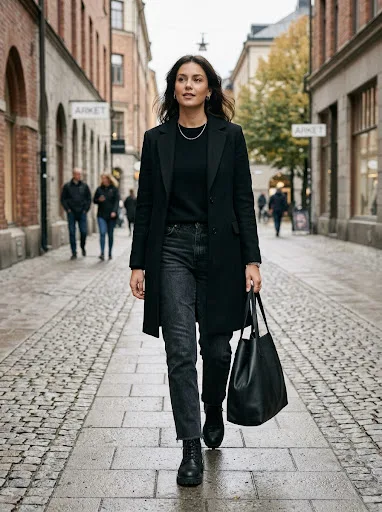
All black works because of texture, not colour. My base is a pair of faded black straight jeans — that washed, charcoal-leaning tone stops the outfit going flat. Over a black cotton tee goes a fine black cashmere crewneck, then a short black wool car coat, with a pebbled belt and matte hardware, so nothing shiny breaks the run. Black combat boots slide under the hems. The check that saves it: hold every piece together at a window before you commit. Blacks have undertones, and I once built the whole look around a knit that turned out, in daylight, to be very dark navy. Nobody died, but I could see it all evening. Keep the textures varied — matte denim, soft knit, smooth leather — and one tone reads as three. This is my gallery-evening formula.
6. The Cropped Bouclé Jacket with High-Rise Flare Jeans
The cream bouclé that snags on everything and is worth it anyway.
The bouclé jacket is cropped and boxy, collarless, with a knobbly looped texture that does all the decorative work here. Because it ends exactly at the waistband, it belongs over high-rise jeans — mine are a deep mid-blue with a gentle flare below the knee — with a camisole underneath and the jacket left half open. The flare balances the boxy shoulders, and the high waist does the lengthening. Two things I check before wearing it. The jeans hem must sit about half an inch above the floor in the actual shoes — I wear block-heel ankle boots — because a flare that pools will fray and trip you. And bouclé snags: on rings, on bag hardware, on rough door handles. My cream jacket has one pulled loop I now call character. Skip this outfit for cycling or dog walks; it is a lunch-and-gallery piece.
7. Quilted Liner Jacket and Relaxed Tapered Denim
Surplus-shop liner, mustard cap — my weekend uniform since the first frost.
The quilted liner was made to hide inside a soldier’s coat, and wearing it as the coat is the whole trick. Mine is collarless, snap-fronted, army green, bought cheap at a surplus shop, layered over a heavy grey sweatshirt. Underneath, relaxed tapered jeans — room through the thigh, narrowing to the ankle — with a small hem roll so the retro suede runners show. The one loud note is my mustard watch cap; everything else stays slate, grey and mid-wash blue. Practical honesty: quilting stops wind, not weather. This is a dry, cold-day outfit, and on wet days I reach for the trench instead. The tapered cut matters more than it looks — wide jeans under a straight utility jacket turn into one long rectangle. Who should skip it: anyone who needs polish. This is my weekend uniform, and it has never pretended otherwise.
8. The Striped Breton Long-Sleeve and Ecru Denim
Stripes, ecru and a cognac belt: the café-morning combination I never rotate out.
The Breton is the one pattern I fully trust. Mine is heavyweight cotton jersey, navy stripes on a cream ground, with a boat neck, and I wear it tucked completely into high-rise ecru jeans. Ecru denim is unbleached — warm-toned, flecked, softer than stark white — and a cognac leather belt with a brass buckle makes the clean break at the waist. The weight of the jersey is the buying test: thin Bretons twist at the side seams and the stripes go crooked by lunchtime. On cooler days I knot a navy cardigan over my shoulders, the way my mother always did, and carry a canvas tote. One honest limit: ecru shows every mark, so this is not the outfit for gardening, grandchildren with jam hands, or a bicycle with a chain guard missing. For café mornings and seaside walks, nothing I own feels fresher.
9. Oversized Cardigan as a Top with Distressed Vintage Denim
The cardigan does the top’s job now; the jeans just have to be honest.
A heavy cardigan worn as a top is the cosiest formula I know. Mine is a deep V-neck in a soft taupe alpaca blend with big tortoiseshell buttons, and I fasten all but the top one, over a seamless camisole — do the sit-down test in the mirror, because a buttoned knit that gaps when you sit will gap all day. The front centre gets a small partial tuck into vintage light-wash jeans, straight-legged, with real knee fraying earned by wear, not applied in a factory. That distinction matters to me: bought distressing always looks like a costume, while honest fading looks like a life. Leather mules or ballet flats in espresso balance the slouch. Cost note: the jeans cost twelve euros at a flea market, the cardigan was the investment, and the ratio feels right. Delicate days only — alpaca and rain are not friends.
10. Tailored Shearling Coat with Clean Dark Denim
Minus six, market day, shoulders aching by four — worth every step.
This is the winter heavy artillery: a knee-length shearling coat, suede outside, plush fleece at the collar and cuffs, over a fine cream cashmere turtleneck and clean dark indigo jeans pressed with a soft centre crease. The rule underneath a coat this warm is thin layers only — a chunky knit under shearling makes the sleeves impossible and the whole thing feel like upholstery. The dark jeans keep one unbroken vertical line so the big coat reads as a frame. My boots are Goodyear-welted leather with rubber soles, because shearling weather is icy-pavement weather, and fleece-lined gloves live in the coat pockets. Honest notes: the coat was second-hand and still the most I have paid for one garment, and it is heavy — by the end of a long market day my shoulders know it. For anything under minus five, nothing else I own comes close.
What I’d buy first — and what can wait
If you are building a jeans wardrobe from scratch, buy the denim first and buy it properly: one rigid straight-leg pair in mid-blue and one in dark indigo will carry most of this list, and vintage pairs from second-hand shops are often better made than new ones at triple the price. After the jeans, one good wool blazer — the men’s rail is full of them, barely worn. What can wait: the shearling, the bouclé, a second trench. And the cheapest habit on this page: fifteen minutes on a Sunday evening, check the week, and hang three complete outfits together. Weekday mornings have run on rails ever since I started doing that.
Questions I get asked
Why do my jeans outfits always look a bit thrown together?
Nine times out of ten, it is the denim itself. Very stretchy, thin jeans cling and bag at the knees, and cannot hold their own against a heavy knit or a structured blazer, so the whole outfit sags. Choose rigid cotton or low-stretch denim with at most one percent elastane, and skip heavy factory distressing — clean washes and honest fades are the base everything else stands on.
How often should I wash rigid jeans, and how?
As rarely as you can manage. Spot-clean marks, air them overnight, and wash perhaps every couple of months of wear. When you do: inside out, cold water, gentle cycle, then hang them to dry away from direct heat. That routine keeps the indigo rich and stops the shrinkage that ruins the length you chose so carefully.
How do I get the hem length right with different shoes?
The hem should break cleanly over the shoe, never pool on the ground. For flat loafers I have straight jeans tailored to skim the top of the shoe; for boots, a single neat cuff does the adjusting. Delicate, flimsy shoes under wide or heavy denim are the classic mistake — the hem drags, frays, and takes the outfit down with it.
How do you store all of this without wrecking it?
My denim lives on one rail, sorted by wash from pale vintage blue to raw indigo to washed black, jeans folded in thirds so I can see the tones. Knitwear is always folded flat, never hung — hangers stretch shoulders within a season. Blazers and the trench go on wide wooden hangers, belts are rolled in a drawer divider, and boots get cedar shoe trees and conditioning cream before the wet season.
Can I add any colour, or is it neutrals forever?
One accent is plenty, and it works harder for being alone: my mustard watch cap, a cobalt scarf, a cherry-red bag against the black outfit. When you want a bigger experiment, try denim on denim — a raw denim jacket over matching dark jeans with a cream turtleneck underneath. Just change one thing at a time and live with it for a day before judging.
That is my jeans rail, honestly worn and honestly priced. If one of these earns a place in your week, save it to your denim board on Pinterest for the next morning when the wardrobe feels empty and is not. — Elias