A few years ago I stood in a fitting room in Copenhagen, in the third oversized jumper of the afternoon, and caught sight of myself looking like a well-upholstered armchair. The assistant — a woman of about sixty, with the confidence of someone who has dressed every shape there is — didn’t offer another jumper. She fetched a belt. “Your waist is the best thing in this room,” she said, “and you keep hiding it under sacks.” I have thought about that roughly once a week ever since.
It changed how I read Scandinavian dressing, which I had been copying from pictures of tall, straight-up-and-down women. The real principles travel fine to a curvier body: calm colours, honest fabrics, one clear line. For an hourglass figure after forty, that line is the waist — not squeezed, just acknowledged. Below are ten outfits built on that idea, with the checks I do in the fitting room and the mistakes I have already made on your behalf.
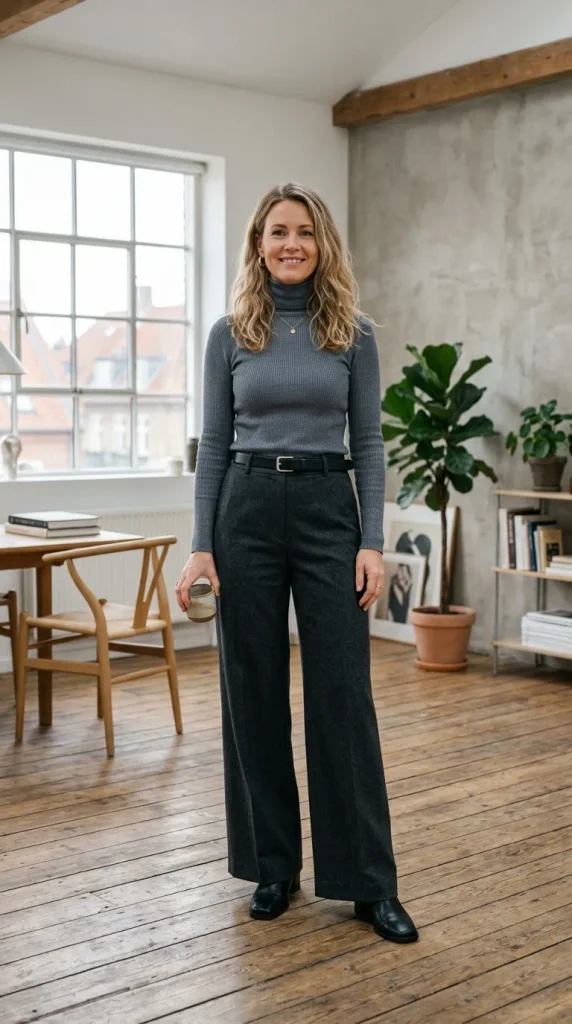
1. Wide-leg trousers with a ribbed turtleneck
The trousers I live in from October on. That waistband has never once picked a fight with me.
The outfit I reach for most once the weather turns. High-rise wide-leg trousers in a heavy wool crepe or a good viscose twill, with front pleats that open downwards so the fabric falls away from the hip instead of ballooning across it. On top, a fine-gauge ribbed turtleneck, tucked in properly, all the way round — a half-tuck undoes the point here, which is one clean line from shoulder to waist and then all that lovely drape below. Two checks before you pay. Sit down in the trousers: the waistband should stay put at your back, no gaping. And hold the knit up to the shop light; fine-gauge rib should lie flat and not fight the waistband. My own mistake was a pair hemmed for heels that I kept wearing with flats — a whole winter of damp hems trailing on wet pavements. Hem them for the shoes you actually live in.
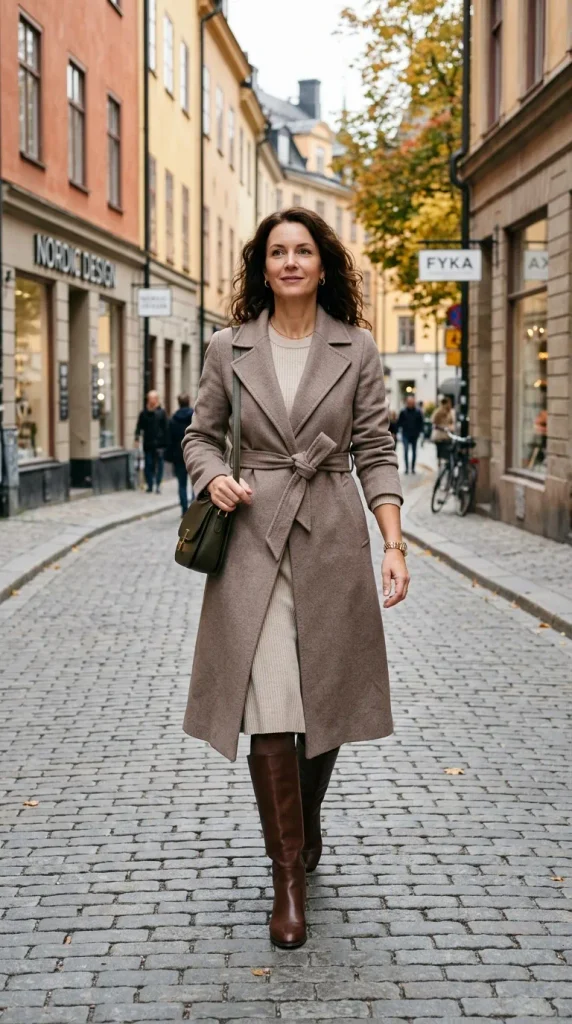
2. A wool wrap coat over an A-line knit dress
Belted, always. Left hanging open, this coat turns me into a very warm tent.
An A-line knitted dress is the hourglass shape’s easiest friend, provided the sleeves are set in properly — the shoulder seam should sit right at the edge of your shoulder, not slouching down your arm, or the whole dress turns to mush. Mid-gauge knit, hem somewhere below the knee. Over it, a structured wool wrap coat, belted at your natural waist, never left hanging open like a dressing gown. The belt is not decoration; it is what keeps the coat’s volume honest. Check the dress fabric in daylight: cheap acrylic knit goes shiny at the seat and thighs within a month. A wool blend costs more and earns it. I bought the shiny kind once, in a hurry, in a sale. It looked tired by Christmas, and I looked tired in it. The good version of this outfit is on its third winter and still gets compliments from strangers at the bakery — my most reliable measure of anything.
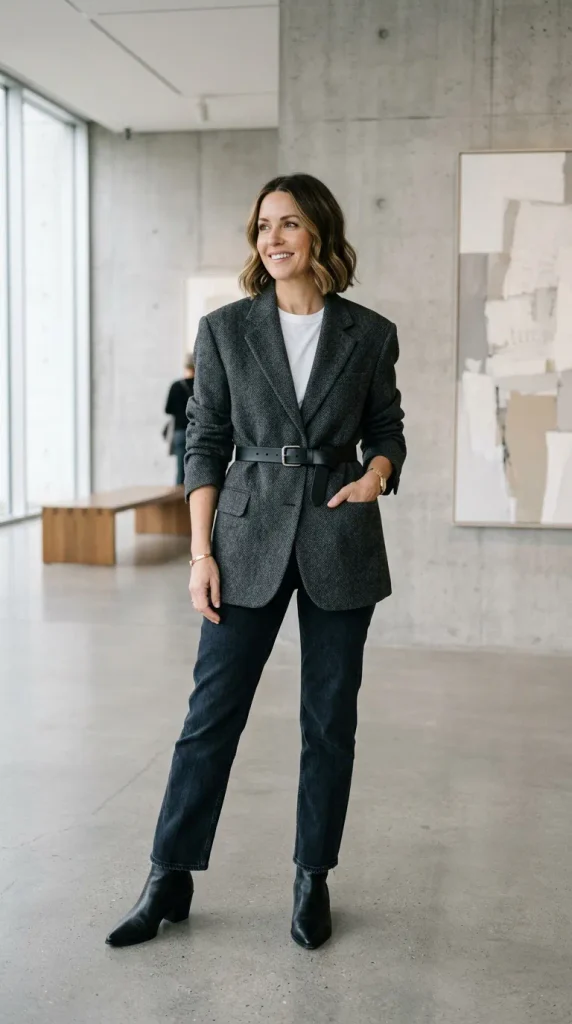
3. The oversized blazer, belted, with straight jeans
Charity-shop blazer, pizza-money price. The belt does the expensive-looking part.
The oversized blazer is the piece everyone warns hourglass figures about, and worn open and shapeless, fair enough — it is a tent. The fix is embarrassingly simple: belt it, or keep it open over a slim tucked-in base and let your waist do the talking underneath. I prefer a proper leather belt over the blazer, fastened at the true waist, with high-rise straight-leg jeans in a clean dark wash, hem finishing just above the ankle bone. No whiskering, no fading — scruffy denim fights the tailoring. Fit check: the blazer shoulder should end roughly where yours does. An inch of slouch is style; three inches is borrowing your father’s jacket. Mine came off a charity shop’s men’s rail for less than a pizza, and a tailor took the sleeves up. The first time I wore the belt over it I felt like a fancy-dress pirate. By lunch I had forgotten, and three people had asked where it was from.
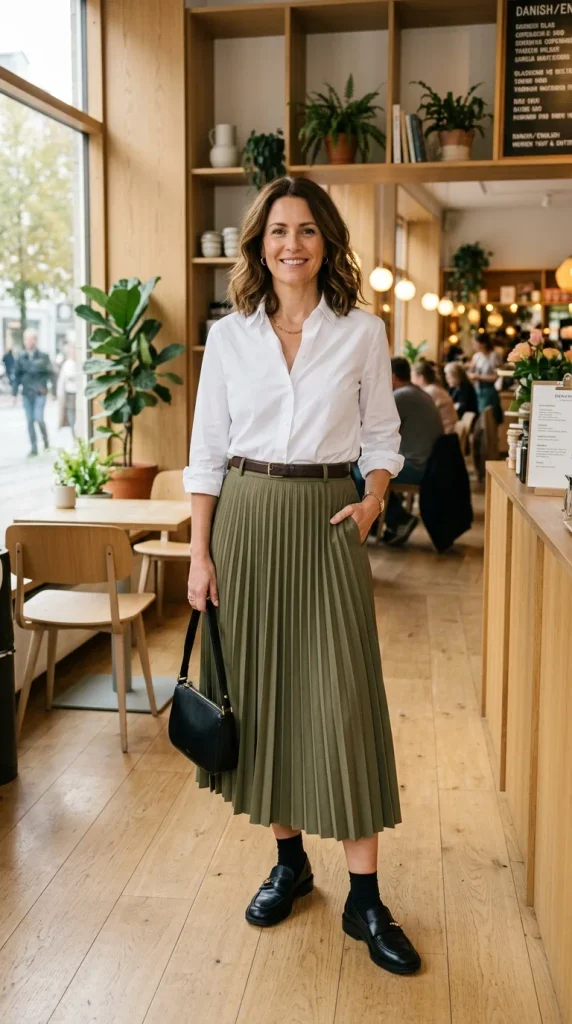
4. A poplin shirt tucked into a pleated midi skirt
Five minutes with the steamer the night before. I have stopped pretending it is optional.
Menswear on top, movement below. A crisp cotton poplin shirt — the dense kind that rustles slightly and holds a collar — tucked all the way into an accordion-pleated midi skirt. The skirt’s waistband matters more than anything else in this outfit: firm, non-elastic, sitting exactly at your natural waist, or the shirt works loose and the pleats wander. Unbutton the top two buttons and let the collar sit open; after forty, a shirt buttoned to the throat over a full skirt can read a bit schoolmistress. The honest cost of admission: poplin creases, and the pleats want five minutes with a steamer the night before. I just do it while the kettle boils. Check the pleats too — stitched-down ones should release at the hip, not above it, or they spring open at precisely the wrong place. And skip this on a windy day, unless you enjoy holding your skirt down at bus stops. I speak from experience.
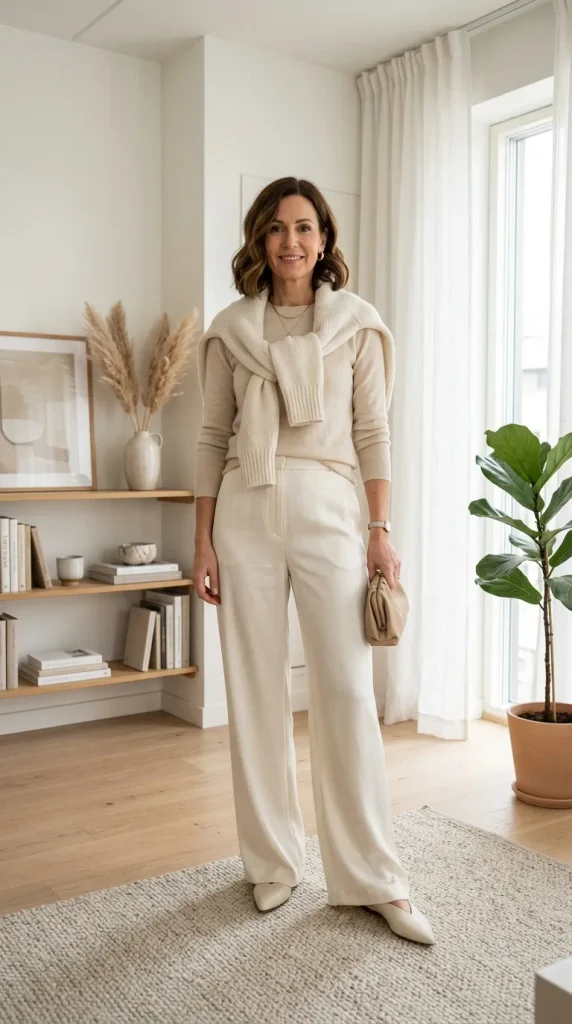
5. Monochrome knits with silk wide-leg trousers
One colour, three textures. The creases across the lap come free with sitting, and I have made my peace with them.
One colour, top to toe, and the interest comes from texture instead of contrast. Wide-leg silk trousers — or a good matte viscose that behaves like silk — with a fine-gauge cashmere crew-neck tucked in, and a second knit layer over the top in a slightly different weight, so the eye can tell them apart. The trousers should skim: if the side zip pulls or smiles at you in the mirror, go up a size and have the waist taken in. That alteration costs little and changes everything. Now the honest part. Silk trousers crease across the lap the moment you sit down, and they show it. I have made my peace with this; women in silk on trains everywhere have made their peace with it. A small travel steamer helps on the worst of it. What I will not compromise on is knit quality — one decent cashmere jumper, bought once, outlasts four cheap ones and does not pill into a halo by February.
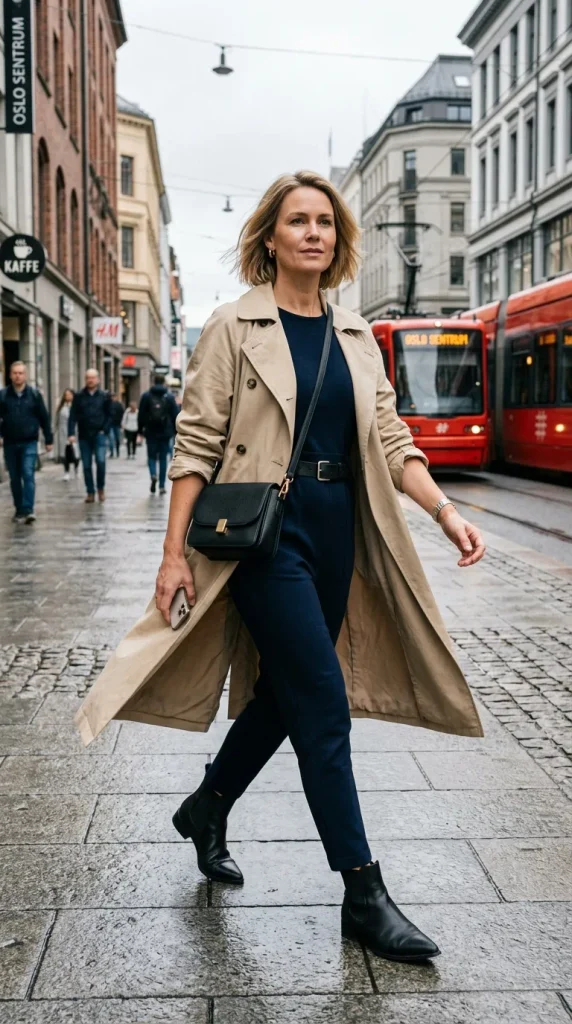
6. A trench over a tailored jumpsuit
My smartest one-piece — as long as the zip passes the reach-it-alone test.
A jumpsuit sounds like a young woman’s game, but a tailored one — structured ponte or wool gabardine, with a real waist seam — is one of the most hourglass-friendly things I own. One unbroken line, the waist already marked, nothing to tuck or match. Over it, a relaxed trench worn open, framing the whole thing like a doorway, plus leather boots and a leather belt if the jumpsuit’s own waist needs underlining. Now the practical matter nobody mentions until you are hopping around a train toilet: you will have to get out of it, alone, in a hurry. Choose a zip you can reach and work entirely by yourself, and test that at home, not on the Copenhagen express. I learned it the hard way so you don’t have to. Fabric check, too: ponte should be dense and matte. Thin ponte shows every line of what is underneath and turns a tailored idea into gym wear.
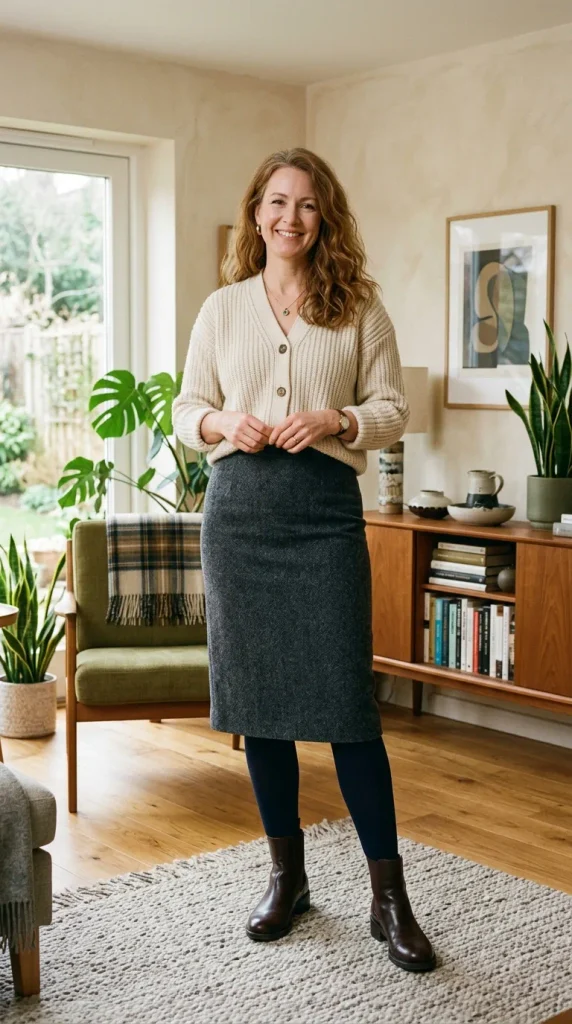
7. A chunky cable-knit cardigan with a pencil skirt
Half-buttoned is the whole trick. Done up to the neck, I am a cube; like this, I have a waist.
Chunky knitwear and an hourglass shape are not natural allies — the knit adds width exactly where you already have it. The counterweight is a high-waisted pencil skirt in heavy stretch wool, knee-length or just past it, holding the line from waist to knee like a drawn stroke. The cardigan goes on top, buttoned only to the middle of your torso, the lower buttons left open so the skirt shows and nothing strains across the bust. That half-open trick is the whole outfit; buttoned to the neck, you are a lovely warm cube. Check the cardigan’s weight in your hands before you buy. Real wool has heft, and the cables should spring back when you squeeze them. Acrylic cables flatten by the second wear and look sad doing it. One warning from my own wardrobe: a very long cardigan swallows the skirt’s waistband and the shape along with it. Cropped to the hip bone is the sweet spot.
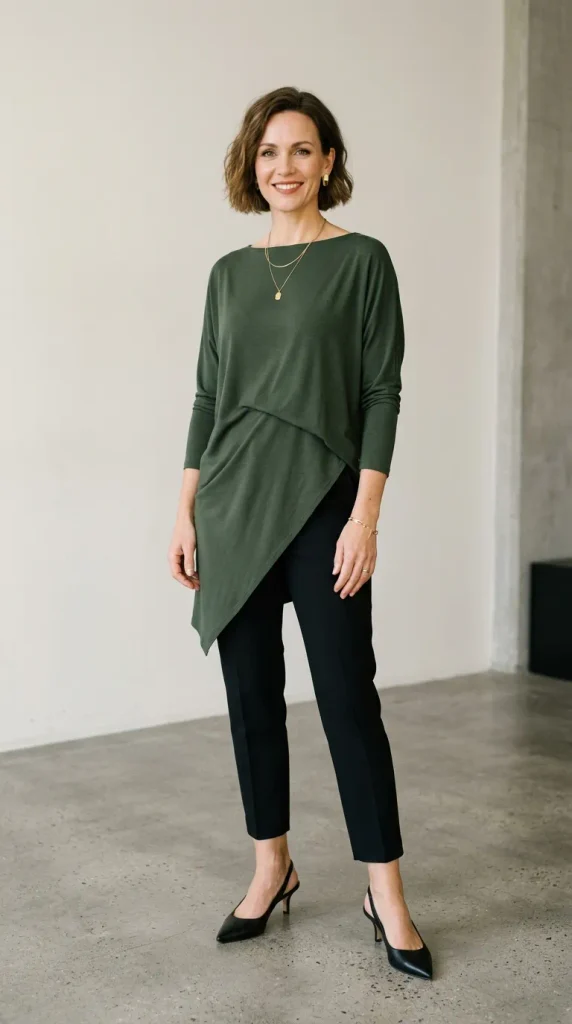
8. An asymmetrical tunic over cigarette trousers
The diagonal line does the flattering. Dense jersey or don’t bother — trust me, and the christening photos.
Asymmetry sounds like a risk, but on a curvy frame a diagonal line is a kindness — the eye travels across the body instead of measuring it. A draped tunic in dense matte jersey, the hem or neckline cut on the slant, over tailored cigarette trousers in cotton sateen or bi-stretch wool. The trousers must be plain and close-fitting, ending cleanly a couple of inches above the ankle bone, so all the drama stays up top. If the tunic floats completely free of your body, give it one small tuck at the front, or a slim belt worn low on the slant. Fabric is where this outfit lives or dies. Flimsy jersey twists as you wear it, the slant migrates, and by afternoon you are wearing a spiral. It happened to me at a christening; I spent the photographs angled like a comma. Dense jersey holds its cut. And if you like everything level and symmetrical, skip this one entirely — it will itch at you all day, and life is too short.
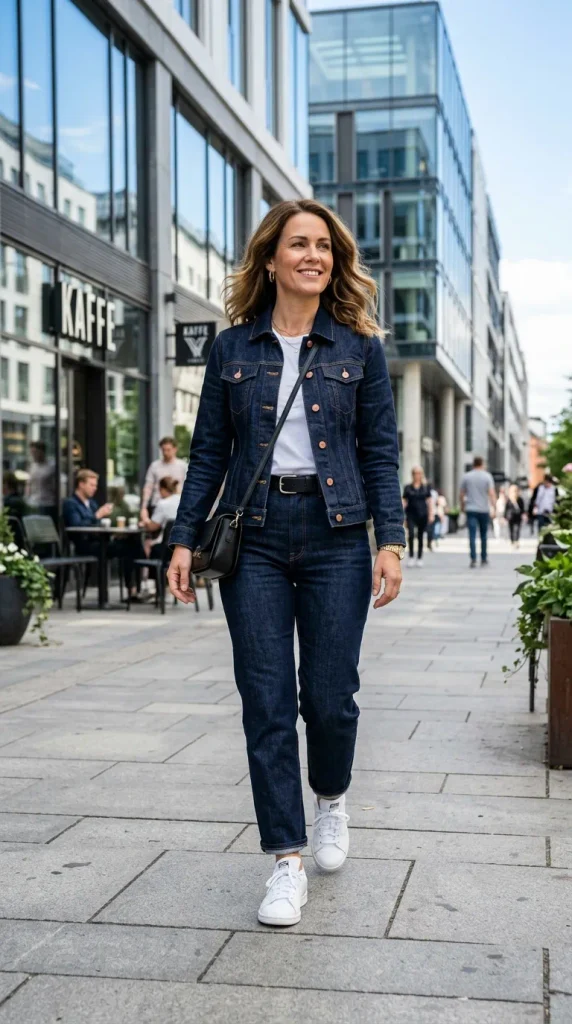
9. Denim on denim, same wash, proper tailoring
Same wash, or it looks like an accident. Daylight check, every single time.
Denim on denim has two versions: the deliberate one and the accident. The deliberate one uses the same wash top and bottom — dark raw indigo is the safest — so the whole outfit reads as one column, almost like a jumpsuit. High-rise jeans with minimal stitching, sitting at the natural waist, and a denim shirt or fitted denim jacket tucked in or belted, so your waist stays in the picture. A fine-ribbed cotton tank underneath softens it and gives the eye a rest at the neckline. The checking matters here: hold the two pieces together in daylight before you commit. Under shop lights, washes lie. I once assembled what I believed was a matching set and saw the truth in a café window — top half blue-grey, bottom half green-blue, me looking like a before-and-after photograph. Raw denim is stiff for the first few weeks and then moulds to you; buy it snug at the waist, not tight at the hip.
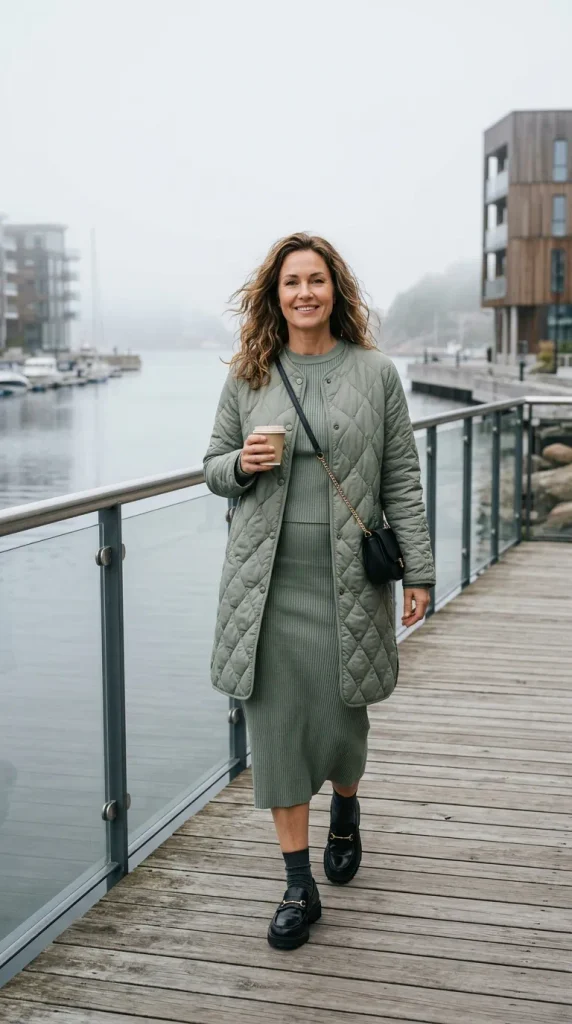
10. A quilted liner coat over a ribbed knit co-ord
Sunday uniform. If the rib doesn’t snap back in the shop, it doesn’t come home with me.
The comfortable end of the list, and the one I wear on slow Sundays. A co-ord set in heavy ribbed knit — long-sleeved top and a midi skirt in the same colour — with the skirt’s soft waistband sitting precisely at your natural waist, so the rib skims over your hips instead of pooling above them. Over it, a quilted liner coat, which adds the structure the knit lacks and turns something pyjama-adjacent into a decision. Liner coats are the Scandinavian secret weapon: light, genuinely warm, and a fraction of the price of a proper coat, because they were designed to hide inside one. The knit quality check is non-negotiable. Stretch the rib sideways and let go. Good rib snaps back; cheap rib stays stretched, and by the third wearing the skirt is a size bigger at the seat than at the waist. That happened to a skirt I loved. I still mourn it. Keep the colours tonal — oatmeal, stone, soft charcoal — and let the quilting’s stitch lines be the pattern.
What I’d buy first — and what can wait
If I were starting this wardrobe from an ordinary rail of clothes, the money would go in this order: the wide-leg trousers from outfit one, hemmed properly, and one good leather belt. Those two pieces rescue half the jumpers and shirts you already own. The wrap coat comes next, when the budget allows — it is an investment and behaves like one. What can wait: the co-ord set, the silk trousers, anything bought in a panic the night before an event. Buy slowly, one piece a month if that is what the budget says. A Scandinavian wardrobe is built like their furniture, meant to still be good in ten years. And honestly, most women I know already own four or five of these outfits in pieces, scattered across the wardrobe. The work is mostly in the fitting, not the shopping.
Questions I get asked
Do I have to belt everything?
No. A full tuck or a built-in waist seam does the same quiet job. The belt is just the loudest of the three — use whichever one the outfit in front of you is already offering.
My waist is thicker than it was at thirty. Does this still work?
Yes, because the rule was never “small waist” — it is “narrowest point.” Sit the waistband where that point is now, choose structure over squeeze, and the proportions follow.
Can I wear oversized pieces at all?
Gladly, with one anchor. A big blazer or coat is fine as long as something — a belt, a tuck, a slim layer underneath — marks the waist. Volume everywhere at once is what turns it into the armchair.
Which fabrics should I avoid?
Flimsy jersey, thin unlined knits that cling in the wrong places, and shiny acrylic that goes tired by Christmas. Heavy, matte and natural beats light and apologetic nearly every time.
Won’t dressing this plainly get boring?
It gets calm, which is different. Interest comes from texture — cable against smooth wool, rib against silk — and from one column of colour worn well. Boredom is usually discomfort in disguise.
That’s the rail I keep coming back to, in the order my own wardrobe earned it. If your waist has been hiding under sacks the way mine was, start with the belt — and save this to your wardrobe board on Pinterest before your next fitting-room trip. — Elias