The morning of a friend’s gallery opening, three years ago, I stood in front of a wardrobe so full the doors barely closed — and I had nothing to wear. Everything was nearly right: trousers that almost matched a jacket, a good shirt in a colour that fought with everything else I owned. I pulled half of it onto the bed, sat down among the hangers, and admitted the problem wasn’t quantity. It was that nothing had been chosen to go with anything.
What came out of that weekend is one rail of clothes, mostly navy, charcoal, cream and camel, that all agree with each other. These are the combinations I actually rotate through, the checks I do in the fitting room, and the mistakes I have already paid for so you don’t have to.
1. The navy blazer and straight-leg jeans everything starts with
The outfit I have worn more than any other. Six years on, the blazer still earns its rail space.
If I could keep only one outfit, it would be this: a single-breasted navy wool blazer over a white cotton shirt and dark straight-leg jeans. The fitting-room check is the shoulder — the seam should sit exactly on your shoulder bone, and the sleeve should end a sliver short so the shirt cuff shows. My first blazer was bought a size too big because I thought loose meant forgiving; it just looked borrowed, and a tailor taking in the sleeves cost me €35 to learn that. A narrow cognac belt and loafers finish it. The whole thing takes me four minutes, which is precisely the point. The blazer was the most expensive thing I bought that year. Worn weekly since, it works out cheaper than the jumpers I bought on sale and never reached for.
2. Cashmere crewneck with pleated wool trousers
Dove grey on charcoal, most weekdays from October to March. Quiet, and people always ask about the knit.
A fine-gauge cashmere crewneck, worn in a tone close to the trousers below it, is my weekday uniform: dove grey knit, charcoal pleated wool trousers, one long column of colour. The checks are small but they matter. Run a fabric comb over the knit before wearing — thirty seconds lifts the fuzz that makes cashmere look tired. The comb lives in the same drawer as the sweaters, or the job never happens. Wear a light undershirt that stays invisible at the neckline, and tuck just the front of the hem so the pleats fall straight. One honest warning: if you run warm, as I do since my late forties, cashmere indoors can be too much by lunchtime. My second crewneck is fine merino instead, same shape, half the heat, and nobody has ever noticed the difference.
3. The fluid trench over a monochrome knit column
The trench I knot behind my back, never in front. It keeps the whole line long and unbothered.
For the in-between months I wear a long, soft trench open over a matching ribbed knit top and midi skirt — all camel, all one unbroken column. The trick I learned late: knot the trench belt loosely behind your back instead of fastening it in front. It pulls the spare fabric out of the way, and the front falls in two clean lines instead of bundling around your middle. Two practical notes. Hang the knit pieces on wide padded hangers, never wire ones, or the shoulders stretch into points. And let the skirt hem cover the top of your boots completely — a gap of leg between skirt and boot cuts the column in half. This is the outfit that has carried me through more gallery afternoons and long train journeys than I can count.
4. White poplin shirt with wide-leg chinos
Rolled sleeves, hem just clearing the ground. The shirt gets ironed the night before or not at all.
A crisp white poplin shirt tucked into high-waisted wide-leg chinos is the combination I trust on days that start with errands and end somewhere nicer. Poplin earns its place because the tight weave holds a collar upright all day. My checks: iron the collar, placket and cuffs with a little starch the night before; smooth the chino pockets flat before you leave, because flared pockets undo the whole clean line; and hem the trousers to clear the ground by about half an inch — wide legs that drag look untidy by noon. Clean white sneakers work too, on dry days. Roll the sleeves twice, to the forearm. One confession: white shirt plus coffee is a risk I have lost more than once. I now drink the coffee before I get dressed, not after.
5. Boiled wool cardigan over a silk slip skirt
Heavy wool over fluid silk — the contrast does all the work. My theatre outfit, twice a month.
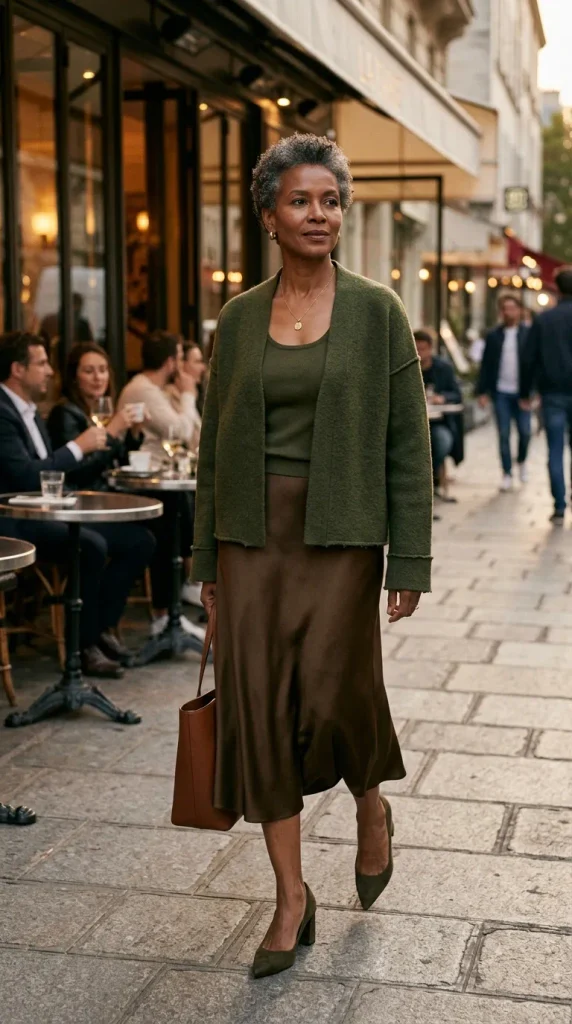
This is texture doing the work that colour does elsewhere: a boxy, open boiled-wool cardigan over a plain fitted tank and an A-line silk midi skirt. Boiled wool is felted so densely it holds a clean edge and shrugs off wind; the silk underneath moves. The proportion check is the one worth memorising — the cardigan hem should stop at the high hip, roughly a third of the way down, so the skirt owns the lower two-thirds. Longer, and the outfit splits you in half. Hang the skirt in a steamy bathroom for ten minutes instead of ironing it; silk forgives steam and hates a hot iron. My skirt came from a consignment shop for €40. Skip this one if you hate dry-cleaning bills, because the silk will ask for one eventually.
6. The all-linen overshirt and pleated trousers
All one shade of flax. By ten in the morning it is creased, and I have stopped apologising for that.
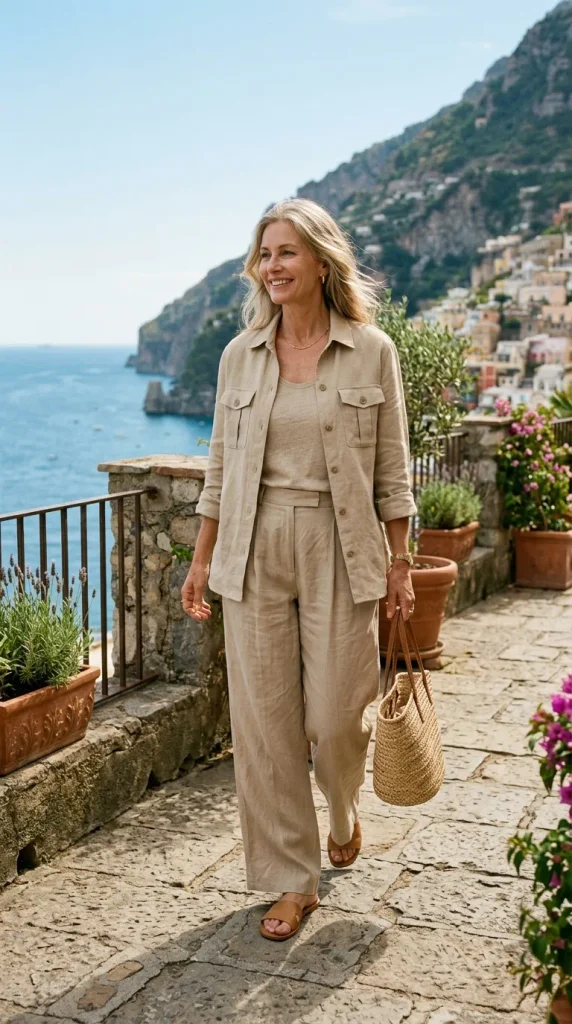
High summer, I wear linen head to toe: a structured overshirt with proper chest pockets, left open over a plain linen-jersey top in the same shade, with pleated linen trousers below. The buying check matters more here than anywhere — hold the trousers up to the light in the shop. Good heavy flax is opaque; thin linen goes transparent in sunlight and feels like tissue by August. Steam everything, hang it for fifteen minutes, then push the sleeves up to the forearm and stop fussing. Linen creases. Mine is rumpled by ten o’clock every single time, and I have made my peace with it: the creases read as ease on a matching set, as long as the colour stays in one family and the shoes are clean, flat leather sandals.
7. The double-breasted wool coat with column trousers
Bought in a January sale, worn every cold week since. The anchor button inside is the detail that matters.
Deep winter gets one serious outfit: a double-breasted coat in heavy melton wool over a fine mock-neck and flat-front trousers in the same dark weave. Melton is felted and windproof, so the coat keeps its shape instead of flapping. When you try one on, fasten the hidden inside anchor button as well as the outside one — that is what keeps the overlap lying flat across your chest, and sales assistants rarely mention it. I run a lint roller over mine every Sunday; dark wool shows every fibre. Boots need a grippy sole and a low heel you can stand in at a bus stop. Honest cost note: this coat was a January-sale purchase and still the priciest thing I own — and if your winters are mild, skip it entirely and put the money into the trench instead.
8. Ribbed mock-neck with an A-line wrap skirt
The skirt I test sitting down before I buy. Rust and plum are my autumn versions of this one.
A fine-ribbed mock-neck — the ribs run vertically and quietly lengthen everything — tucked into an A-line wrap skirt gives me a defined waist without a belt doing any squeezing. I wear it in rust or deep plum with opaque tights and block-heel boots. The check I never skip now: wrap the skirt, sit down in the fitting room, and cross your legs. You want a good hand’s width of overlapping fabric, well past what looks sufficient standing up. My first wrap skirt passed the mirror test and failed at a lecture, in the front row, twenty minutes in. Nobody said anything, which was worse. Also press the waistband flat and make sure the mock-neck collar stands up on its own rather than rolling — a rolled collar makes the whole top look tired.
9. Utility jacket with tailored straight trousers
Four real pockets and trousers sharp enough to keep it honest. My market-day and dog-walk uniform.
A garment-dyed cotton utility jacket over a plain white tee and sharply creased charcoal trousers is my answer to days that involve markets, trains and a dog. The jacket brings four pockets that genuinely hold things; the tailored trousers stop the whole outfit sliding into gardening clothes. Two small adjustments make it work: tighten the jacket’s inside drawstring just slightly, so there is shape at the back without pulling at the front, and roll each cuff once so your watch shows. The trousers need their crease — press it, don’t hope for it. The canvas softens beautifully after a few washes, which is the honest trade: it looks better in year two than year one. Skip it if your work is formal; no trousers, however pressed, will make a field jacket boardroom-appropriate.
10. Shirtdress under a longline open cardigan
My travel dress. One outfit, no decisions, and the cardigan hem lines up with the dress hem.
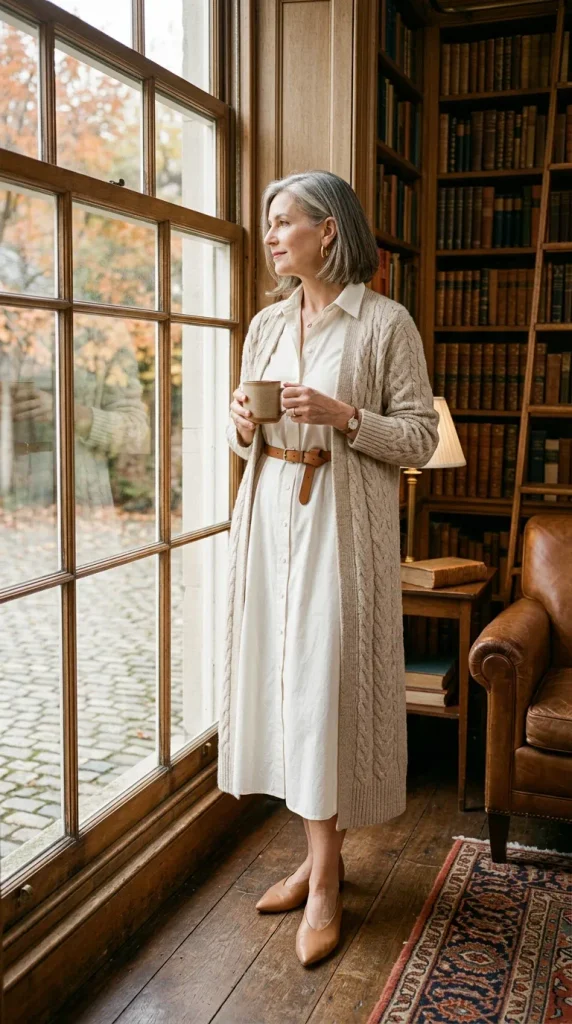
An ivory cotton shirtdress with a narrow belt, under a calf-length open cardigan in oatmeal, is the outfit I pack first and host dinners in. The cardigan’s two open front panels draw long lines either side of the dress’s button placket, and it takes the chill off air-conditioned rooms and evening terraces alike. Practical checks: leave the bottom two dress buttons undone so you can actually stride, fasten the belt on its middle notch so the fabric gathers gently rather than gripping, and line the cardigan hem up with — or just past — the dress hem; a cardigan that ends mid-skirt looks like a mistake. Steam the collar and cuffs, not the whole dress. Pointed flats in the same pale family keep the bottom of the outfit as calm as the top.
11. The one accent knit that wakes up the neutrals
The burgundy knit my sister talked me into. It is now the piece strangers compliment most.
Once the neutrals are in place, one rich colour earns its keep — for me, a fine burgundy knit my sister insisted I try when I claimed it “wasn’t me.” She was right; it is now the piece people compliment most. I wear it the same ways as the grey crewneck in idea two: over pleated trousers, collars of the white shirt showing, nothing else changed. That is the rule that keeps it classic — one accent at a time, and interest from texture rather than pattern, so a brushed wool or a ribbed knit in a strong colour does more than a print would. Choose whichever of burgundy, deep olive or saffron sits best against your own skin, in daylight, held up to your face. If a colour only works under shop lighting, it does not work.
What I’d buy first — and what can wait
Start with the audit, not the shopping: one weekend, everything onto the bed, keep what you wear weekly and write down the gaps. Then spend the real money where the wear is — the coat, the blazer, the leather shoes — and let shirts and chinos come from mid-range shops or a good consignment shop. Keep a small tailoring line in the budget; hems at the right length and sleeves showing a sliver of cuff make mid-priced clothes look made for you. One or two considered pieces a quarter is plenty. And on Sunday evening I hang up five complete outfits for the week, shoes underneath. Mornings have been calm ever since.
Questions I get asked
How many pieces do I actually need?
Fewer than you think. My rail holds twenty-three pieces, coats included, and they combine into more outfits than I wore when I owned three times as much. Count combinations, not garments.
Won’t all those neutrals look dull by week two?
Only if the fabrics are all the same. Brushed wool against smooth silk, a ribbed knit next to crisp poplin — texture is what stops a quiet palette feeling clinical. That, and the one accent colour from idea eleven.
I buy oversized clothes to hide my middle. What’s wrong with that?
Mostly that it adds the bulk it promises to hide. A clean shoulder seam and a whisper of waist shaping — a French tuck, a belted cardigan — look kinder and feel just as comfortable. Oversized has never once made me feel smaller.
How do I keep knitwear looking new?
Fold it flat rather than hanging it, keep a fabric shaver in the drawer and use it little and often, and give coats and blazers contoured wooden hangers. Two minutes of grooming beats replacing a jumper every second winter.
Does this still work if I wear colour every day?
Yes — keep the shapes and swap the palette. The system is about pieces agreeing with each other, not about beige. A friend of mine runs the same rail in navy, red and white, and it works exactly the same way.
That bed-full of clothes taught me the only rule I still follow: buy less, choose it to match, and look after what you keep. If you are starting your own clear-out, save this on Pinterest for the weekend you do it — and tell me which piece survived longest in your wardrobe. — Elias