10 Monochrome Scandinavian Outfit Ideas for Women Over 40
Three winters ago I stood in a changing room in Copenhagen holding six garments in six clashing colours, close to tears because nothing in my hands went with…
Three winters ago I stood in a changing room in Copenhagen holding six garments in six clashing colours, close to tears because nothing in my hands went with anything else I owned. I was forty-eight, I had a wardrobe full of clothes, and I dressed like a jumble sale. That afternoon I bought one charcoal trouser suit and left the rest on the rail. It was the first honest decision I’d made about clothes in a decade.
What followed, slowly, was the system I still live in: one colour at a time, head to toe, with the interest coming from texture instead of print. Ribbed knit against smooth silk. Matte wool against a slight sheen. Here are the ten combinations I rotate, the checks I do before money changes hands, and the mistakes I have already paid for so you don’t have to.
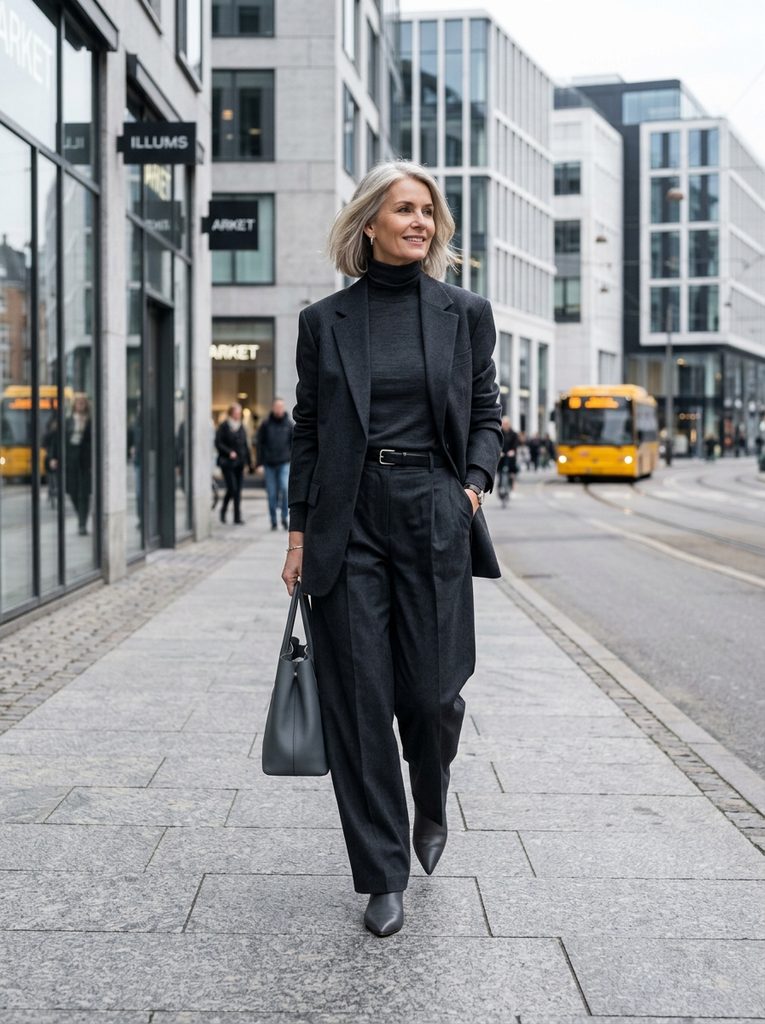
1. Charcoal wool suiting with a fine-gauge turtleneck
The suit that started everything. Charcoal does black’s job without draining my face.
This is the outfit everything else hangs off: wide-leg charcoal wool trousers, an oversized unlined blazer, and a featherweight merino turtleneck underneath. Charcoal is kinder than black after forty — it sharpens you without washing the colour out of your face. Two checks matter. First, sit down in the blazer; Scandinavian tailoring is loose, but the shoulder seam should still sit near your own shoulder, or the whole thing reads borrowed. Second, hold the trouser hem to the shoes you’ll actually wear — the wool should break once over the instep, never pool. I half-tuck the turtleneck, let its cuffs peek an inch past the blazer sleeves, and carry a slate tote. The suit was expensive, bought in that Copenhagen changing room. Per wearing across three winters, it is now cheaper than most of my jumpers.
2. Ivory cashmere with a fluid silk skirt
Winter white, done warm. The heavy knit against the silk is the whole trick.
All-ivory sounds like a hostage to fortune, and the first time I wore it I spilled coffee within the hour. I wear it anyway, because warm white does something for my skin that no foundation manages: it reflects light back up. The formula is a heavy ribbed cashmere crewneck, French-tucked at the front, over a bias-cut silk maxi skirt in ecru, with ivory knee boots hiding under the hem. The check is undertone, and it must happen in daylight by a shop window: warm ivory against cool optical white looks grubby, not tonal — I once bought a “cream” sweater that turned yellow next to my skirt and had to be dyed or donated. It was donated. Also insist on a true bias cut; straight-cut satin clings at the hips and shines like wrapping paper. Skip this outfit entirely if your life involves toddlers, dogs, or red wine.
3. Sand trench over oatmeal linen separates
My travel uniform in warm weather. It creases, and I have made my peace with that.
For warm weather I trade wool for flax: wide-leg oatmeal linen trousers, a sand linen shirt with the top two buttons undone and cuffs rolled twice, and an unlined fluid trench over everything, its belt tied loosely behind my back. This is my travel and museum-day outfit — breathable, covered, and calm against silver hair. The check is weight, again: hold the trousers up in the shop. Medium-weight linen drapes; the tissue-thin kind creases into a map within the hour and turns transparent against the light. Honest warning that no shop will give you: even good linen creases, and at our age I count that as texture rather than failure. A palm-smooth and a mist of water before leaving settles the worst. Who should skip it: anyone who irons for pleasure and expects clothes to stay pressed. These will not, and they are not sorry.
4. Ink navy knits with a pleated midi skirt
Navy after dark. The pleats move when I walk, which keeps all one colour from going flat.
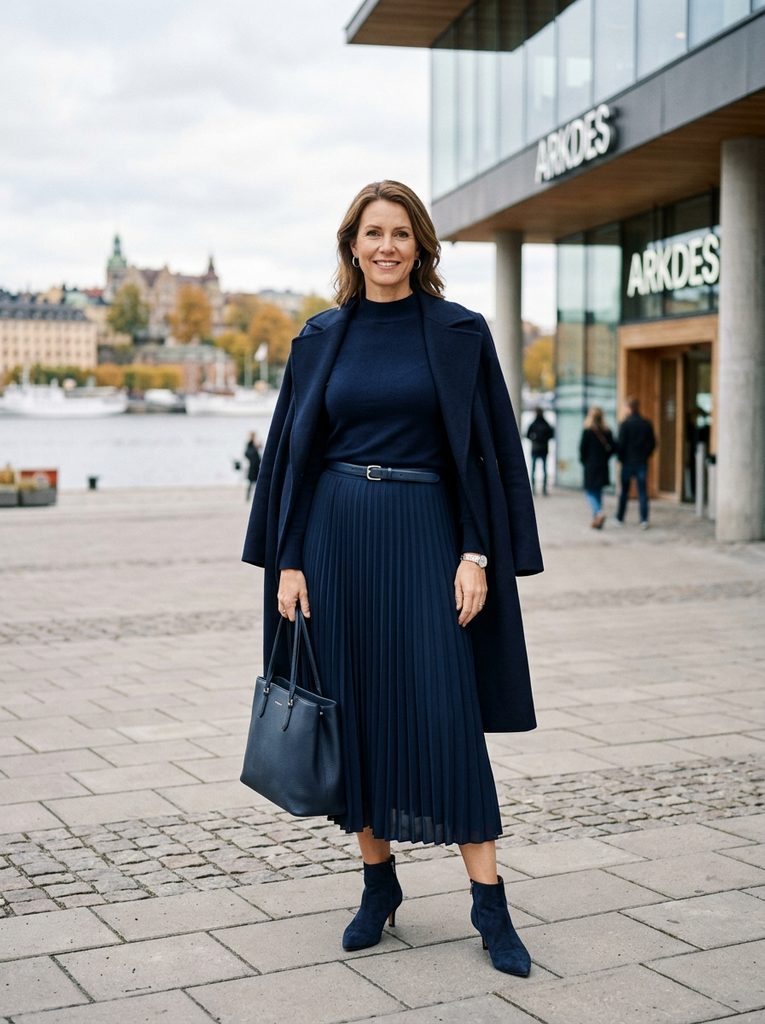
Navy is my evening answer to black: a fine-gauge merino top tucked into an accordion-pleated midi skirt, a slim navy belt at the waist, and an unlined wrap coat over the top when the evening turns. The pleats are doing the real work here — they catch light as you move, so a single dark colour never sits flat. Two checks. First, the boot shafts must rise high enough to meet the skirt hem; a band of bare leg breaks the column and shortens you. Second, walk across the shop in the skirt. Good pleats swing and settle; cheap ones flare like a lampshade and stay there. I wear this to concerts and dinners, with silver drop earrings as the only contrast. My first navy skirt was a shade too purple and fought with every top I owned — hold new pieces against your existing navy in daylight, because navy is three colours pretending to be one.
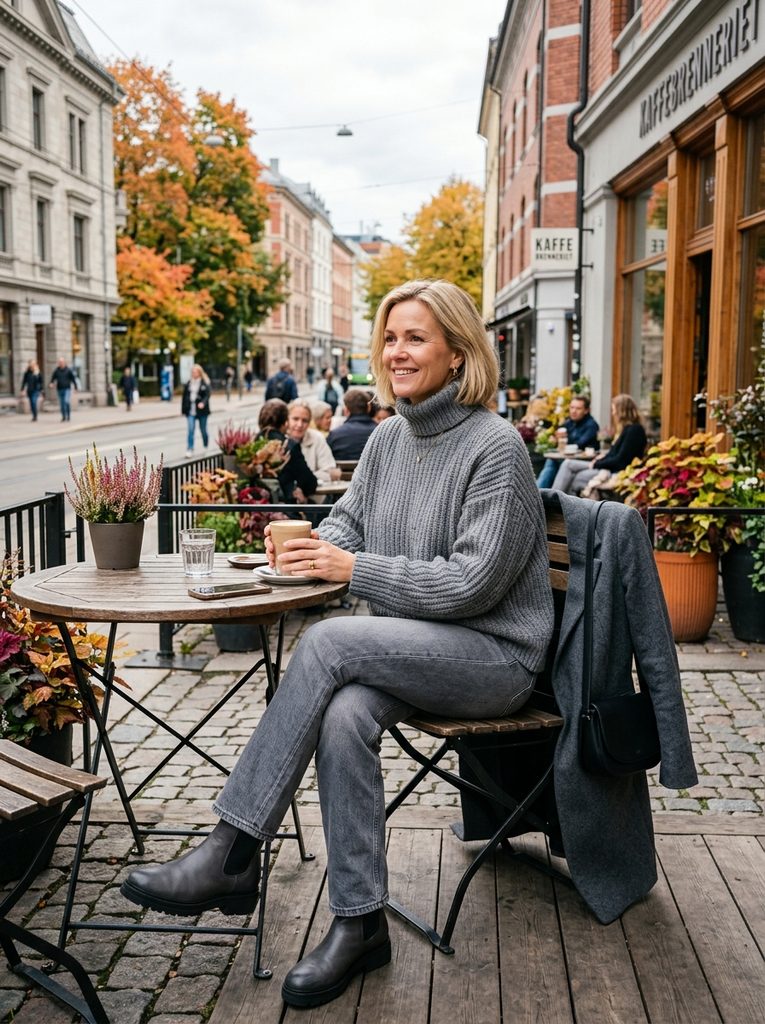
5. Slate grey denim with a chunky turtleneck
Weekend armour. Grey denim reads as tailoring in a way blue jeans at my age no longer do.
Grey denim is the quiet cheat of my wardrobe: straight-leg jeans in a washed slate that read as trousers, not workwear, under a heavy heather-grey fisherman turtleneck and a graphite car coat. This is weekend walks, family lunches, studio days. Weigh the sweater in your hands before anything else — a proper heavy-gauge knit feels dense, and that density is why it keeps its shape instead of bagging at the elbows by February. The denim check is the label: rigid or a whisper of stretch. My first grey pair had so much elastane they were leggings by Christmas, and the whole outfit slid from tailored to tired. I front-tuck two inches of the sweater, push the sleeves up to show a silver watch, and wear lug-soled Chelsea boots I can actually walk in. Skip the chunky knit if your winters are mild; real wool indoors is a slow roast.
6. Black silk tunic with cropped cigarette pants
All black, but the sheens argue with each other — that argument is the interest.
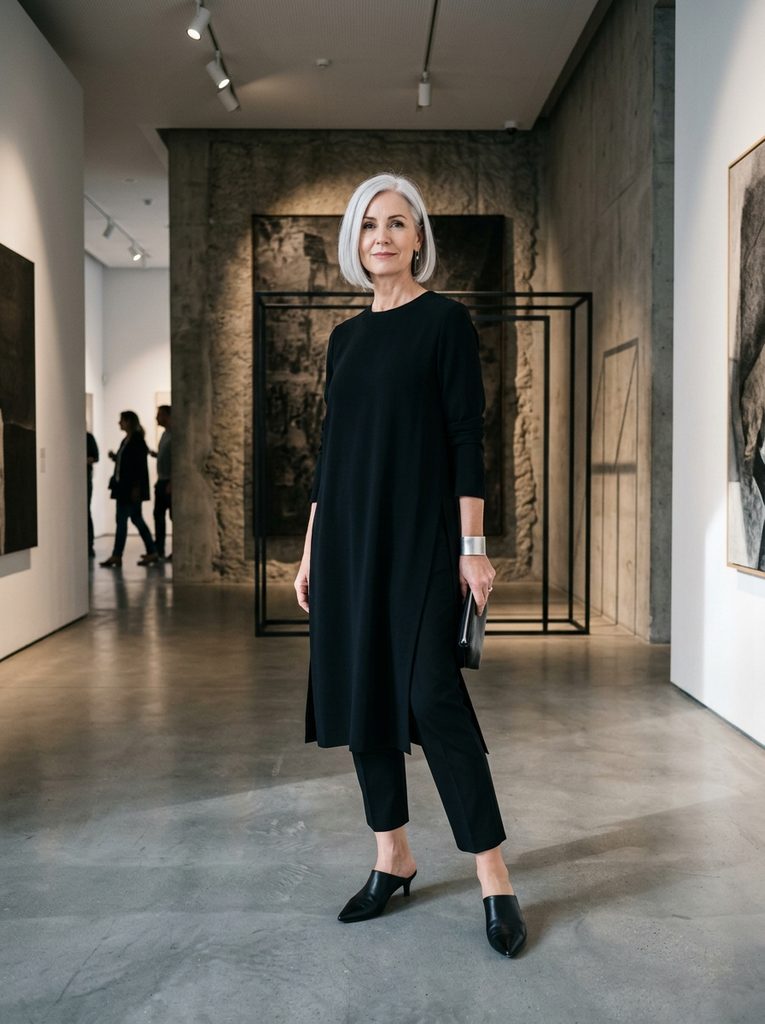
All black fails when every surface is the same matte cotton; it succeeds when the fabrics disagree politely. Mine is a washed-silk longline tunic, matte rather than shiny, falling to mid-thigh with side vents, over cropped cigarette pants in high-twist wool that refuses to crease. The cropped hem shows the narrowest part of the ankle, which anchors all that flowing silk. The tunic check is the vent: it should reach just above the hip so you can reach your pockets and sit without the silk straining — I returned one that pulled across my thighs every time I sat down, however beautiful it looked standing. For cold evenings I drape a collarless black wool duster over my shoulders without putting my arms in. Pointed mules, one pair of brushed-gold earrings, a small box clutch. Who should skip it: anyone whose household includes a white cat. I speak from bitter, lint-rolled experience.
7. Taupe kimono wrap coat with knit culottes
Travel-day comfort that still looks like a decision. The wrap adjusts to the body I have that day.
Taupe is the diplomat of neutrals — half grey, half brown, kind to silver, blonde and brunette hair alike — and the wrap coat is its best ambassador. Mine is boiled wool in a kimono cut, belted in a flat knot off to one side, over ribbed knit culottes and a plain modal scoop-neck top in the same mushroom tone. The wrap is the honest garment here: it adjusts to the body I have that day instead of demanding the body I had at thirty-five. Two checks. The wide sleeves must end just above the wrist bone, or you’ll trail them through soup — test by miming a meal in the shop, however foolish it feels. And squeeze the boiled wool: dense and almost board-like is right; flimsy versions curl at the edges within a season. This is my long-train-journey outfit, with a big tonal scarf and suede loafers. It feels like loungewear and photographs like tailoring.
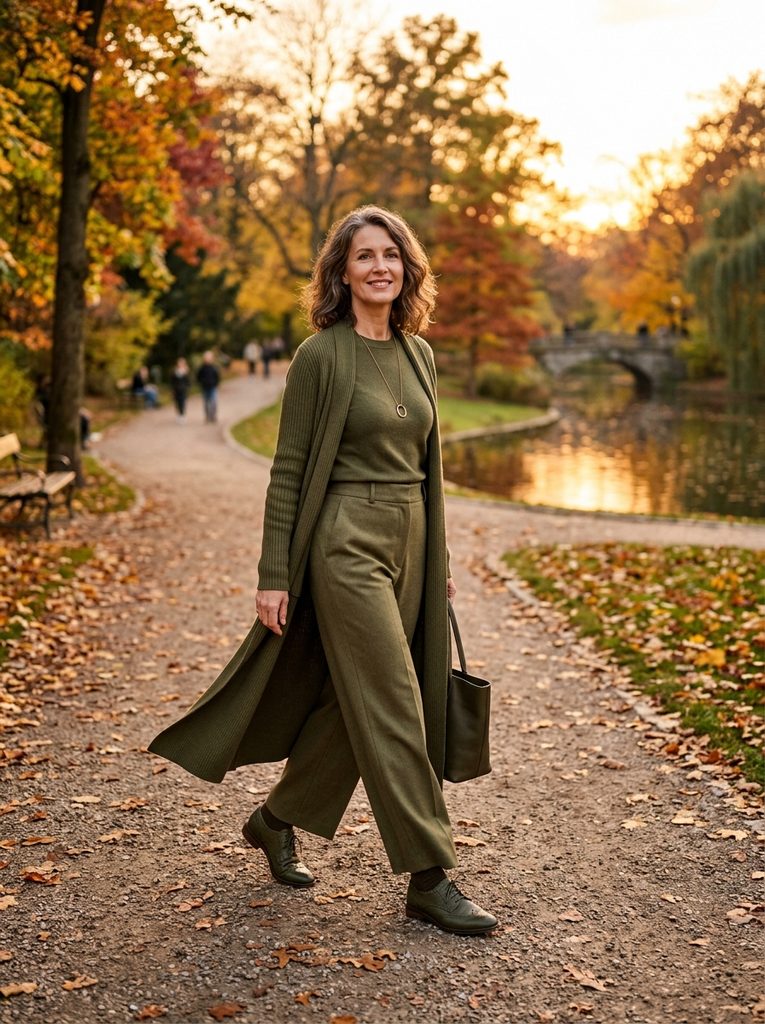
8. Forest moss duster over tailored wide-leg trousers
Green as a neutral. It does everything navy does and wakes my face up while it’s at it.
Green is the monochrome nobody expects, and on my skin it does what navy promises and doesn’t always deliver: it puts colour back. My version is front-pleated wide-leg trousers in olive-moss wool twill, a fine moss crewneck tucked in flat, a slim olive belt, and an ankle-length ribbed duster worn open so it falls in two long lines. The duster is the drama and the risk. Walk the length of the shop in it — the ribbing should sway and settle, and the hem should skim, not drag; an inch too long and you’ll carry it up every staircase like a bridesmaid. Check the trouser drape too: moss in cheap fabric goes khaki-dull by the third wash, so this is a buy-once piece. I wear it for autumn walks and creative workdays, with a hammered-gold pendant as the single warm note. Skip it if your wardrobe leans warm-toned overall; moss argues with camel more than you’d think.
9. Bone white quilted cocoon coat with corduroy
Winter white for actual winter. The corduroy grooves stop it looking like a hospital corridor.
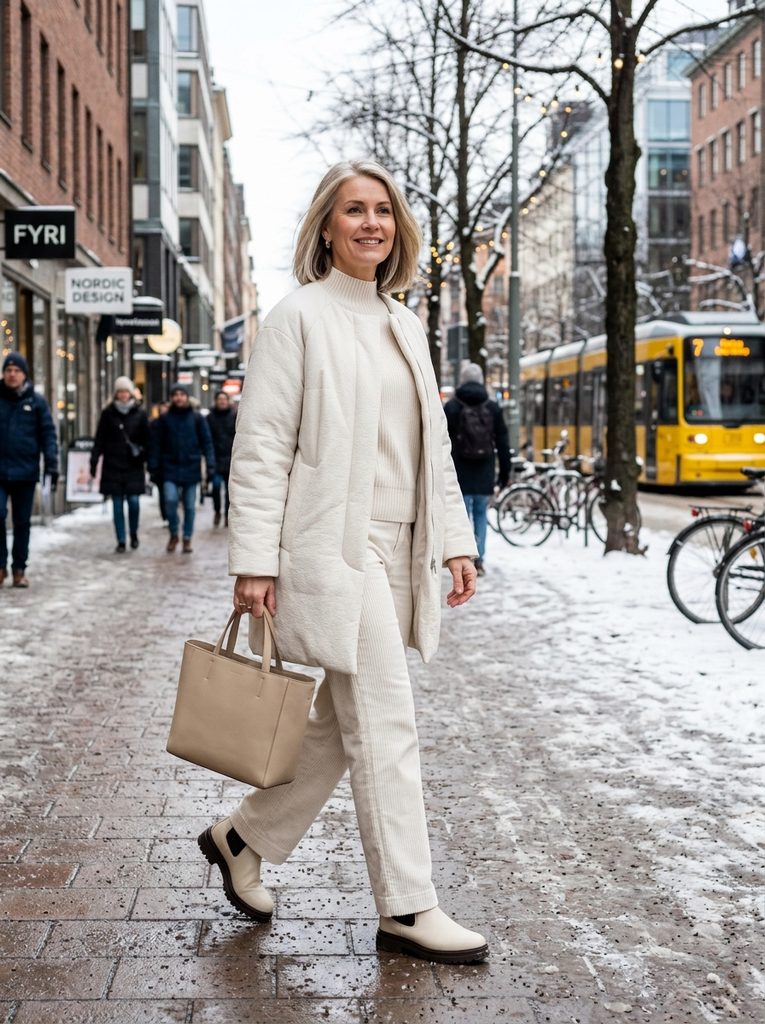
Winter white usually means a silk blouse and optimism. Mine is built for real cold: wide-wale corduroy trousers in bone, a cotton-modal mock neck, cream Chelsea boots with lug soles, and a collarless quilted cocoon coat over the top, fastened only at the top two snaps so the hem swings. The corduroy is the texture that saves this outfit — those deep grooves catch what little light January offers, where flat white fabrics just look clinical. Two checks. The coat’s dropped shoulders should rest on your frame, not slide off it; shrug in the shop and see if it stays put. And the corduroy should be high-waisted with a straight leg — wide-wale cord in a low rise is a one-way ticket to 1974. Machine-washable everything, which is the point: this is my Christmas-market outfit, worn among crowds and glühwein, and it has survived both. A thick wool beanie finishes it.
10. Ice blue poplin shirt with a fine wool overcoat
The cool one. Pale blue against silver hair is the most flattering accident I ever stumbled into.
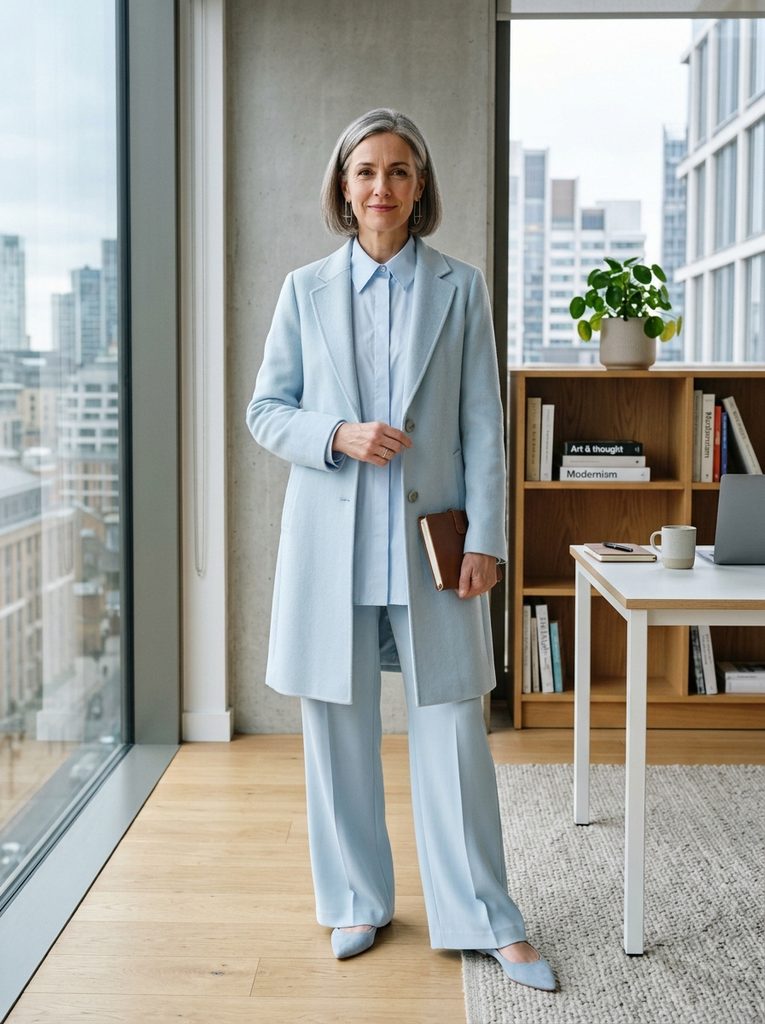
The last of my ten is the one strangers ask about: an oversized ice-blue poplin shirt, front tails tucked loosely into matching ice-blue crepe trousers, and a long double-faced wool overcoat in the same glacier shade draped over it. Pale blue against grey or white hair is quietly luminous — it does the work of good lighting. The poplin check is the light test again: hold a sleeve up in the shop, and if you can see your fingers clearly, it will wilt by lunchtime and show every seam beneath. Good poplin is papery and stays crisp till evening. Button the shirt halfway, roll the cuffs once, and let the back hem hang free over the trousers; that untucked back is what keeps it Scandinavian rather than corporate. The overcoat was a sale find, bought in July for a third of its price — pale colours are cheapest when nobody is dreaming of spring. Silver wire earrings, pale suede flats, done.
What I’d buy first — and what can wait
Start where I started: one suit or matching set in the colour you already wear most — for me charcoal, for you maybe navy — because that single column carries half the outfits here. Then one honest heavy knit, then trousers hemmed to the shoes you actually own; a tailor does more for a monochrome outfit than a new top ever will, because one colour shows every dragging hem. Roughly seventy percent of my money goes on coats, trousers and boots, the pieces worn weekly for years. What can wait: the silk tunic, the ice-blue set, anything bought to complete a colour in one impatient afternoon. My other rule is unglamorous and absolute — a new piece must match three things already hanging in my wardrobe, and it waits seventy-two hours in my phone’s wishlist before it earns the right. Most candidates quietly disqualify themselves.
Questions I get asked
Won’t one colour head to toe look like a uniform?
Only if every fabric is flat. The interest in a monochrome outfit is texture: ribbed cashmere against smooth silk, crisp poplin against brushed wool, corduroy’s grooves against a quilted coat. Match the colour, vary the surfaces, and it reads as a choice rather than a costume.
How do I know if my whites and creams actually match?
Take them to a window in the morning and lay them side by side. Warm ivories and cool optical whites fight — one always ends up looking faintly dirty. Shop lights lie about this; daylight never does. If two pieces argue by a window, believe the window.
What is the mistake you see most often?
Volume at both ends at once — a huge sweater over huge trousers, or everything skin-tight. One colour removes the visual breaks that usually rescue a lopsided outfit. Pair the generous piece with a straight one and the proportions settle.
Isn’t this expensive to build?
Done in a weekend, yes. Done over a year of phased buying, mostly in sales and second-hand for coats and cashmere, it cost me less than my old habit of six clashing impulse buys a season — and everything I own now works with everything else.
Can I wear jewellery, or does that break the rule?
One metal, worn consistently, is my answer — brushed silver for the cool outfits, a single warm gold piece with the moss and taupe. It reads as a focal point rather than another colour, and it keeps the calm intact.
That’s my ten, worn on rotation while the rest of my wardrobe stays small and strangely peaceful. If you’re standing in front of your own overstuffed rail tomorrow, start with one colour you love and one honest column outfit — the rest follows more easily than you’d expect. Save this to your wardrobe board on Pinterest if it helps. — Elias