10 Scandinavian Dress Outfit Ideas for Women Over 40
The morning I finally understood Scandinavian dressing, I was standing in a Copenhagen bakery queue in a white poplin dress with a grey sweater pulled over it, watching…
The morning I finally understood Scandinavian dressing, I was standing in a Copenhagen bakery queue in a white poplin dress with a grey sweater pulled over it, watching women twenty years older than me do exactly the same thing. Nobody looked overdressed, and nobody looked like they had tried for an hour either. I had spent years thinking a dress had to be an occasion by itself, belted and finished and slightly uncomfortable by lunchtime. That queue taught me the opposite: a good dress is a starting point, and the layers over it are where your own life gets written in.
These are the nine dress formulas I actually rotate through now, built on natural fibres, calm colours and shoes I can walk a market in. I am over forty and my waist is not where it was at thirty, so everything here skims rather than squeezes. A few of these dresses cost real money. A couple came from a charity shop. I will tell you which is which as we go.
1. Crisp Poplin Tiered Midi with Chunky Knits
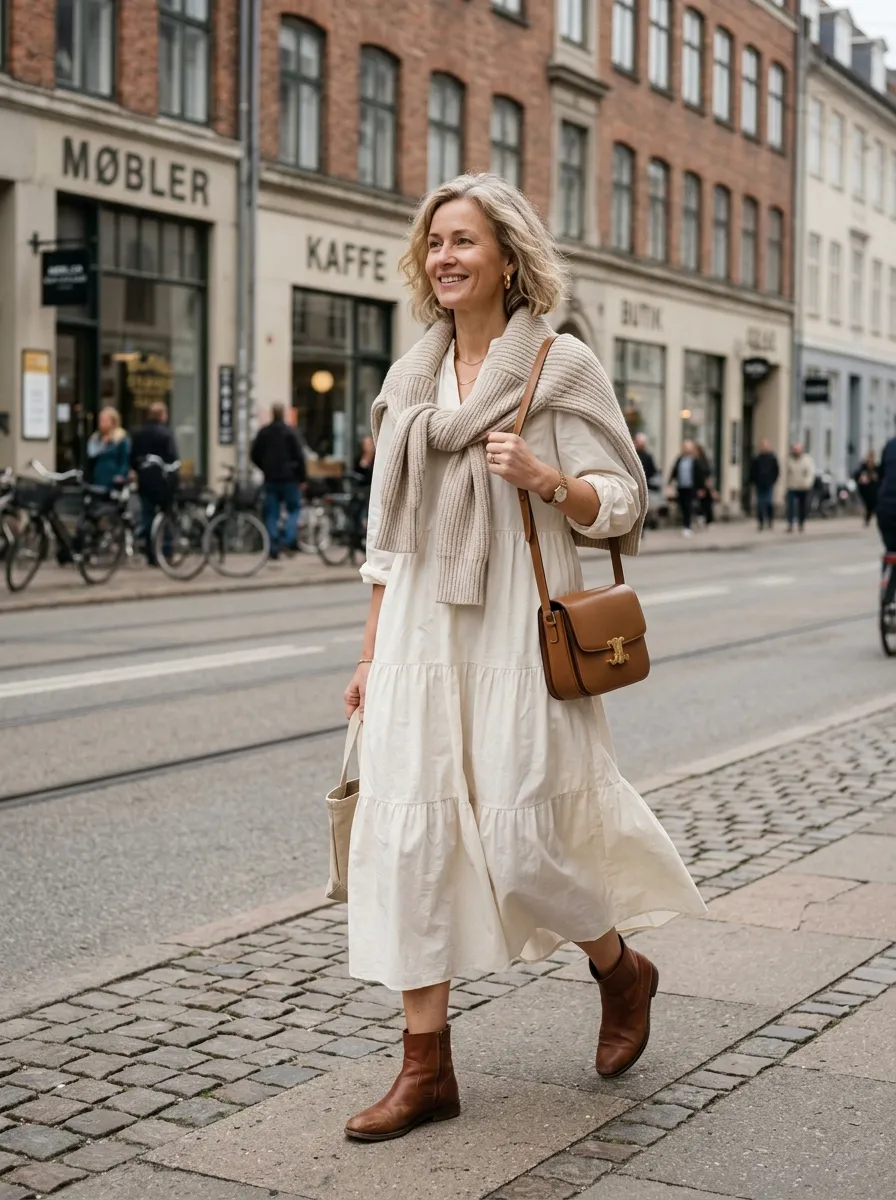
My white poplin dress with the oatmeal knit over it — the collar peeking out is the whole trick.
Start with a midi poplin dress in white or cream, point collar, side pockets, tiers that move when you walk. Then pull a chunky crewneck knit over it in oatmeal or heather grey and let the collar and cuffs show at the edges. The knit anchors all that volume — the difference between looking relaxed and looking like you borrowed a tent. My check in the shop: pinch the poplin. If it feels papery and creases into sharp white lines when scrunched, it will look tired by October. Good poplin is dense and springs back.
I wear mine with flat chestnut ankle boots, the shafts disappearing under the hem so the leg line stays unbroken. White tiers and coffee are enemies. Mine has a faint splash mark near the second tier that only I can see, and I have made peace with it. If you spill things constantly, choose pale stone instead of white. Skip this one if you hate ironing — poplin forgives a steam, but it does need one.
2. Monochrome Charcoal Linen Tunic Over Tailored Trousers
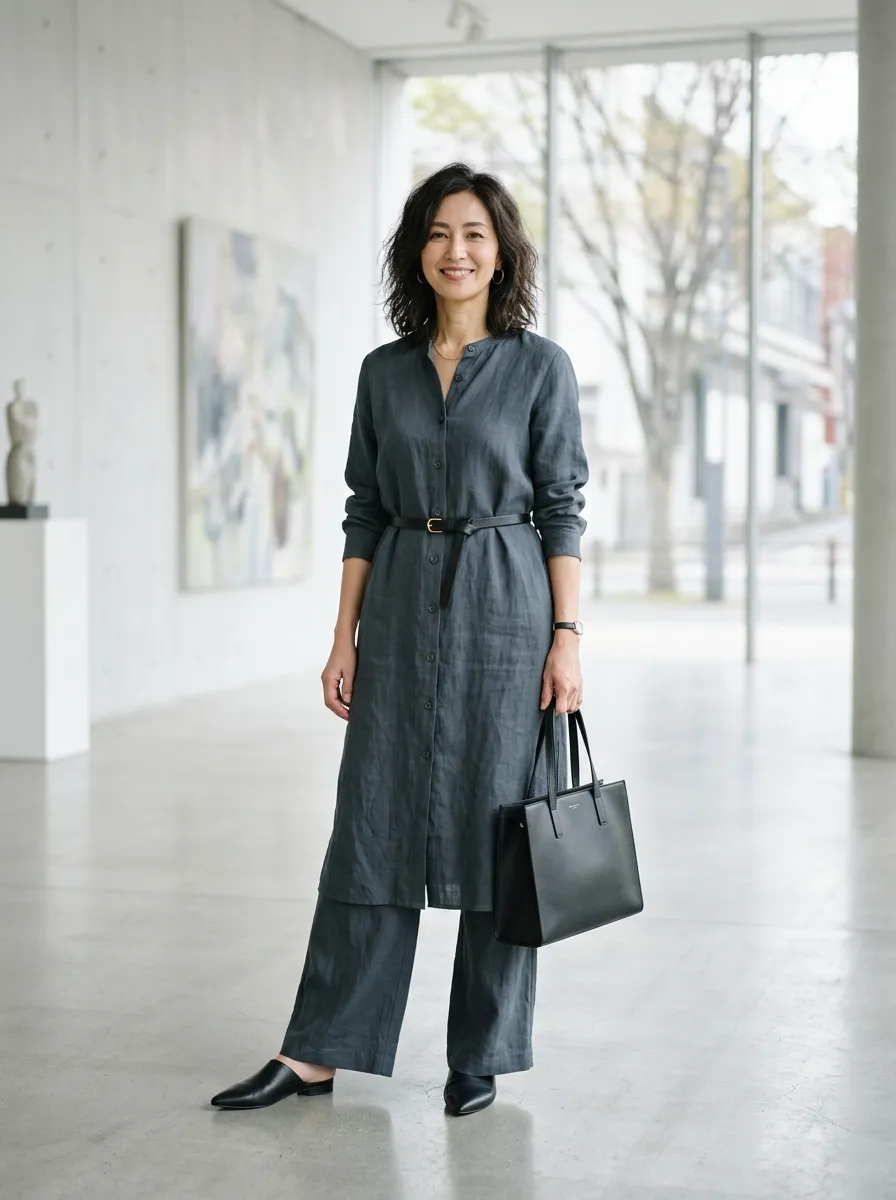
Charcoal on charcoal — the open buttons at the hem are what make the trousers underneath work.
This is the outfit I wear when I want to look like I have opinions about architecture. A straight linen tunic in deep charcoal, side slits to mid-thigh, worn over wide-leg trousers in the same colour family. Leave the bottom three buttons undone so the trousers show as you move; that flash of a second layer stops it reading as a dress that shrank. A slim black belt worn loose over the tunic gives the column a waist without squeezing anything.
The practical check is the linen itself. Hold it to the light: a tight, even weave keeps its shape, while a loose, gauzy weave will bag at the seat by the third wear. My first charcoal tunic was the gauzy kind, and by midsummer it looked like a sack with ambitions. The replacement cost more and has lasted four years. Pointed black loafers underneath, a rectangular tote, one silver cuff. If your workplace is formal, this raises eyebrows — it is a gallery outfit, not a boardroom one. I tested it on both.
3. Ribbed Cashmere Column Dress with Tailored Trench Coat
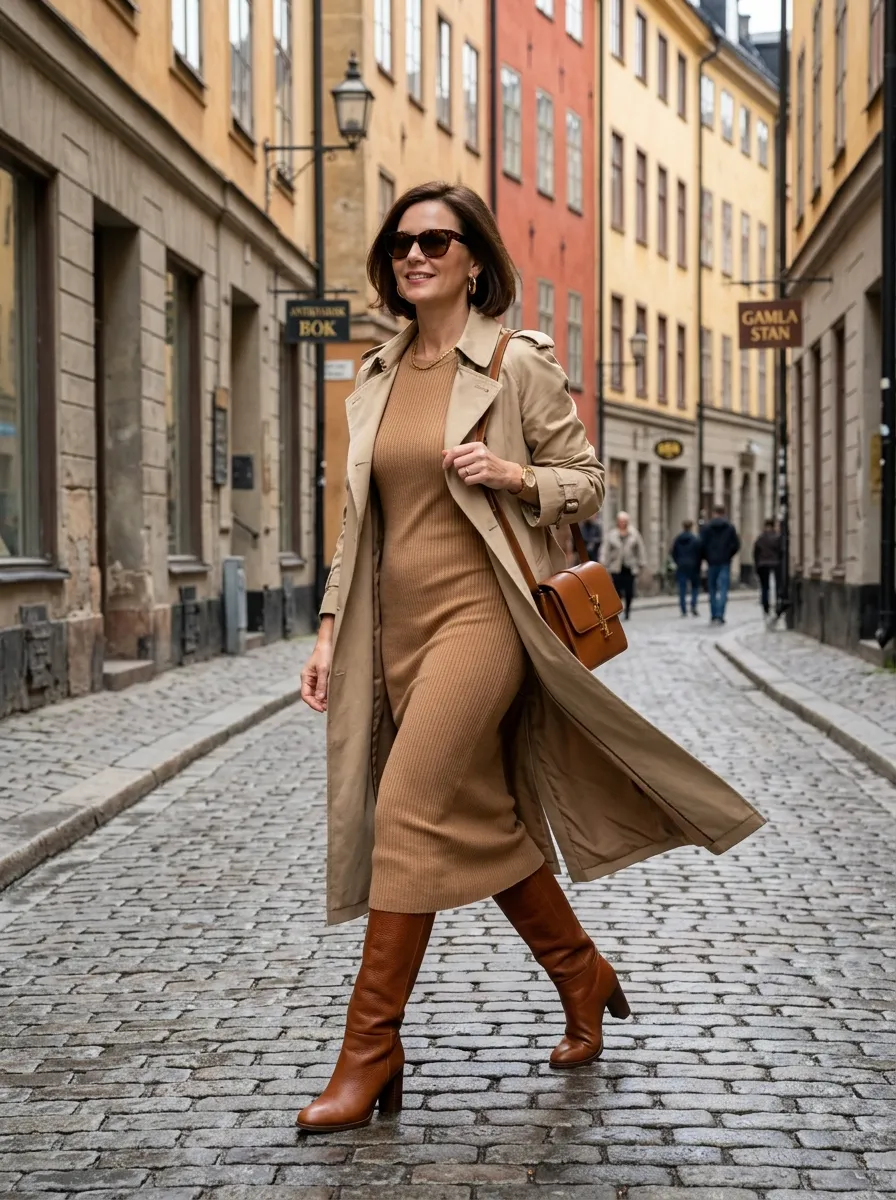
The camel column dress under my old trench — the ribs do the shaping.
A ribbed knit column dress in camel is the closest thing I own to a magic trick. The vertical ribs lengthen everything, the knit skims instead of clinging, and with an open trench over the top it works from a cold morning train to dinner without a change. I knot the trench belt loosely behind my back so the coat sits slightly in at the sides but never pulls across my stomach. Knee-high cognac boots disappear under the hem, thick socks and all.
Now the honest part: real cashmere in a full-length dress is expensive, and cheap versions pill between the thighs within a month. Do the scrunch test — ball the knit in your fist for ten seconds. Good yarn relaxes smooth; poor yarn stays fuzzy and creased. My dress is a cashmere-merino blend bought in a January sale, which brought it down to merely painful. If the budget says no, a fine merino column does ninety percent of the same job. Fold it, never hang it — a stretched knit column is a sad sight.
4. Architectural Black Smock Dress with Modern White Sneakers
Black smock, white sneakers, sleeves pushed up — my Saturday gallery uniform.
Every wardrobe needs one dress with drama that still lets you stride. Mine is a black smock in structured cotton, gathered cuffs, volume everywhere, worn with plain white leather sneakers and a crossbody bag pulled across the front to give the billow some order. The black keeps the shape grown-up; the sneakers keep it from looking like I am on my way to a christening. Push the sleeves up to your elbows — showing forearm stops a big black dress from swallowing you whole.
Fit check: the volume should start below the bust, not at the neck. If the gathering begins at the throat, it reads nightdress on most of us, whatever the assistant says. I returned one for exactly that reason, but the replacement gets worn weekly. Also weigh the fabric in your hand. Structured cotton holds the shape; thin viscose collapses by noon. Skip it if your life involves small children and jam — that much black cotton shows every fingerprint.
5. Flowing Silk Satin Slip with Heavy Cardigan
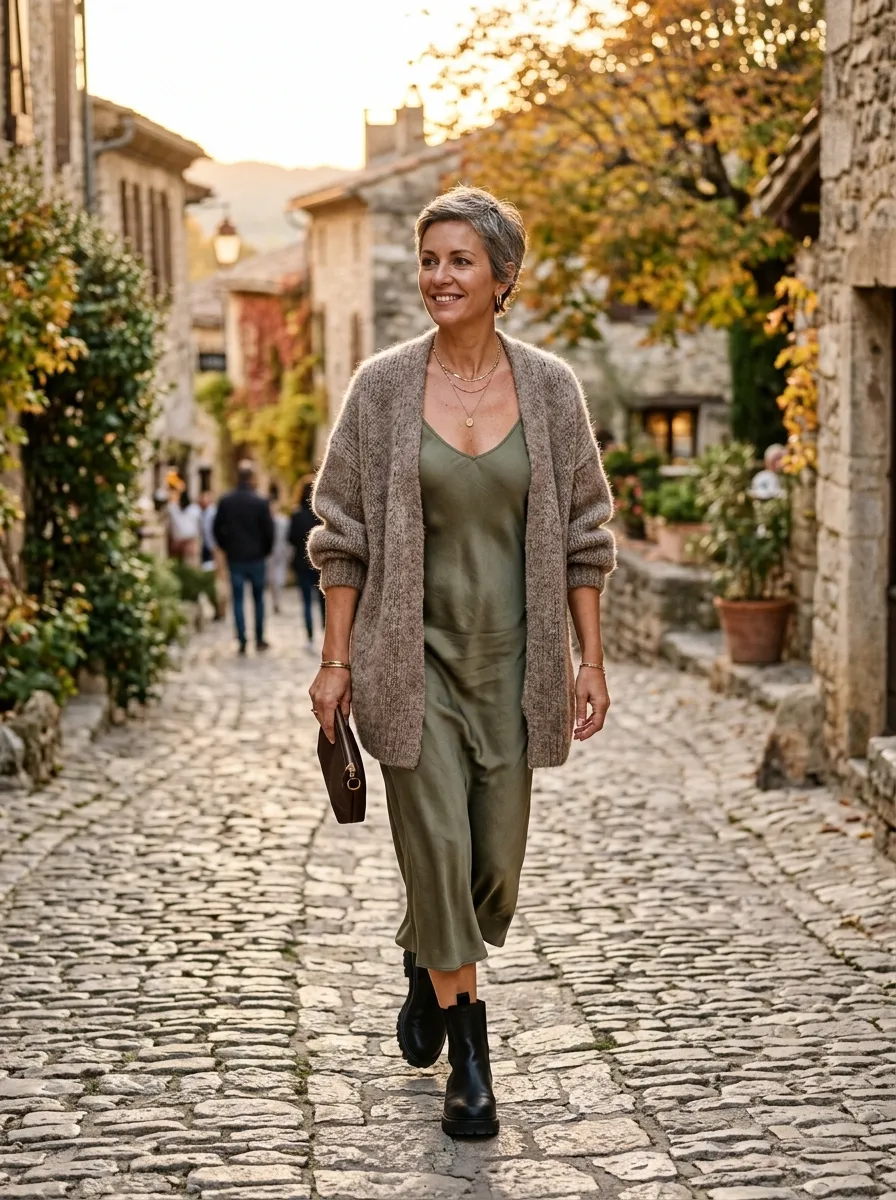
The olive slip under my heaviest cardigan — sheen for the evening, wool for reality.
I resisted slip dresses for years because I assumed they were for women with different arms than mine. The heavy cardigan changed the maths. A bias-cut silk slip in olive or pewter, neckline near the collarbone, with a long chunky cardigan over it falling well below the hip — the silk does the glowing, the knit does the covering, and chunky Chelsea boots stop the whole thing floating away. Leave the cardigan open so the satin catches light as you move, and roll the cuffs once to show your wrists.
Two checks before you pay. First, sit down in the slip: bias silk creeps up and twists on a chair, and you want to know that in the shop, not at a family dinner. Second, check the silk weight. Heavier sandwashed silk drapes; thin shiny satin shows every seam underneath and wrinkles if you glance at it. My first slip was the thin kind, bought online, and it lived at the back of the drawer until I gave it away. The heavier replacement cost double and earns it monthly.
6. Minimalist Shirt Dress with Wide Leather Cinch Belt
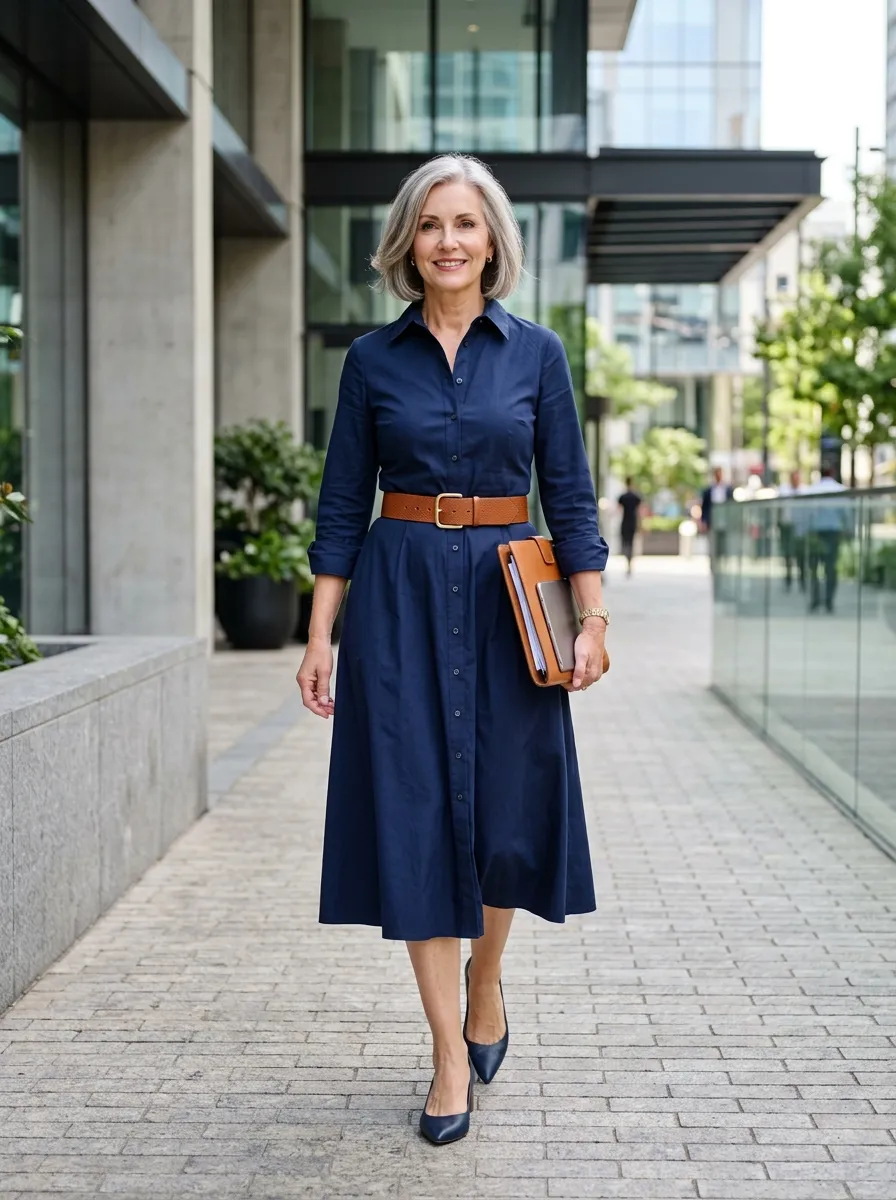
Navy shirt dress, wide cognac belt — the one outfit that has never once let me down at work.
When I have a meeting and ten minutes, this is the outfit. A navy shirt dress in crisp cotton, concealed buttons, collar fastened to the collarbone, sleeves rolled to three-quarter length. Then a wide leather belt — a full three inches — fastened at the waist, buckle centred, tail tucked into its keeper. The belt is not decoration here; it is the architecture. Without it the dress is a pleasant sack. With it, I have a waist and a plan.
Buy the belt like you mean it. Thin belts disappear into a shirt dress, and cheap wide ones curl at the edges within a season. Mine is cognac leather, five years old, and has outlasted two dresses it belts. Check the placket while you are at it: button it, sit, reach forward. If it gaps, size up and let the belt do the shaping — a gaping placket ruins the whole effect. Kitten heels or low ankle boots, small gold drops, done. This is also the easiest dress here to find second-hand, because shirt dresses never date.
7. Moody Floral Prairie Dress with Structured Wool Blazer
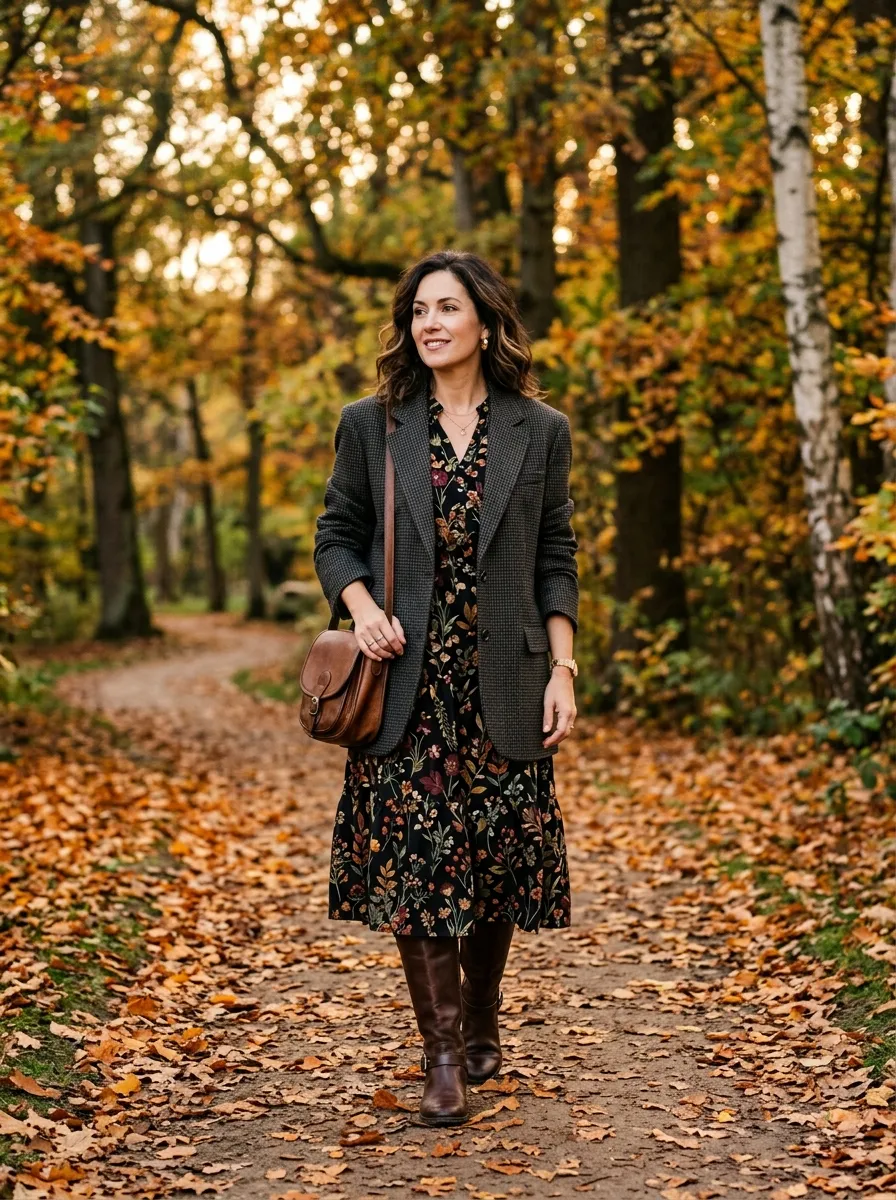
Dark florals under the charcoal blazer — soft dress, strict shoulders, no apology.
The one print I allow myself is a small dark floral — tiny flowers on black or deep forest green, tiered skirt, a smocked chest. Worn alone it can drift toward costume, so I put my charcoal wool blazer over it, unbuttoned, shoulders square. The blazer gives the dress a spine. Suddenly it suits a book launch or garden party instead of a period drama. Knee-high espresso riding boots tuck under the hem, and that is the whole machine.
Check the print scale. Hold the dress at arm’s length: if you can identify individual flowers from across the room, the print is too loud for this look. You want a pattern that reads as texture from a distance. My blazer was a charity-shop find with a torn lining I had repaired for less than a pizza — wool blazers are the best second-hand buy on this whole list. Skip the combination if you run warm: blazer, long sleeves and boots is a lot of insulation, and I have peeled mine off by dessert more than once.
8. Asymmetric Drop-Waist Dress with Soft Cashmere Scarf
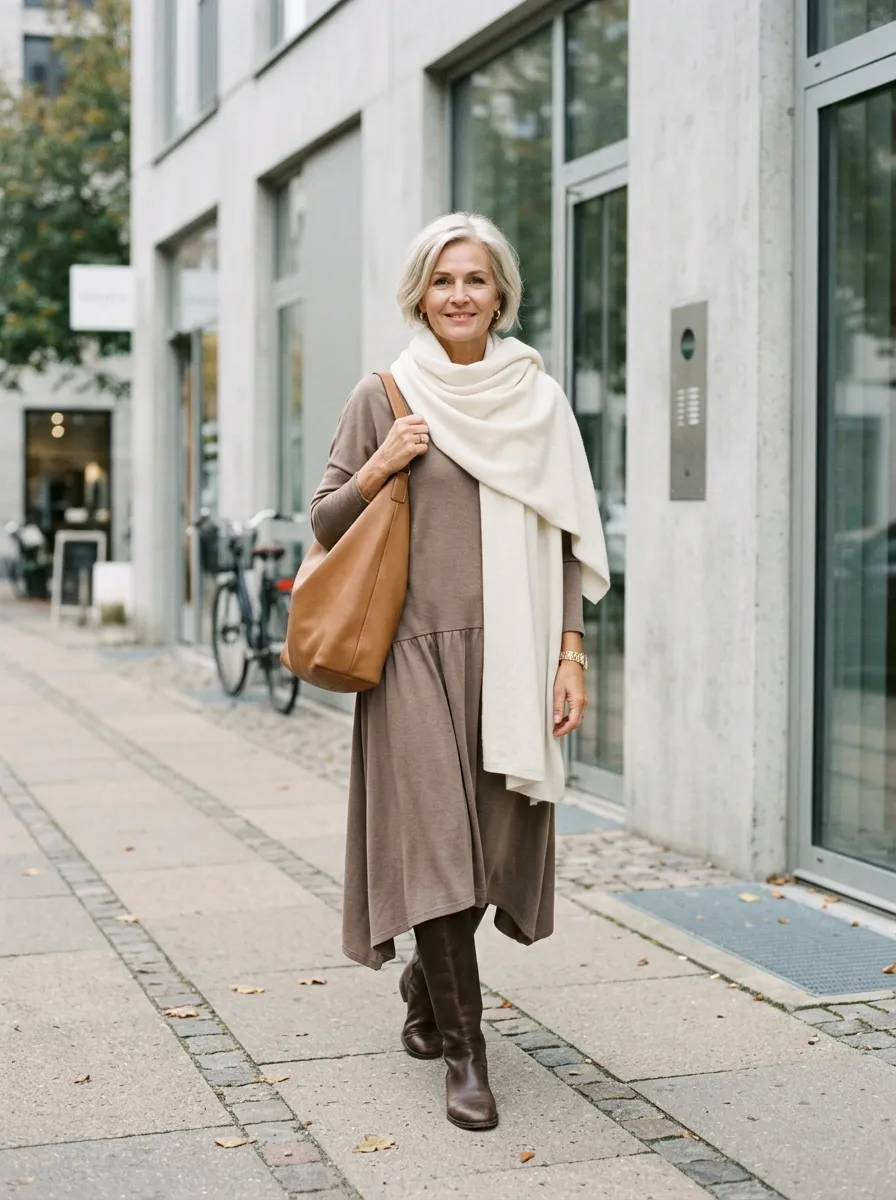
The taupe drop-waist with my cream wrap — low waist, high comfort, zero cling.
The drop-waist dress is the kindest silhouette I know after forty-five. The waistline sits at the upper hip, so nothing digs in at the middle, and the skirt releases into a loose asymmetric hem. Mine is warm taupe in a heavy jersey that drapes instead of clinging. Over it, a big cream cashmere scarf draped once around the neck, one end tossed over a shoulder. The scarf frames your face and balances the flared skirt below.
Jersey quality is everything here: cheap jersey shows every line underneath and twists as you walk. Twist a handful of the skirt: if it springs back smooth, good; if it stays creased and shiny, leave it. The scarf is where I spent real money, after years of acrylic ones that pilled into sadness — one good cashmere wrap, bought in a summer sale, has served a decade. Honest warning: the drop waist does nothing for your waist, because it does not try to. If you want definition, outfit six is yours. This one is for women who want comfort that looks deliberate.
9. Denim Utility Midi Dress with Shearling-Lined Outerwear
Indigo denim dress, shearling jacket, market tote — pockets that actually hold things.
Weekends belong to this dress: dark indigo denim, point collar, patch pockets that fit a phone and a shopping list, its own belt snug enough to shape, never tight enough to strain the placket. A white crewneck underneath, the top button open, and a shearling-lined jacket over it when the wind comes off the water. Thick wool socks peeking over waterproof Chelsea boots. It is workwear, cleaned up — the denim holds its structure all day.
Check the denim weight before anything else. If you can fold the skirt fabric easily between two fingers, it is shirting, not utility denim, and the dress will lose its line by lunch — real denim resists a little. Mine cost more than I planned and has been worn some two hundred times — the cheapest dress I own per outing. One mistake to learn from: worn new and unwashed with cream boots, the indigo transferred. Wash it twice, inside out, before it meets anything pale. Shearling is an investment too — a good faux version warms just as well for market mornings.
What I’d buy first — and what can wait
Start with the shirt dress and the wide leather belt. Together they cover work, lunches, travel and most evenings, and the belt upgrades half the dresses you already own. Second, the poplin midi, because the knit-over-a-dress trick will reorganise your whole wardrobe in a week. The denim utility dress earns third place on cost per wear alone. What can wait: the cashmere column dress — buy it in a January sale or not at all, and let a merino version prove you will wear the shape first. The silk slip waits until you own a cardigan heavy enough to partner it.
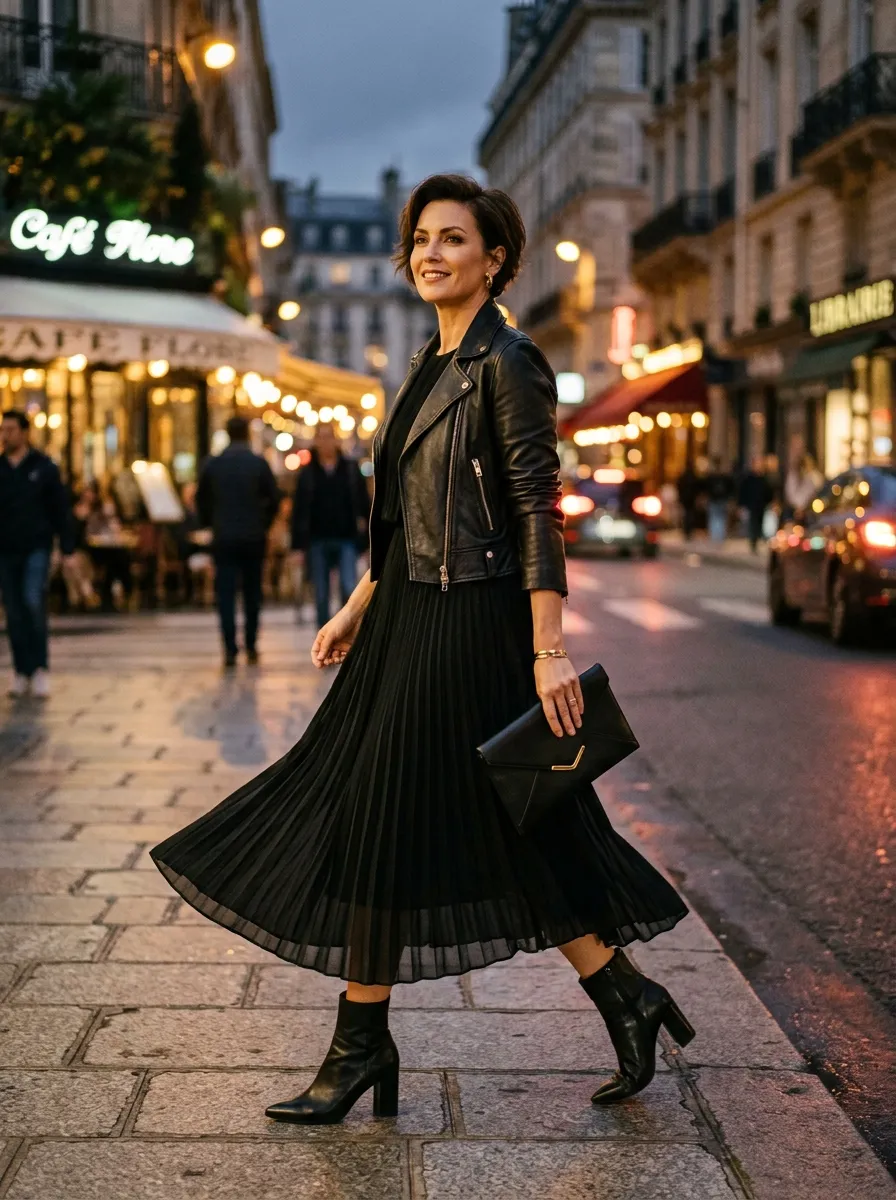
One more combination sits in my wardrobe for evenings: a pleated trapeze dress under a cropped leather moto jacket, the hem hitting the natural waist so the pleats flare cleanly below it. It is a good look, plum or black pleats with pointed ankle boots, but the jacket has to be real, well-cut leather to work — a save-up purchase, not a starter one. Buy the anchors first, steam what you own, sort your closet by colour so these outfits assemble themselves, then add the drama pieces when budget and occasion agree.
Questions I get asked
Can I wear a dress over trousers without looking bulky?
Yes, if the dress has side slits and you open the lower buttons so the trousers show. Keep both layers the same colour family, like the charcoal outfit above, and let the trousers be the slimmer line underneath.
What shoes work with all of these?
Three pairs cover nearly everything here: clean white leather sneakers, flat Chelsea boots with a real sole, and knee-high boots for the knit and floral dresses. Skip delicate ballet flats — they look lost under heavy layers.
Is the moto jacket and pleated dress look too young for me?
No, but the proportions do the work. The jacket must end at your natural waist, the pleats should fall to mid-calf, and the boots want a modest block heel. Keep the pleats black or plum and skip the studs. Worn that way it reads confident, not costume, at any age.
How do I stop voluminous dresses looking shapeless?
Give the outfit one anchor: a belt, a structured blazer, a cropped jacket, or a crossbody bag. Bare forearms help a lot — push sleeves to the elbow. Volume plus one firm line looks intentional; volume alone looks like laundry day.
How much should I spend on the knit pieces?
Spend on the pieces that touch outfits weekly: the chunky knit, the heavy cardigan, the cashmere scarf. Buy them in end-of-season sales and choose blends with merino if pure cashmere breaks the budget. A cheap knit that pills in a month costs more per wear than a good one on sale — I have the drawer of evidence to prove it.
Nine dresses, three pairs of shoes, and a rail sorted by colour will carry you further than a wardrobe twice the size bought in a panic. Start with the shirt dress, and be honest in the fitting room. If a formula here becomes your uniform, save it to your Pinterest board so future-you remembers why it works. — Elias