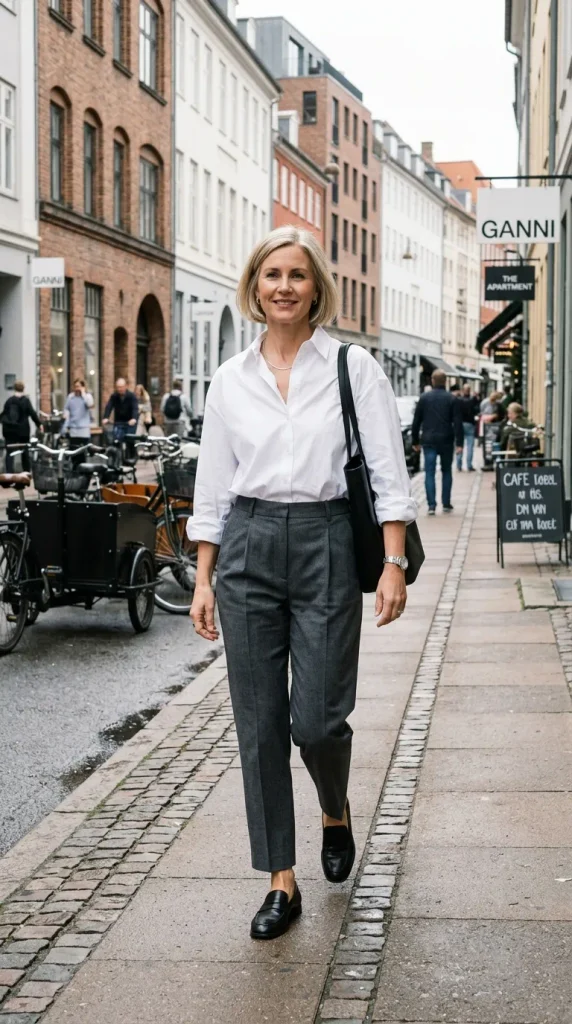
10 Scandinavian Outfit Ideas to Flatter Arms for Women Over 40
Somewhere around my forty-sixth birthday, I stopped reaching for sleeveless things automatically — not out of shame, exactly, but because I kept catching sight of my upper arms…
Somewhere around my forty-sixth birthday, I stopped reaching for sleeveless things automatically — not out of shame, exactly, but because I kept catching sight of my upper arms in café windows and spending the rest of lunch thinking about them instead of the conversation. My arms have carried children, shopping, a whole household’s worth of furniture up narrow stairs. They are not the problem. The problem was sleeves cut for somebody else’s arms: too tight at the bicep, ending at exactly the widest point, clinging where they should have skimmed.
Scandinavian dressing taught me that the answer is not hiding. It is choosing sleeves with a job to do — a bit of structure, a bit of room, a hem that lands where the arm is narrower. These are the ten combinations I rely on now, with the fitting checks I actually do in the shop and the mistakes I have already made, so you can skip that part.
1. The structured poplin shirt, sleeves doing the work
The shirt that ended my café-window problem. Crisp sleeves, nothing clinging, nothing to adjust.
A stiff cotton poplin shirt is the single most reliable garment I own for this. The fabric stands slightly away from the body on its own, so the sleeve holds an A-line of space around the upper arm instead of wrapping it. I buy one size up from my usual, look for a set-in shoulder seam and a sleeve that ends past the wrist bone, and wear it over tapered trousers with the front half tucked. Steam the collar and cuffs properly; crisp is the whole effect.
The check that matters happens seated, in the changing room: bend your elbow and reach forward, as if for a menu. If the sleeve pulls tight across the bicep, go up another size — poplin has no stretch to forgive you. My mistake for years was buying my “real” size in shirts and spending every meal quietly aware of my arms. One size up costs nothing extra and buys you a whole evening of not thinking about it.
2. A fine-gauge cardigan over a plain tank
Coverage you can take off the moment the room warms up. The tank underneath has to be decent, though.
This is the layering answer for days that start cool and end warm. A tissue-weight merino or cashmere cardigan, worn open over a high-neck ribbed tank, gives you a soft column of fabric down each arm without any bulk. The cardigan should fall below the hip, with a straight, unribbed hem — a banded hem grips the body and cuts the line in two. Underneath, the tank needs to be dense cotton, not a flimsy vest; if the cardigan comes off at lunch, what is under it still has to look deliberate.
Fine-gauge knit is where cheap versions betray you fastest. Hold the sleeve up to the light: if you can see your hand clearly through it, it will go baggy at the elbow within a month and cling damply to the arm. A decent merino cardigan is not the cheapest thing on this page, but mine is five years old and has outlived three tanks. Worth it. Skip this one if you run hot — two layers, however fine, are still two layers.
3. The linen tunic with split sleeves
Summer, sorted. The sleeve ends below the elbow, where the arm is narrower — that is the whole trick.
Summer is when most arm advice collapses, because the instinct is to cover up and swelter. A relaxed linen tunic with wide sleeves that end just below the elbow solves it differently: the sleeve hem lands at the narrow part of the forearm, air moves through the open cut, and nothing touches the upper arm at all. I look for medium-weight, pre-washed linen with a small split neckline, worn over loose trousers in the same natural family.
Linen quality shows in the hand. The good stuff feels almost coarse in the shop and softens with every wash; the thin, papery kind creases into a map within the hour and goes limp against the skin — the opposite of what we want. Buy the heavier weave and accept the creases; everyone in honest linen is creased by ten. I wore a cheap tunic like this to a garden lunch once and spent it peeling fabric off my arms. Never again.
4. The trench coat with raglan sleeves
No shoulder seam, no tight armhole. The raglan line is the kindest cut I know for a fuller upper arm.
A raglan sleeve is cut diagonally from the neckline instead of sitting in a tight circle at the shoulder, which means there is no armhole seam digging in and no hard line marking where the arm begins. On a trench coat — cotton gabardine, worn open, belt tied behind — it gives you one long, easy line from neck to wrist over whatever you are wearing. This is my most-used piece from September to May — over knits, over shirts, over the shirt-dress further down this page.
Two checks before you pay. First, the underarm room: try it on over your thickest jumper and lift both arms as if reaching a high shelf. If it binds, it will bind every single day. Second, the fabric needs real weight; a flimsy trench flaps and looks apologetic by noon. A proper gabardine coat costs proper money, but divided by eight winters of wear it is one of the cheapest garments I own.
5. The boxy blazer, sleeves pushed up
Pushed-up sleeves, on purpose. The forearm showing makes the whole arm read longer and slimmer.
A small paradox I learned late: pushing a blazer sleeve up to the forearm flatters the arm more than leaving it covered to the wrist. The eye goes to the narrowest visible point, and a slim strip of forearm below a structured sleeve does that beautifully. The blazer itself should be boxy and menswear-cut, lightly padded at the shoulder, straight through the body — the structure sits on the outside, so nothing underneath has to perform.
The sleeve has to be wide enough to push up and stay up. Test it in the shop: shove both sleeves to the forearm and shake your arms about a bit. If they slide straight back down, the sleeve is too narrow or the lining too slippery, and you will spend the day re-shoving. My blazer came from the men’s rail of a vintage shop for very little, and a tailor shortened the sleeves so the pushed-up bunch sits exactly right.
6. The bell-sleeve jumper in chunky wool
The flare sits at the wrist, far from the upper arm. Chunky knit, and somehow the arms look finer for it.
Chunky knitwear sounds like the enemy — all that extra width — but a gentle bell sleeve puts the volume at the wrist, the narrowest point, and leaves the upper arm inside a relaxed, straight fall of wool. The contrast does the flattering: a wide, soft flare at the hand makes everything above it read slimmer. I choose a medium-to-chunky gauge with a mock neck, the bell beginning only below the elbow, nothing fitted anywhere near the bicep.
Squeeze the knit before you buy. Good wool springs back when you crush it in your fist; tired yarn stays dented and will bag at the elbows by Christmas. And mind the flare’s size — a dramatic, costume bell swallows your hands and makes eating soup an extreme sport. Mine is modest, an extra inch or so of swing, and it has survived six winters of Sunday lunches. Skip it if you are very petite — a big knit plus a bell can wear you rather than the other way round.
7. The batwing silk blouse with slim jeans
No armhole seam at all. The cloth falls from the body in one piece — nothing to grip, nothing to show.
A batwing sleeve is cut in one piece with the body of the blouse, so there is no armhole seam anywhere near the upper arm — the fabric simply drapes from the shoulder and falls. In sand-washed silk or matte rayon it moves beautifully and covers completely while looking like evening wear — my answer for dinners. The trick is the cuff: a proper buttoned cuff at the wrist gathers all that flowing cloth into one neat point, so the silhouette reads deliberate rather than billowy. Slim, dark jeans below keep the proportions honest.
Fasten every cuff button before you judge it in the mirror — unbuttoned, a batwing blouse looks unfinished and twice its size. Check the fabric against the light, too: shiny satin shows every contour underneath and photographs harshly, while matte silk or rayon just pours. Real silk is a treat purchase, honestly. But this is the one piece here that goes from a weekday lunch to a birthday dinner unchanged.
8. The kimono cardigan in boiled wool
Wide sleeves that end above the wrist, and boiled wool that never clings. My cold-morning favourite.
Boiled wool is felted so densely that it holds a clean, architectural edge with no lining and no stretch — which means it can never cling to an arm, even in principle. Cut as a kimono wrap, with wide rectangular sleeves ending a few inches above the wrist, it gives you coverage, structure and a defined waist from the belt, all in one garment. I wear mine over a thin modal long-sleeve top, so there is a smooth layer underneath.
Because boiled wool does not fray, the edges are left raw and sharp — check they are cut cleanly, because there is no hem to hide a wobbly line. Size it honestly: the wrap should overlap generously at the front without pulling, since the fabric will not give an inch all day. It barely needs washing, either; air it by an open window overnight. This is the piece I lend to friends who claim they have nothing to wear; it always comes back late.
9. The poplin shirt-dress with raglan seams
One garment, start to finish. The raglan seams run from the neck — no circle of seam sitting on the arm.
The shirt-dress is my one-decision outfit, and the raglan version is the one to hunt for: the sleeve seams run diagonally from the neckline, so nothing circles the upper arm and the whole top half reads as one smooth, easy shape. Crisp poplin does the rest, standing away from the body as it does in the shirt from idea one. I unfasten the bottom two or three buttons so the skirt moves when I walk, and use the fabric belt loosely — or not at all, on days when the waist is not a conversation I want.
The sit-down test matters here more than anywhere: poplin shirt-dresses gape between buttons across the middle when seated if they are even slightly small, so sit, cross your legs, reach forward. A hidden press-stud sewn between the two worst offenders costs pennies and fixes it permanently; I have done it twice. Choose midi length, ending mid-calf. Shorter, and the dress reads as a shirt that got ideas above its station.
10. The smock blouse with elbow-length sleeves
The softest option here. Gathers at the chest, room everywhere else, and sleeves that end where the arm narrows.
The romantic end of the list: a cotton smock blouse with gathers across the chest and wide sleeves that end at the elbow with a clean, flat cuff. Everything below the gathers falls loose and easy, and the sleeve — wide, unhurried, finishing where the forearm begins — is genuinely kind to an upper arm. It is the one blouse here I would call pretty rather than handsome, and some days that is exactly what is wanted. Cotton keeps it grounded; this is a market-day, lunch-with-friends blouse, not a costume.
Two honest cautions. The smocking must sit flat and smooth across the chest — if the gathers pull or twist, the size is wrong, and a twisted smock front makes the whole blouse look homemade in the wrong way. And choose a plain, ungathered cuff: a frilled, elasticated one puffs the sleeve into a balloon right at the elbow, which adds the very volume we have spent this whole page avoiding. With straight trousers or plain jeans underneath, the balance stays calm.
What I’d buy first — and what can wait
If I were starting from an ordinary wardrobe, the money goes in this order: the poplin shirt first, because it teaches you what structure does and works under half of everything else; then the trench, which carries three seasons on its own; then one piece of honest knitwear. What can wait is the silk blouse — lovely, and the priciest thing here. And a general rule I wish someone had given me at forty: never buy a sleeve you have not bent your elbow in. The mirror lies kindly. The elbow does not.
Questions I get asked
Do I have to cover my arms completely for this to work?
No. The elbow-length sleeve and the pushed-up blazer sleeve both show plenty of arm. What matters is where the fabric ends and whether it grips — a sleeve that stops at the narrow forearm flatters more than a long one that clings all the way down.
Why do cap sleeves look so bad on me?
Because a cap sleeve ends exactly at the widest point of the upper arm and draws a line there. It is not your arm; it is the hem. A sleeve ending above the elbow crease or below it will always treat you better.
Will oversized sleeves make me look bigger overall?
Only if everything is oversized at once. One volume at a time: a wide sleeve with slim trousers, a boxy blazer over a plain fitted top. The contrast between the two is what the eye reads as shape.
What about sleeveless in summer — is it just off the table?
It is your table. On the hottest days I reach for the linen tunic, or keep a fine cardigan over my shoulders. If you love a sleeveless dress and feel good in it, wear it. These ideas are for the days you do not feel good in it — most of us have both kinds.
Which fabric should I avoid most?
Thin, stretchy jersey with a lot of elastane. It maps every contour of the arm and goes shiny where it strains. Crisp cotton, boiled wool and matte silk all stand away from the body instead — that small gap of air is the whole secret.
That is the list as I wear it, elbow-tested and café-window approved. If one of these ends the sleeve argument in your own wardrobe, save this on Pinterest for your next shopping trip — that is exactly when you will want it. — Elias